

With the Venus transit set to occur, researchers will also be studying the Arc of Venus to better under why our sister planet’s atmosphere evolved to be so different than Earth’s.
When Venus transits the sun on June 5th and 6th, an armada of spacecraft and ground-based telescopes will be on the lookout for something elusive and, until recently, unexpected: The Arc of Venus.
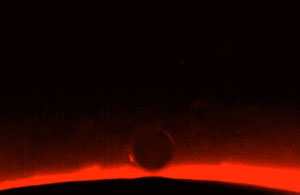
“I was flabbergasted when I first saw it during the 2004 transit,” recalls astronomy professor Jay Pasachoff of Williams College. “A bright, glowing rim appeared around the edge of Venus soon after it began to move into the sun.”
For a brief instant, the planet had turned into a “ring of fire.”
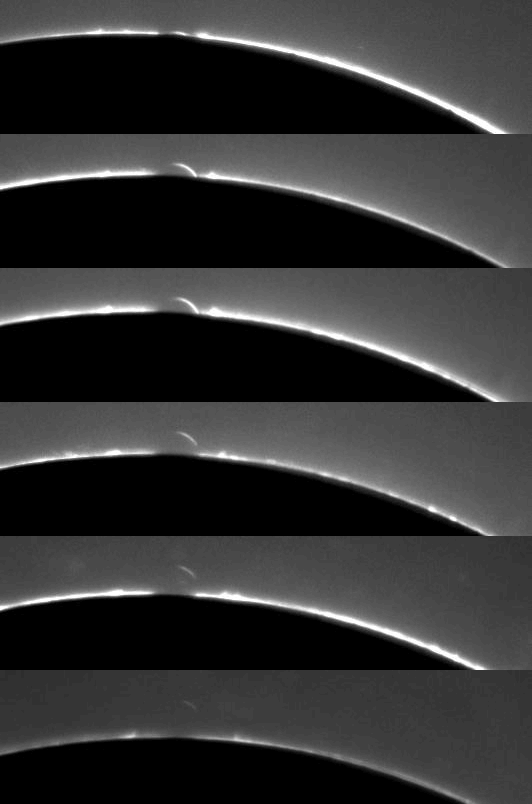
Researchers now understand what happened. Backlit by the sun, Venus’s atmosphere refracted sunlight passing through layers of air above the planet’s cloud tops, creating an arc of light that was visible in backyard telescopes and spacecraft alike.
It turns out that researchers can learn a lot about Venus by observing the arc. Indeed, it touches on some of the deepest mysteries of the second planet.
“We do not understand why our sister planet’s atmosphere evolved to be so different than Earth’s,” explains planetary scientist Thomas Widemann of the Observatoire de Paris.
Earth and Venus are similar distances from the sun, are made of the same basic materials, and are almost perfect twins in terms of size. Yet the two planets are wrapped in stunningly dissimilar blankets of air. Venus’s atmosphere is almost 100 times more massive than Earth’s and consists mainly of CO2, a greenhouse gas that raises the surface temperature to almost 900 °F (482 °C). Clouds of sulfuric acid tower 14 miles (23 kilometers) high and whip around the planet as fast as 220 mph (354 kph). A human being transported to this hellish environment would be crushed, suffocate, desiccate, and possibly ignite.
For the most part, planetary scientists have no idea how Venus turned out this way.
“Our models and tools cannot fully explain Venus, which means we lack the tools for understanding our own planet,” points out Widemann. “Caring about Venus is caring about ourselves.”
One of the biggest mysteries of Venus is super-rotation. The whole atmosphere circles the planet in just four Earth days, much faster than the planet’s spin period of 243 days. “The dynamics of super-rotation are still a puzzle despite a wealth of data from landmark missions such as NASA’s Pioneer Venus, Russia’s Venera, and VEGA missions, NASA’s Magellan and more recently ESA’s Venus Express.”
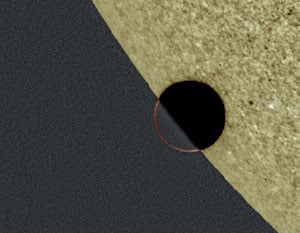
This is where the Arc of Venus comes in. The brightness of the arc reveals the temperature and density structure of Venus’s middle atmosphere, or “mesosphere,” where the sunlight is refracted. According to some models, the mesosphere is key to the physics of super-rotation. By analyzing the lightcurve of the arc, researchers can figure out the temperature and density of this critical layer from pole to pole.
When the arc appeared in 2004, the apparition took astronomers by surprise; as a result, their observations were not optimized to capture and analyze the fast-changing ring of light.
This time, however, they are ready. Together, Pasachoff and Widemann have organized a worldwide effort to monitor the phenomenon on June 5th, 2012. “We’re going to observe the arc using 9 coronagraphs spaced around the world,” says Pasachoff. “Observing sites include Haleakala, Big Bear, and Sacramento Peak. Japan’s Hinode spacecraft and NASA’s Solar Dynamics Observatory will also be gathering data.”
Pasachoff has some advice for amateur astronomers who wish to observe the arc. “The best times to look are ingress and egress–that is, when the disk of Venus is entering and exiting the sun. Ingress is between 22:09 and 22:27 UT on June 5th; egress occurs between 04:32 and 04:50 UT. Be sure your telescope is safely filtered. Both white light and H-alpha filters might possibly show the arc.”
Never miss a breakthrough: Join the SciTechDaily newsletter.
Follow us on Google and Google News.