
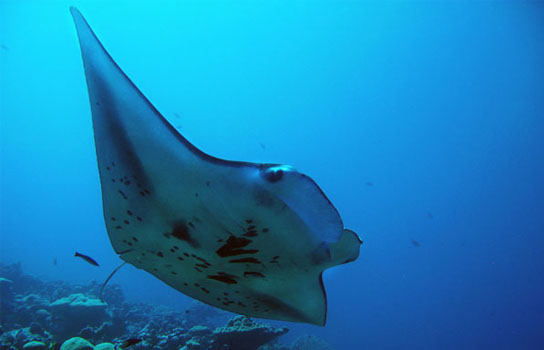
A newly published study from Stanford scientists describes one of the longest ecological interaction chains ever documented and sheds light on how human disturbance of the natural world may lead to widespread disruptions of ecological interaction chains.
Douglas McCauley and Paul DeSalles did not set out to discover one of the longest ecological interaction chains ever documented. But that’s exactly what they and a team of researchers – all current or former Stanford students and faculty – did in a new study published in Scientific Reports.
Their findings shed light on how human disturbance of the natural world may lead to widespread, yet largely invisible, disruptions of ecological interaction chains. This, in turn, highlights the need to build non-traditional alliances – among marine biologists and foresters, for example – to address whole ecosystems across political boundaries.
This past fall, McCauley, a graduate student, and DeSalles, an undergraduate, were in remote Palmyra Atoll in the Pacific tracking manta rays’ movements for a predator-prey interaction study. Swimming with the rays and charting their movements with acoustic tags, McCauley and DeSalles noticed the graceful creatures kept returning to certain islands’ coastlines. Meanwhile, graduate student Hillary Young was studying palm tree cultivation’s effect on native habitats nearby and wondering how the impact on bird communities would play out.
Palmyra is a unique spot on Earth where scientists can compare largely intact ecosystems within shouting distance of recently disturbed habitats. A riot of life – huge grey reef sharks, rays, snapper and barracuda – plies the clear waters while seabirds flock from thousands of miles away to roost in the verdant forests of this tropical idyll.
Over meals and sunset chats at the small research station, McCauley, DeSalles, Young and other scientists discussed their work and traded theories about their observations. “As the frequencies of these different conversations mixed together, the picture of what was actually happening out there took form in front of us,” McCauley said.
Through analysis of nitrogen isotopes, animal tracking, and field surveys, the researchers showed that replacing native trees with non-native palms led to about five times fewer roosting seabirds (they seemed to dislike palms’ simple and easily wind-swayed canopies), which led to fewer bird droppings to fertilize the soil below, fewer nutrients washing into surrounding waters, smaller and fewer plankton in the water and fewer hungry manta rays cruising the coastline.
“This is an incredible cascade,” said researcher Rodolfo Dirzo, a senior fellow with the Stanford Woods Institute for the Environment. “As an ecologist, I am worried about the extinction of ecological processes.”
Equally important is what the study suggests about these cascades going largely unseen. “Such connections do not leave any trace behind,” said researcher Fiorenza Micheli, an associate professor of biology affiliated with the Stanford Woods Institute. “Their loss largely goes unnoticed, limiting our understanding of and ability to protect natural ecosystems.” McCauley put it another way: “What we are doing in some ecosystems is akin to popping the hood on a car and disconnecting a few wires and rerouting a few hoses. All the parts are still there – the engine looks largely the same – but it’s anyone’s guess as to how or if the car will run.”
By way of comparison, researcher Robert Dunbar, a Stanford Woods Institute senior fellow, recalled the historical chain effects of increasing demands on water from Central California’s rivers. When salmon runs in these rivers slowed from millions of fish each year to a trickle, natural and agricultural land systems lost an important source of marine-derived fertilizer. These lost subsidies from the sea are now replaced by millions of dollars’ worth of artificial fertilizer applications. “Humans can really snip one of these chains in half,” Dunbar said.
Reference: “From wing to wing: the persistence of long ecological interaction chains in less-disturbed ecosystems” by Douglas J. McCauley, Paul A. DeSalles, Hillary S. Young, Robert B. Dunbar, Rodolfo Dirzo, Matthew M. Mills and Fiorenza Micheli, 17 May 2012, Scientific Reports.
DOI: 10.1038/srep00409
Never miss a breakthrough: Join the SciTechDaily newsletter.
Follow us on Google and Google News.
1 Comment
Not to worry, evolution will sort out the problem…or Mother Nature.