
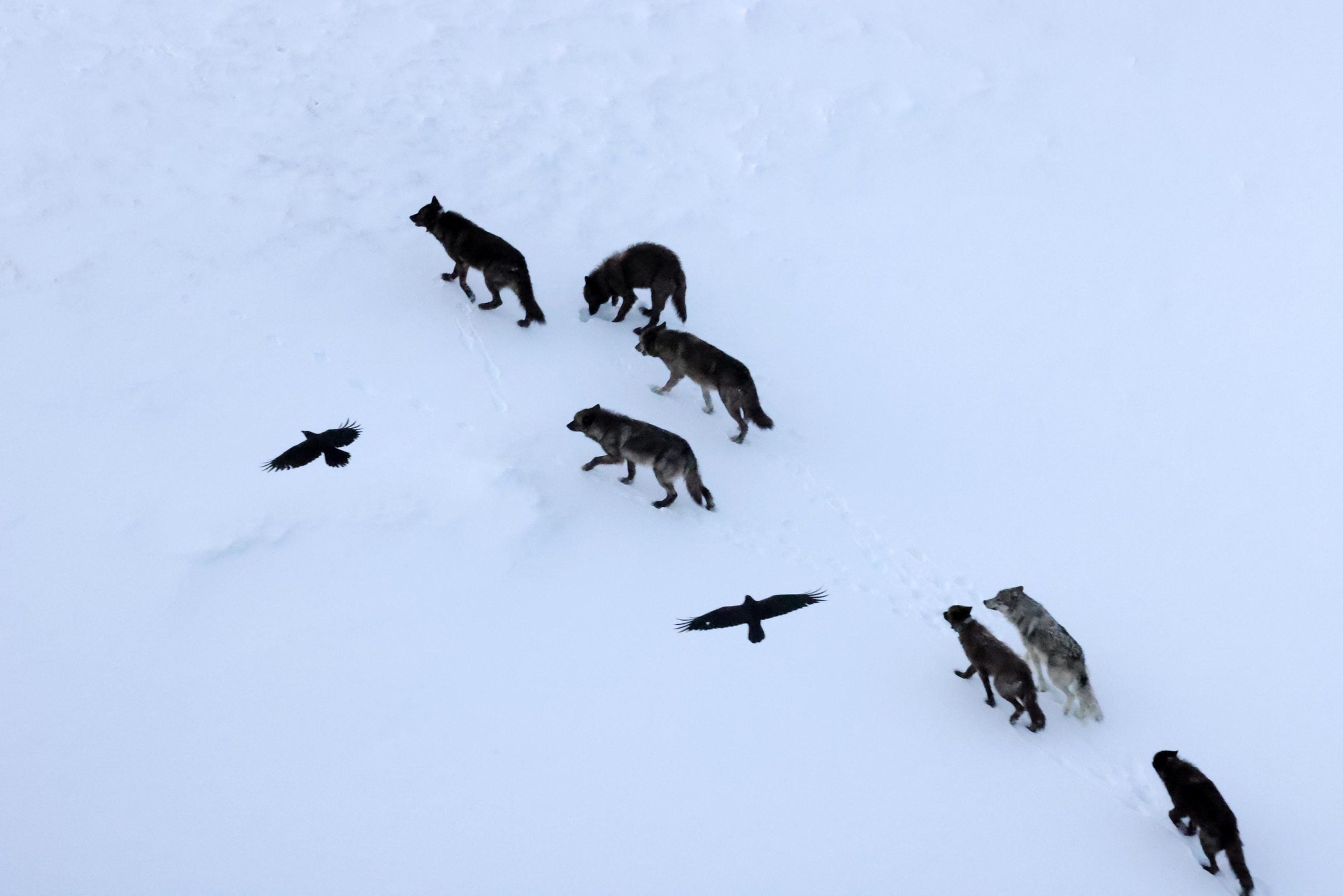
When wolves bring down prey in Yellowstone National Park, ravens often appear almost immediately. Long before the predators finish feeding, the birds gather nearby to grab scraps of meat. Their ability to locate fresh kills so quickly has puzzled observers for years, leading many people to assume that ravens simply follow wolves across the landscape.
Ravens Use Memory To Find Wolf Kills
A new study suggests the real explanation is far more impressive. After tracking ravens and wolves in Yellowstone for more than two years, researchers discovered that ravens rely heavily on memory. Instead of shadowing wolf packs over long distances, the birds remember places where wolves frequently make kills and return to those areas later.
“They can fly six hours non-stop, straight to a kill site,” says Dr. Matthias Loretto, the study’s lead author.
The findings, published in Science, indicate that ravens use spatial memory and navigation skills to search for food spread across large areas. According to Loretto, ravens do not need to stay close to wolves all the time because they can recall where food is most likely to appear. “Ravens can cover large distances by flying, and they seem to have a good memory, so they don’t need to constantly follow wolves in order to profit from the predators,” he says.
The project was led by the Research Institute of Wildlife Ecology at the University of Veterinary Medicine Vienna and the Max Planck Institute of Animal Behavior (Germany), along with several international partners, including the Senckenberg Biodiversity and Climate Research Centre (Germany); School of Environmental and Forest Sciences at the University of Washington (USA); and Yellowstone National Park (USA).
Tracking Ravens and Wolves in Yellowstone
Researchers carried out the study in Yellowstone National Park, where wolves were reintroduced in the mid-90s after being absent for 70 years. About one quarter of the park’s wolves wear tracking collars each year, allowing scientists to monitor their movements.
Dr. Dan Stahler, a Yellowstone biologist who has studied the wolves since their return, says ravens often seem closely connected to the predators. “You see them flying directly above traveling packs or hopping close behind wolves as they take down prey.”
Because wolves regularly leave behind edible remains, scientists long believed ravens followed a simple strategy: stay near wolves to find food. “We all assumed that the birds had a very simple rule; just stick close to the wolves,” says Stahler.
However, nobody had thoroughly tested that idea before. “We didn’t know what ravens were capable of because nobody had ever put them at the center; nobody had taken the scavenger’s point of view,” he says.
GPS Tracking Reveals Raven Intelligence
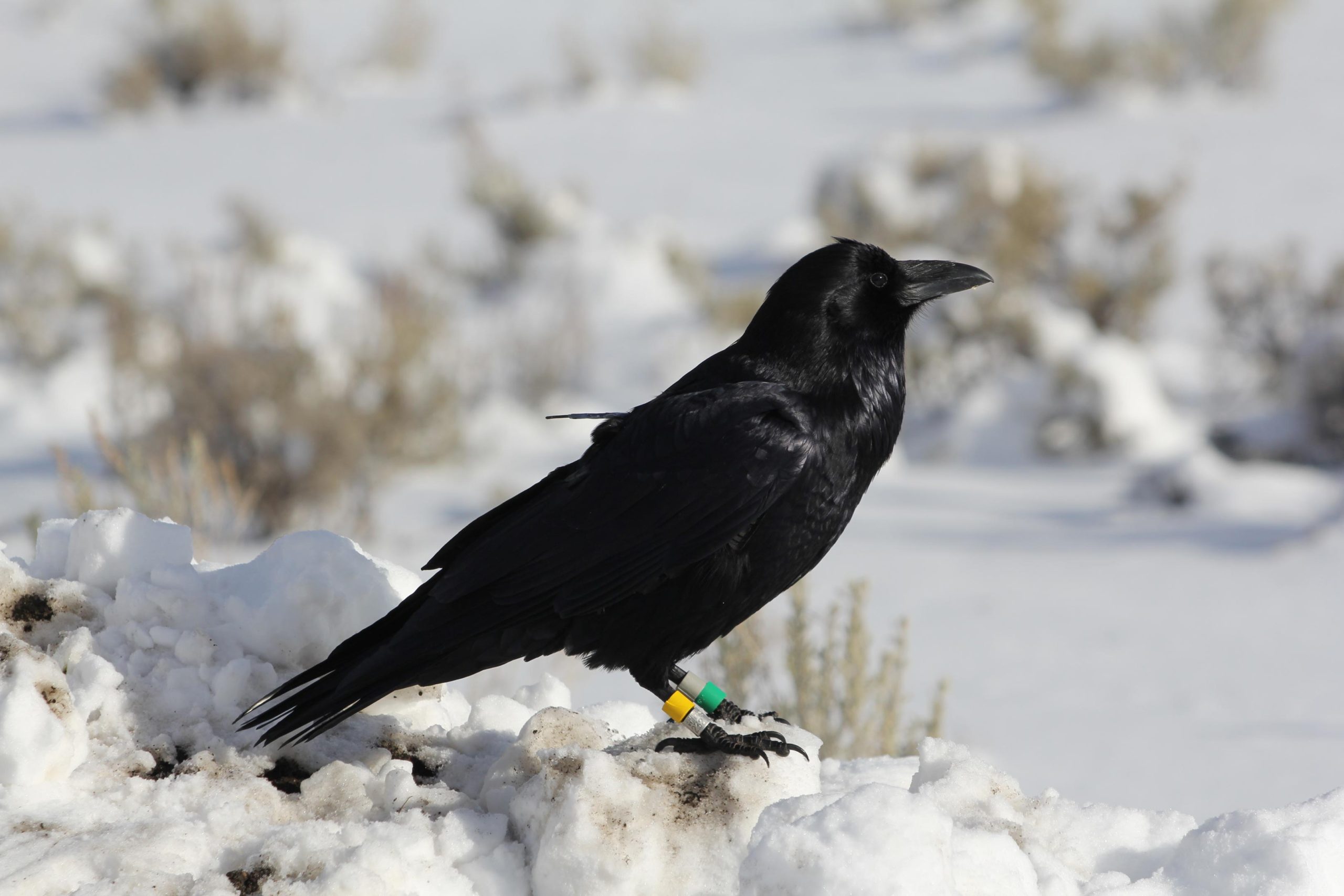
To better understand raven behavior, the team fitted 69 ravens with tiny GPS tracking devices. Loretto describes that number as unusually high for this kind of research. Capturing the birds was difficult because ravens are highly observant and cautious around unfamiliar objects.
“Ravens are so observant of the landscape that they don’t step into traps easily,” says Loretto.
Researchers carefully disguised traps to blend into the environment. Near campsites, they even used trash and fast food as camouflage and bait. Otherwise, “the ravens would suspect that something was off and wouldn’t come near it,” Loretto explains.
The scientists also analyzed movement data from 20 collared wolves. During winter, when ravens most often interact with wolves, GPS locations were recorded every 30 minutes for ravens and every hour for wolves. Researchers also tracked the locations and timing of wolf kills involving prey such as elk, bison, and deer.
Ravens Remember Productive Hunting Areas
Over two-and-a-half years of monitoring, scientists found only one clear case in which a raven followed a wolf for more than one kilometer or longer than one hour.
“At first, we were puzzled,” says Loretto. “Once we realized that ravens are not following wolves over long distances, we couldn’t explain why the birds still arrive so quickly at wolf kills.”
A deeper analysis eventually revealed the answer. Ravens repeatedly traveled back to areas where wolf kills commonly occurred rather than directly trailing predators. Some birds flew as far as 155 kilometers in a single day, often along remarkably direct routes toward places where carcasses were likely to appear, even though the exact timing of a kill could not be predicted.
Researchers found that wolf kills often clustered in certain parts of the landscape, especially flat valley bottoms where wolves hunt more successfully. Ravens visited these areas much more often than places where kills rarely happened. This suggests the birds learn and remember long-term feeding patterns across the environment.
“We already knew that ravens can remember stable food sources, like landfills,” says Loretto. “What surprised us is that they also seem to learn in which areas wolf kills are more common. A single kill is unpredictable, but over time some parts of the landscape are more productive than others — and ravens appear to use that pattern to their advantage.”
What the Study Reveals About Animal Intelligence
The researchers believe ravens may still follow wolves over short distances in some situations. Nearby cues, including wolf behavior or howling, could help birds locate kills once they are already in the area.
“To find wolf kills locally, ravens likely use short-range cues, like monitoring wolf behavior or listening to wolf howling,” says Loretto.
Still, the broader pattern points strongly toward memory-based navigation. Ravens appear to decide where to search using knowledge gained from previous experiences, sometimes traveling across tens or even hundreds of kilometers.
Senior author Prof John M. Marzluff of the University of Washington says the findings reveal remarkable flexibility in raven behavior. “What our study clearly shows is that ravens are flexible in where they decide to feed. They don’t stay tied to a particular wolf pack. With their sharp senses and memory of past feeding locations, they can choose among many foraging opportunities far and wide. This changes how we think about how scavengers find food—and suggests we may have underestimated some species for a long time.”
Reference: “Ravens anticipate wolf kill sites across broad scales” by Matthias-Claudio Loretto, Kristina B. Beck, Douglas W. Smith, Daniel R. Stahler, Lauren E. Walker, Martin Wikelski, Thomas Mueller, Kamran Safi and John M. Marzluff, 12 March 2026, Science.
DOI: 10.1126/science.adz9467
Never miss a breakthrough: Join the SciTechDaily newsletter.
Follow us on Google and Google News.
1 Comment
crow lifespan has been documented to be up to 130 years, in captivity.