
Close Menu
    Facebook X (Twitter) Instagram
    SciTechDaily
    • Biology
    • Chemistry
    • Earth
    • Health
    • Physics
    • Science
    • Space
    • Technology
    Facebook X (Twitter) Pinterest YouTube RSS
    SciTechDaily
    Home»Physics»Scientists Use Ultra-Short Pulses of Terahertz Laser Light to Manipulate Magnetism
    Physics

    Scientists Use Ultra-Short Pulses of Terahertz Laser Light to Manipulate Magnetism

    By Mike Ross, SLAC National Accelerator LaboratoryFebruary 1, 2012No Comments4 Mins Read
    Facebook Twitter Pinterest Telegram LinkedIn WhatsApp Email Reddit
    Share
    Facebook Twitter LinkedIn Pinterest Telegram Email Reddit
    ultrashort pulse of terahertz light (yellow arrow) distorting a manganite crystal lattice
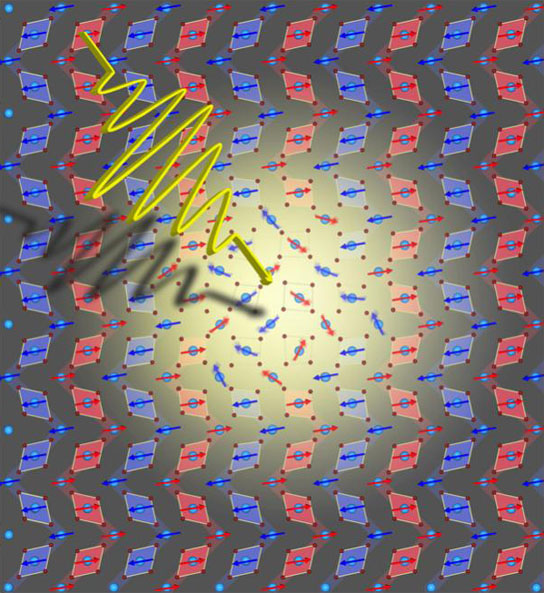
    This graphic depicts an ultrashort pulse of terahertz light (yellow arrow) distorting a manganite crystal lattice. Around where the light hits, the diamond-like shaped arrangement of manganese (blue) and oxygen (red) atoms changes to become more square-like, a distortion that also alters the material’s magnetism, which is indicated by the direction of red and blue arrows shown over the manganese atoms. The extremely brief duration and high intensity of the LCLS X-ray laser pulses allowed the team to take stop-action images used to measure the material’s altered magnetism. Credit: Jörg Harms, Max-Planck Department for Structural Dynamics

    Scientists working at the SLAC National Accelerator Laboratory’s Linear Coherent Light Source (LCLS) discovered a way to distort the atomic arrangement and change the magnetic properties of an important class of electronic materials. By using 130-femtosecond-long pulses of terahertz light aimed at samples of manganite, the team was able to watch the material’s atoms shimmy and shift positions without heating the material up.

    Scientists have found a way to distort the atomic arrangement and change the magnetic properties of an important class of electronic materials with ultra-short pulses of terahertz (mid-infrared) laser light without heating the material up. While the achievement is currently of purely scientific interest, the researchers say this new approach control could ultimately lead to extremely fast, low-energy, non-volatile computer memory chips or data-switching devices.

    Working at the SLAC National Accelerator Laboratory’s Linear Coherent Light Source (LCLS), the scientists aimed intense, 130-femtosecond-long pulses of terahertz light at samples of manganite, a class of complex manganese-oxide compounds that has many desirable electronic and magnetic properties.

    With each flash, the material’s atoms shimmied and shifted positions, although the overall temperature of the solid barely changed. The scientists then used X-ray laser pulses from the LCLS’s Soft X-ray Materials Science (SXR) instrument to measure the material’s altered magnetism.

    Rapid light-induced switching of manganite magnetism has been known for many years, said physicist Michael Först of the Max Planck Department of Structural Dynamics (MPSD) in Hamburg, Germany, one of the leaders of the international research group. However, earlier efforts to trigger this switch with higher-energy, near-visible lasers heated the materials, which greatly limits potential applications.

    The latest LCLS experiments confirm that terahertz light only distorts the lattice enough to rearrange the electronic and magnetic properties while not generating extra heat.

    The research team was led by scientists from the MPSD (Först and Andrea Cavalleri) and Brookhaven National Laboratory (Ron Tobey and John Hill), and included researchers from England and SLAC. They published their results last month in Physical Review B. SLAC co-authors are Bill Schlotter and Josh Turner, SXR instrument scientists; Wei-Sheng Lee and Rob Moore of the Stanford Institute for Materials & Energy Science (SIMES), and Mariano Trigo of Photon Ultrafast Laser Science and Engineering (PULSE).

    “We will come back to LCLS later this year to use the X-ray Pump Probe instrument to measure terahertz-light-driven atomic displacements directly,” said Först. In recent years, his same group of MPSD scientists has also used terahertz light pulses to shake materials into a superconducting state and to change insulators into metals.

    Future research aims to explore the phenomenon more deeply and start developing capabilities essential for applications, such as reverse-switching techniques, materials that can switch magnetically at room temperature or higher, and a laser source suitable for using on chips.

    Reference: “Driving magnetic order in a manganite by ultrafast lattice excitation” by M. Först, R. I. Tobey, S. Wall, H. Bromberger, V. Khanna, A. L. Cavalieri, Y.-D. Chuang, W. S. Lee, R. Moore, W. F. Schlotter, J. J. Turner, O. Krupin, M. Trigo, H. Zheng, J. F. Mitchell, S. S. Dhesi, J. P. Hill and A. Cavalleri, 2 December 2011, Physical Review B.
    DOI: 10.1103/PhysRevB.84.241104

    Never miss a breakthrough: Join the SciTechDaily newsletter.
    Follow us on Google and Google News.

    Atoms Linac Coherent Light Source Magnetism Popular SLAC National Accelerator Laboratory Structural Dynamics
    Share. Facebook Twitter Pinterest LinkedIn Email Reddit

    Related Articles

    “Pump-Probe” Technique Explores How Molecules Respond to Light

    LCLS Probes Microscopic Components of Air Pollution

    LCLS Finding Gives a Better Understanding of Light-Matter Interaction

    BaBar Data Suggests Possible Flaws in the Standard Model

    LCLS Zaps Electrons Out of Atoms, Resulting in Chemical Analysis with Atomic Resolution

    LCLS Low-Energy Test Just Shy of the 284-Electronvolt Carbon Edge

    Unexpected Graphite Experiment Results Raise New Questions

    Spin State Interaction From Copper Based Materials

    First Real-Time Image of Two Atoms Vibrating in a Molecule

    Leave A Reply Cancel Reply

    • Facebook
    • Twitter
    • Pinterest
    • YouTube

    Don't Miss a Discovery

    Subscribe for the Latest in Science & Tech!

    Trending News

    Just a Few Breathless Minutes a Day Could Slash Your Risk of 8 Major Diseases

    This Simple Habit Could Cut Your Risk of Dementia by 30%

    Scientists Debunk Rattlesnake Myth That Fooled Hikers and Doctors for Decades

    Scientists Discover Plants Can “Count” – and May Be Smarter Than We Thought

    New Research Reveals Ancient Mars May Have Been Warm, Wet – and Possibly Alive

    This Surprising Daily Habit Could Cut Dementia Risk by 35%

    Just 10 Minutes a Day: Scientists Say This Ancient Chinese Practice Shows Powerful Blood Pressure Benefits

    Scientists Say This Popular Food Could Help Your Body Get Rid of Microplastics

    Follow SciTechDaily
    • Facebook
    • Twitter
    • YouTube
    • Pinterest
    • Newsletter
    • RSS
    SciTech News
    • Biology News
    • Chemistry News
    • Earth News
    • Health News
    • Physics News
    • Science News
    • Space News
    • Technology News
    Recent Posts
    • Scientists Uncover Giant Lava Fields From an Active Underwater Volcano
    • Baffling Geologists for 150 Years: New Study Finally Solves Green River Mystery
    • Are Your Vegetables Safe? Scientists Uncover Hidden Chemical Risks in Crops
    • Scientists Discover “Shape-Shifting” Semiconductors Activated by Light
    • Forget Wi-Fi This Laser Tech Hits 360 Gbps at Half the Power
    Copyright © 1998 - 2026 SciTechDaily. All Rights Reserved.
    • Science News
    • About
    • Contact
    • Editorial Board
    • Privacy Policy
    • Terms of Use

    Type above and press Enter to search. Press Esc to cancel.