
Close Menu
    Facebook X (Twitter) Instagram
    SciTechDaily
    • Biology
    • Chemistry
    • Earth
    • Health
    • Physics
    • Science
    • Space
    • Technology
    Facebook X (Twitter) Pinterest YouTube RSS
    SciTechDaily
    Home»Physics»BaBar Data Suggests Possible Flaws in the Standard Model
    Physics

    BaBar Data Suggests Possible Flaws in the Standard Model

    By SLAC National Accelerator LaboratoryJune 18, 2012No Comments4 Mins Read
    Facebook Twitter Pinterest Telegram LinkedIn WhatsApp Email Reddit
    Share
    Facebook Twitter LinkedIn Pinterest Telegram Email Reddit
    latest results from the BaBar experiment may suggest a surplus over Standard Model predictions of a type of particle decay
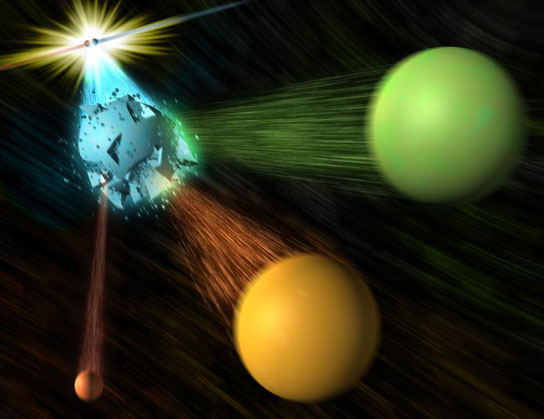
    The latest results from the BaBar experiment may suggest a surplus over Standard Model predictions of a type of particle decay called “B to D-star-tau-nu.” In this conceptual art, an electron and positron collide, resulting in a B meson (not shown) and an antimatter B-bar meson, which then decays into a D meson and a tau lepton as well as a smaller antineutrino. Credit: Greg Stewart, SLAC National Accelerator Laboratory

    Initial results from BaBar data suggest that a particular type of particle decay called “B to D-star-tau-nu” happens more often than the Standard Model says it should.

    Recently analyzed data from the BaBar experiment may suggest possible flaws in the Standard Model of particle physics, the reigning description of how the universe works on subatomic scales. The data from BaBar, a high-energy physics experiment based at the U.S. Department of Energy’s (DOE) SLAC National Accelerator Laboratory, show that a particular type of particle decay called “B to D-star-tau-nu” happens more often than the Standard Model says it should.

    In this type of decay, a particle called the B-bar meson decays into a D meson, an antineutrino and a tau lepton. While the level of certainty of the excess (3.4 sigma in statistical language) is not enough to claim a break from the Standard Model, the results are a potential sign of something amiss and are likely to impact existing theories, including those attempting to deduce the properties of Higgs bosons.

    “The excess over the Standard Model prediction is exciting,” said BaBar spokesperson Michael Roney, professor at the University of Victoria in Canada. The results are significantly more sensitive than previously published studies of these decays, said Roney. “But before we can claim an actual discovery, other experiments have to replicate it and rule out the possibility this isn’t just an unlikely statistical fluctuation.”

    The BaBar experiment, which collected particle collision data from 1999 to 2008, was designed to explore various mysteries of particle physics, including why the universe contains matter, but no antimatter. The collaboration’s data helped confirm a matter-antimatter theory for which two researchers won the 2008 Nobel Prize in Physics.

    Researchers continue to apply BaBar data to a variety of questions in particle physics. The data, for instance, has raised more questions about Higgs bosons, which arise from the mechanism thought to give fundamental particles their mass. Higgs bosons are predicted to interact more strongly with heavier particles – such as the B mesons, D mesons and tau leptons in the BaBar study – than with lighter ones, but the Higgs posited by the Standard Model can’t be involved in this decay.

    “If the excess decays shown are confirmed, it will be exciting to figure out what is causing it,” said BaBar physics coordinator Abner Soffer, associate professor at Tel Aviv University. Other theories involving new physics are waiting in the wings, but the BaBar results already rule out one important model called the “Two Higgs Doublet Model.”

    “We hope our results will stimulate theoretical discussion about just what the data are telling us about new physics,” added Soffer.

    The researchers also hope their colleagues in the Belle collaboration, which studies the same types of particle collisions, see something similar, said Roney. “If they do, the combined significance could be compelling enough to suggest how we can finally move beyond the Standard Model.”

    The results have been presented at the 10th annual Flavor Physics and Charge-Parity Violation Conference in Hefei, China, and submitted for publication in the journal Physical Review Letters.

    Reference: “Evidence for an excess of B -> D(*) Tau Nu decays” by J. P. Lees et al. (BABAR Collaboration), 6 September 2012, Physical Review Letters.
    DOI: 10.1103/PhysRevLett.109.101802

    Never miss a breakthrough: Join the SciTechDaily newsletter.
    Follow us on Google and Google News.

    Antineutrinos BaBar Experiment Higgs Boson Particle Physics Popular SLAC National Accelerator Laboratory Standard Model
    Share. Facebook Twitter Pinterest LinkedIn Email Reddit

    Related Articles

    Truant Particles Dash Hopes of Clues to Supersymmetry From LHC

    Looking Back at the Decades-Long Search for Higgs Boson

    CERN Announces Discovery of Higgs-Like Particle in the 125 GeV Range

    CERN to Announce the Latest Results from ATLAS and CMS

    Higgs Boson Might Have Been Discovered by LHC High Energy Physicists

    MAJORANA, the Underground Experiment that Could Rewrite the Standard Model

    More Data of Elusive Higgs Boson from Defunct US Tevatron Collider

    Higgs Boson Signals Gain Strength at Large Hadron Collider

    The Search for the God Particle Narrows

    Leave A Reply Cancel Reply

    • Facebook
    • Twitter
    • Pinterest
    • YouTube

    Don't Miss a Discovery

    Subscribe for the Latest in Science & Tech!

    Trending News

    The Universe Is Expanding Too Fast and Scientists Can’t Explain Why

    “Like Liquid Metal”: Scientists Create Strange Shape-Shifting Material

    Early Warning Signals of Esophageal Cancer May Be Hiding in Plain Sight

    Common Blood Pressure Drug Shows Surprising Power Against Deadly Antibiotic-Resistant Superbug

    Scientists Uncover Dangerous Connection Between Serotonin and Heart Valve Disease

    Scientists Discover a “Protector” Protein That Could Help Reverse Hair Loss

    Bone-Strengthening Discovery Could Reverse Osteoporosis

    Scientists Uncover Hidden Trigger Behind Stem Cell Aging

    Follow SciTechDaily
    • Facebook
    • Twitter
    • YouTube
    • Pinterest
    • Newsletter
    • RSS
    SciTech News
    • Biology News
    • Chemistry News
    • Earth News
    • Health News
    • Physics News
    • Science News
    • Space News
    • Technology News
    Recent Posts
    • A Common Diabetes Drug May Hold the Key to Stopping HIV From Coming Back
    • Ancient “Syphilis-Like” Disease in Vietnam Challenges Key Scientific Assumptions
    • Drinking Alcohol To Cope in Your 20s Could Damage Your Brain for Life
    • Scientists Crack Alfalfa’s Chromosome Mystery After Decades of Debate
    • Ancient Ant-Plant Alliance Collapses As Predatory Wasps Move In
    Copyright © 1998 - 2026 SciTechDaily. All Rights Reserved.
    • Science News
    • About
    • Contact
    • Editorial Board
    • Privacy Policy
    • Terms of Use

    Type above and press Enter to search. Press Esc to cancel.