
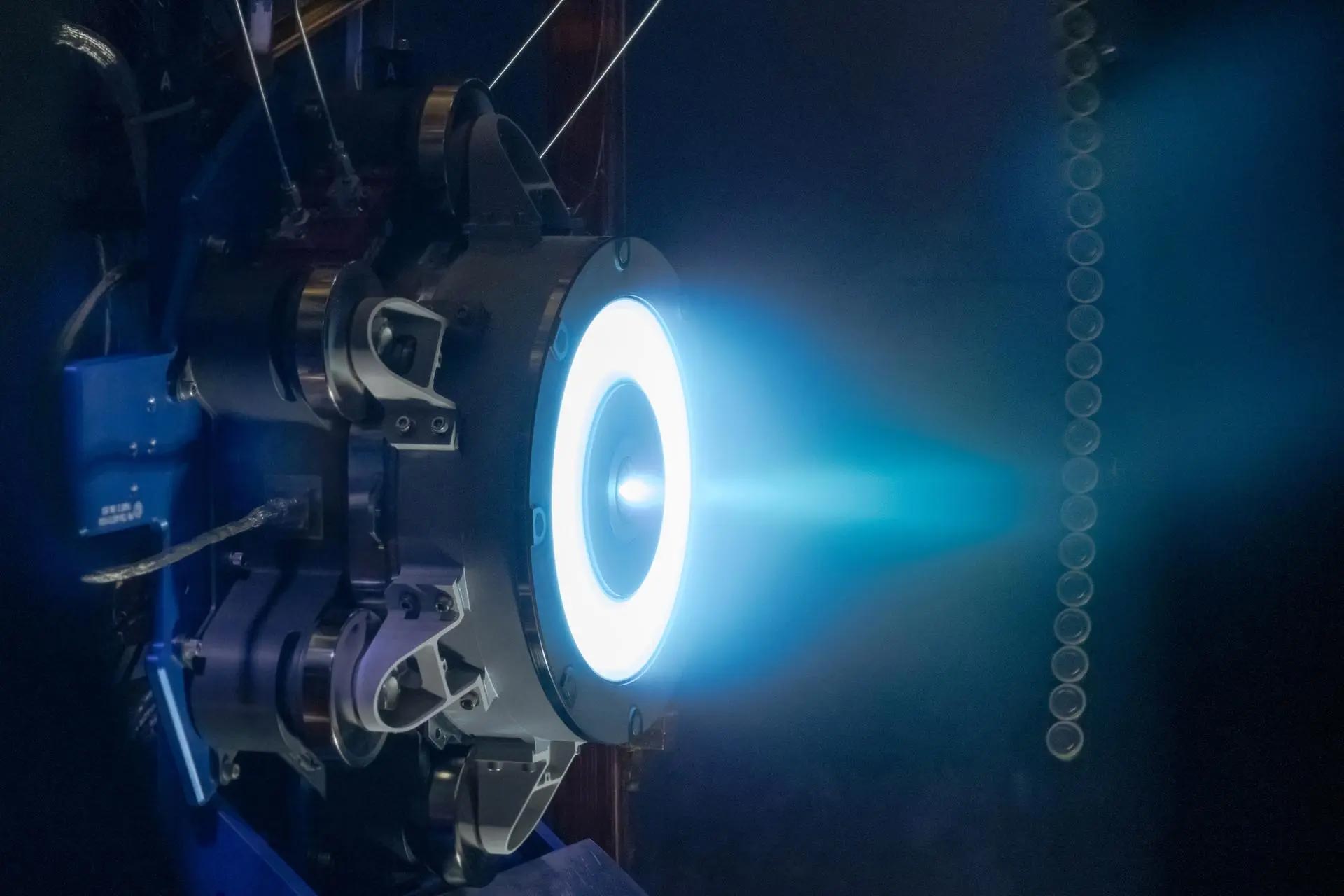
NASA’s new electric propulsion engine set a U.S. power record and could transform future Mars missions. The thrusters use much less fuel than chemical rockets while gradually reaching extremely high speeds.
Imagine you’re part of the fourth crewed mission to Mars. Before launch, engineers promise that the Odyssey spacecraft will deliver the smoothest journey ever attempted in deep space. Its secret is a newly developed electric propulsion system that was still undergoing final testing during the first three Mars missions.
At first, the trip feels strangely slow. The spacecraft eases away from Earth so gradually that you might wonder whether the engines are even working. But electric propulsion is built for steady acceleration rather than explosive liftoff power. After a week in space, Odyssey is racing through the solar system at more than 400,000 kilometers (250,000 miles) per hour. The realization is staggering. You are moving faster than almost any human in history, and the speed keeps increasing.
That futuristic scenario may still be at least a decade away, but NASA is already laying the groundwork. Engineers are developing advanced propulsion technologies that could eventually carry astronauts to Mars faster and more efficiently while also enabling robotic spacecraft to explore deeper into the solar system.
One of the agency’s latest breakthroughs involves a next-generation electric propulsion system that recently set new performance records during testing. Unlike conventional ion engines that rely on gases such as xenon, this experimental design uses lithium metal vapor as fuel. The technology could dramatically improve efficiency and thrust, making it a promising candidate for future long-distance space missions.
If successful, systems like this could reshape how spacecraft travel, reducing mission times, lowering fuel demands, and opening the door to more ambitious exploration beyond Earth orbit.
Electric Thrusters Could Revolutionize Mars Travel
In a remarkable achievement, the tests successfully set a new record in the United States of 120 kilowatts of power, which is estimated to be 25 times greater than NASA’s Psyche spacecraft, which is currently en route to asteroid 16 Psyche and contains the most powerful electric thrusters ever built. While Psyche is currently traveling at approximately 135,000 kph (84,000 mph), its maximum speed near the end of its cruise to asteroid 16 Psyche is estimated to be 200,000 kph (124,000 mph).
Aside from the speed, which gradually builds during the thrusters’ continuous operation, electric propulsion systems save a considerable amount of fuel, up to 90 percent, compared to chemical rockets currently being used.
“Designing and building these thrusters over the last couple of years has been a long lead-up to this first test,” said James Polk, who is a senior research scientist at NASA Jet Propulsion Laboratory. “It’s a huge moment for us because we not only showed the thruster works, but we also hit the power levels we were targeting. And we know we have a good testbed to begin addressing the challenges to scaling up.”
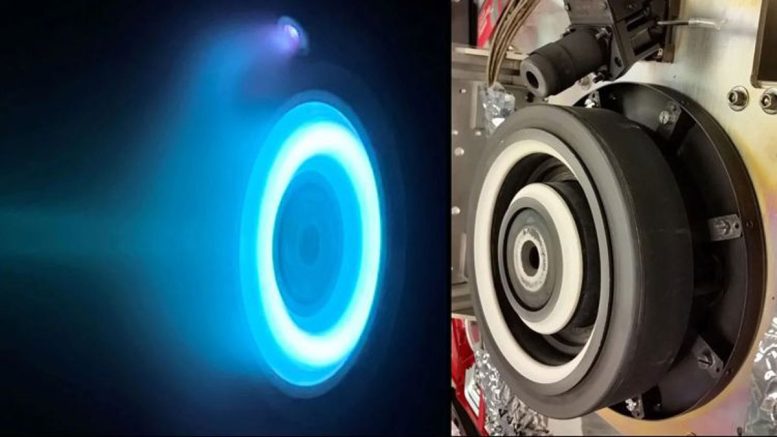
The Challenges of Powering Long-Duration Human Missions to Mars
While 120 kilowatts is a new record, NASA estimates that a future human mission to Mars will require 2 to 4 megawatts of power consisting of several thrusters and requiring more than 23,000 hours (958 days/2.6 years) of operation. To accomplish this, the thrusters would have to withstand more than 2,800 degrees Celsius (5,000 degrees Fahrenheit), which the thrusters achieved during testing.
The reason for the extended operation is due to the estimated time of an entire human mission to Mars, which is estimated to be approximately 2.6 years. This is because the launch window to Mars only opens once every two years due to the orbital behaviors of both planets. While no mission has ever returned from the Red Planet, this same launch window works from Mars to Earth, too. When launched within this window, robotic spacecraft have traditionally taken approximately 6-7 months to reach Mars.
However, a human mission would require a much larger spacecraft to accommodate the astronauts, food, fuel, water, and other mission-essential items. For the approximately 2.6-year mission, this would entail approximately 6-9 months traveling to Mars, followed by approximately 18 months on the surface of Mars until the next launch window opens, then another approximately 6-9 months back to Earth. However, having much less fuel due to the electric propulsion system could potentially alter this timeframe.
How will this new next-generation electric propulsion engine help propel astronauts to Mars and other spacecraft throughout the solar system in the coming years and decades? Only time will tell, and this is why we science!
Adapted from an article originally published in UniverseToday.
Never miss a breakthrough: Join the SciTechDaily newsletter.
Follow us on Google and Google News.
10 Comments
How do they slow down from that speed as they near Mars?
Parachutes won’t work without atmosphere and at that speed any attempted use would shred any known fabrics. Surely?
Reverse trust or some kind of 3 axis gyro respond
As heavier the plane, the more trust/fuel to make brake force.
Turn the ship and thrust engine away from Mars to enter orbit. Pretty standard stuff since Mercury.
Using the plant’s gravity
BTW the first mission should be by AI
With continuous thrust, like from electric thrusters, you would increase speed for half the journey, then flip the ship around & decelerate for the second half, arriving at your destination at just the right speed to assume orbit. Conventional chemical rockets could then be used to reach the surface.
There is already not enough lithium on this planet for all of the electric cars they want us all to drive. Lithium mining is done with child labor in third-world countries and destroys entire ecosystems. Please tell me you can recycle lithium batteries to use as fuel for these things.
There are several new battery technologies nearing production that don’t require lithium. The new sodium ion batteries are one example that is already in production & available for sale to consumers.
Ever thought of magnetic launch and landing controlled by gold portal gateway where the asshole of Maria will be there ready for everyone to enjoy. Let’s spin a bunch of Saturns moons into our meteor belt and have two planets in one orbiting ring
Luv u Maria
If zipping around the solar system for human exploration becomes a big-time venture, this system will be expending thousands of tons of a metal that is hard-won and cannot be recycled, unlike terrestrial applications.
Forget about lithium. Do the best you can with hydrogen, xenon, etc. and/or shift focus to dual-mode nuclear thermal or nuclear electric.