
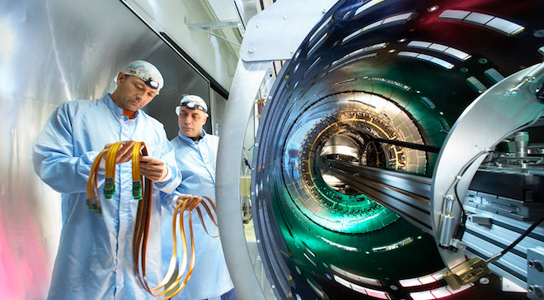
To much fanfare and a packed press room, CERN physicists announced in the early morning of July 4th the discovery of a new particle that behaves similarly to what is expected of the Higgs boson.
The historic milestone was reported by both CMS and ATLAS, the main LHC-Higgs-hunting experiments currently on the way. They discovered a boson that has Higgs-like properties at a mass of 125 GeV with a 5-sigma significance, implying that there is a 99.999% chance of it being the long sought-after particle.
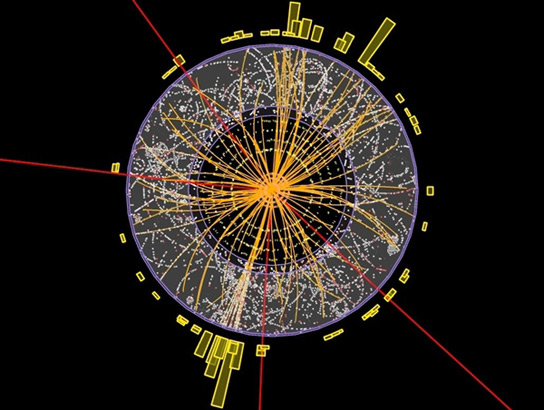
The Higgs was first hypothesized in the 1960s, and it’s the final piece of the Standard Model, the framework explaining the interactions of all known subatomic particles and forces. The Higgs has been the subject of an extensive search that lasted over two decades, which started at the European Large Electron-Positron Collider, then the Tevatron at Fermilab in Illinois, and finally at the Large Hadron Collider in Geneva.
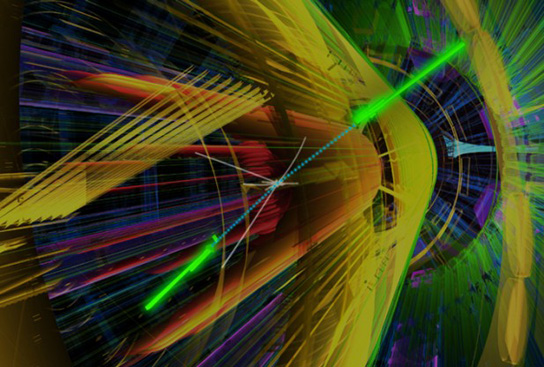
The discovery of the Higgs boson will go down as one of the most important discoveries in the field of particle physics since it gives rise to the mass of all other particles. The last particle discovered of the Standard Model’s 16 was the top quark, which happened at Fermilab’s Tevatron in 1995.
Knowing the Higgs’ characteristics will allow physicists a better understanding of the forces involved subatomically. The Higgs’ importance lies in the fact that it is a manifestation of the Higgs field, which is thought to permeate all of space and interact with all other subatomic particles. The interaction leads to the different mass for each elementary particle. Some, like protons, are slowed by this field while others, like electrons, go through it rapidly, making them light.
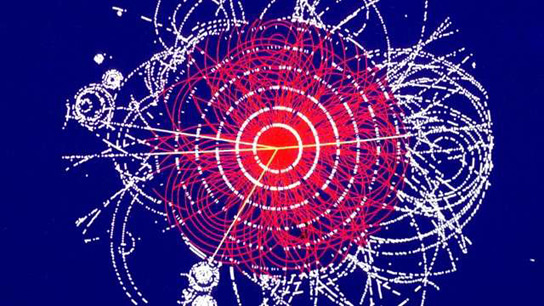
The LHC experiments have been smashing together protons at very high speeds, and counting the many elementary particles created from these collisions. Particles like the Higgs immediately decay into simpler fragments. Physicists were searching for characteristic decays that would indicate the existence of the Higgs. The process is chaotic, so it took a long time to sift through the raw data and find which decays indicated which particles.
In December, the LHC had enough data to ascertain that some events were pointing to the creation of the Higgs at 125 GeV with a 3-sigma significance, implying that there was a 0.13% chance of this happening by chance. Discovery is only confirmed with a 5-sigma result, which has only a one in 3 million chance of happening randomly.
The results are preliminary and will require further analysis to ensure that this new particle is the Higgs boson. Physicists think that if some properties of the Higgs turn out different than predicted, then it could indicate the presence of supersymmetry.
After this year, the LHC will go into repair for the next two years and will come back at a higher energy level, allowing particle physicists to probe for even more esoteric particles. The search is on for particles that could correspond to dark matter. The LHC will be running at full capacity again in 2015 and 2016.
Never miss a breakthrough: Join the SciTechDaily newsletter.
Follow us on Google and Google News.
1 Comment
its a great 4 July with this discovery. for me it dose not mean nor dose it verify to me that god ageists. that i have known for very long time on my own
every new discovery means new questions.