
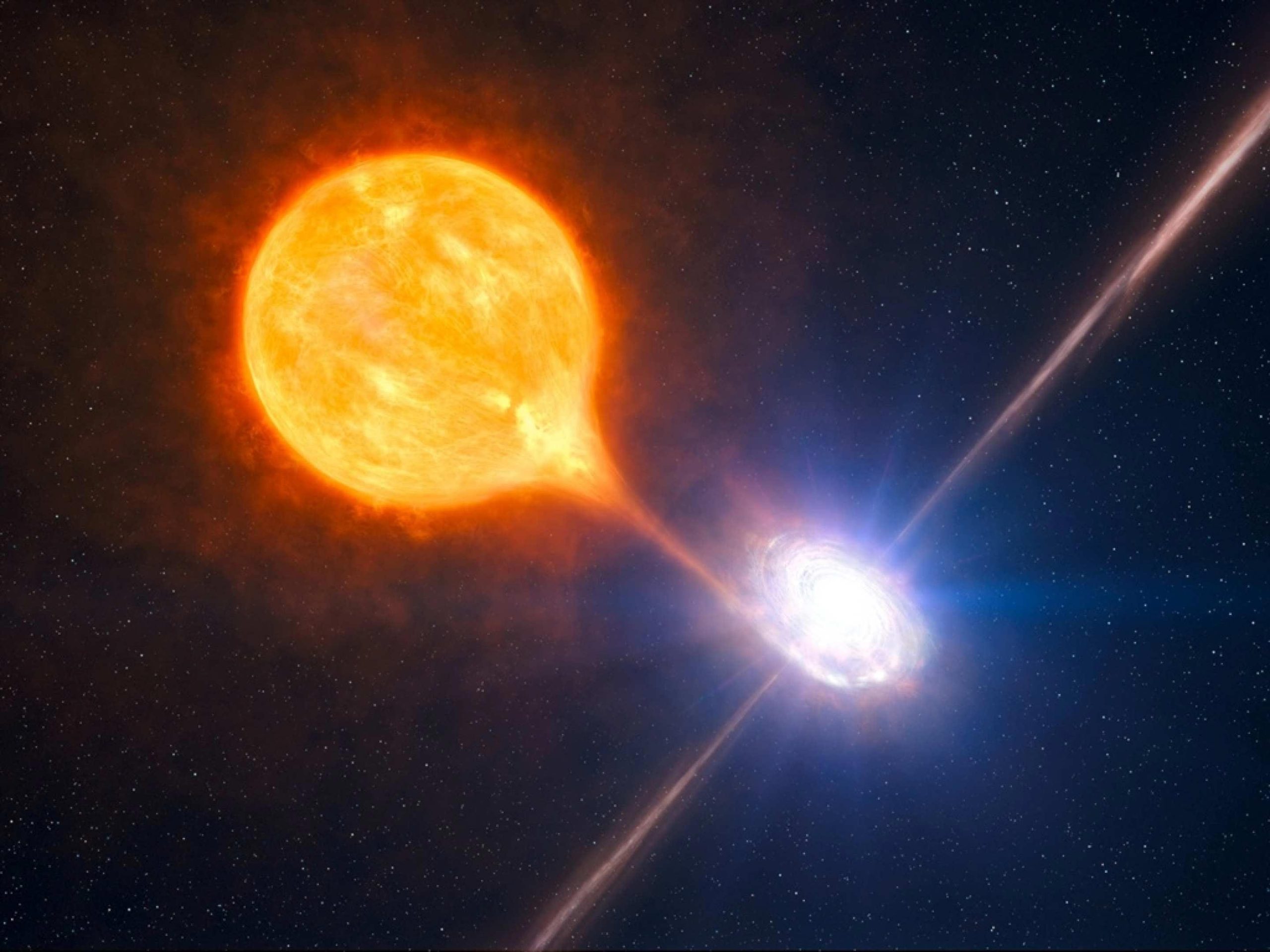
Scientists have been monitoring radio signals from the galaxy Arp 220, located 250 million light years from Earth, and now believe the radio emissions may be coming from a large number of microblazars, which are black holes feasting on dense gas at the center of a galaxy creating powerful jets that can be observed from Earth if they are directed towards us.
Astronomers have found evidence of hundreds of black holes in a galaxy 250 million light years away. The discovery, made with a worldwide network of radio telescopes, gives scientists a new way to find out how black holes are created.
A team led by astronomers at Chalmers University of Technology and Onsala Space Observatory has been monitoring radio signals from the core of the galaxy Arp 220, which lies 250 million light-years from Earth. Besides a number of supernovae, they also found some sources that were at first sight difficult to understand.
“We found three remarkable sources whose brightness was different each time we looked at them. In the beginning, we had no idea what they could be,” says Fabien Batejat, astronomer at Chalmers, who led the study.
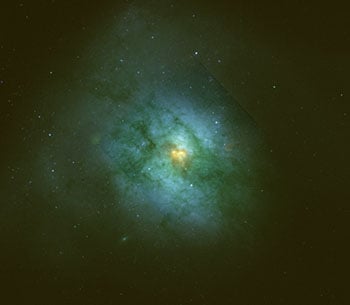
The scientists followed the three peculiar radio sources over several years. Now they think they know what is behind the radio signals: jets created by black holes.
“We believe we are seeing radio emission from binary star systems in which one star has already exploded and left behind a black hole. The black hole “eats” gas which it draws from its companion, producing powerful jets that emit radio waves,” says Fabien Batejat.
The newly discovered black holes in galaxy Arp 220 are only three of many more, the scientists believe. John Conway, professor of observational radio astronomy at Chalmers and deputy director of Onsala Space Observatory, explains.
“Jets from black holes are visible at this distance only if they are pointing right towards us. Probably there are many more systems like this in this galaxy, but their jets point in other directions,” he says.
The galaxy Arp 220 is already famous for creating new stars at a furious pace. Previous research by the same team has also demonstrated that there are many supernova explosions in the galaxy, up to 250 times more than in our galaxy. Supernovae and black holes are related. Astronomers believe that black holes are created when stars with masses more than about 20 times the sun explode.
This discovery in Arp 220 gives astronomers hope to soon be able to put this idea to the test. Only a dozen black holes of this type are known in the Milky Way, and only a few are known in other galaxies.
“By studying large numbers of these small, star-snacking black holes, we have a new way to learn about how they are created. So far, black hole statistics has only been possible for distant, supermassive black holes,” says Anthony Rushton, member of the team in Onsala.
The discovery was made with a network of radio telescopes around the world, linked together to create very sharp images, using the technique VLBI (Very Long Baseline Interferometry). Radio telescopes can follow events in the dense centers of galaxies that lie behind thick layers of dust, invisible to other telescopes. In order to discover what the radio sources in Arp 220 are, the team made measurements at different radio wavelengths over a period of 17 years.
“This result has only emerged after many years of painstaking observations and improvements in VLBI techniques,” says Philip Diamond, member of the team and Chief of CSIRO Astronomy and Space Science in Australia.
These objects, known to astronomers as microblazars, were theoretically predicted over a decade ago. Astronomers believe microblazars are scaled-down versions of the cosmic beacons known as blazars. In a blazar, a supermassive black hole feasting on dense gas at the center of a galaxy creates powerful jets which can be observed from Earth if they are directed toward us.
“Our new results from Arp 220 are the best evidence yet for microblazars. It also seems that galaxies like this one can contain very large numbers of them,“ says Fabien Batejat.
The results are published in a paper in the June issue of the journal Astronomy & Astrophysics.
Reference: “Rapid variability of the compact radio sources in Arp220 — Evidence for a population of microblazars?” by F. Batejat, J. E. Conway, A. Rushton, R. Parra, P. J. Diamond, C. J. Lonsdale and C. J. Lonsdale, 24 May 2012, Astronomy & Astrophysics.
DOI: 10.1051/0004-6361/201219235
Never miss a breakthrough: Join the SciTechDaily newsletter.
Follow us on Google and Google News.