
Close Menu
    Facebook X (Twitter) Instagram
    SciTechDaily
    • Biology
    • Chemistry
    • Earth
    • Health
    • Physics
    • Science
    • Space
    • Technology
    Facebook X (Twitter) Pinterest YouTube RSS
    SciTechDaily
    Home»Space»Herbig-Haro 110, A Geyser of Hot Gas Flowing from a Newborn Star
    Space

    Herbig-Haro 110, A Geyser of Hot Gas Flowing from a Newborn Star

    By The Hubble Space TelescopeJuly 3, 2012No Comments3 Mins Read
    Facebook Twitter Pinterest Telegram LinkedIn WhatsApp Email Reddit
    Share
    Facebook Twitter LinkedIn Pinterest Telegram Email Reddit
    Herbig-Haro HH 110
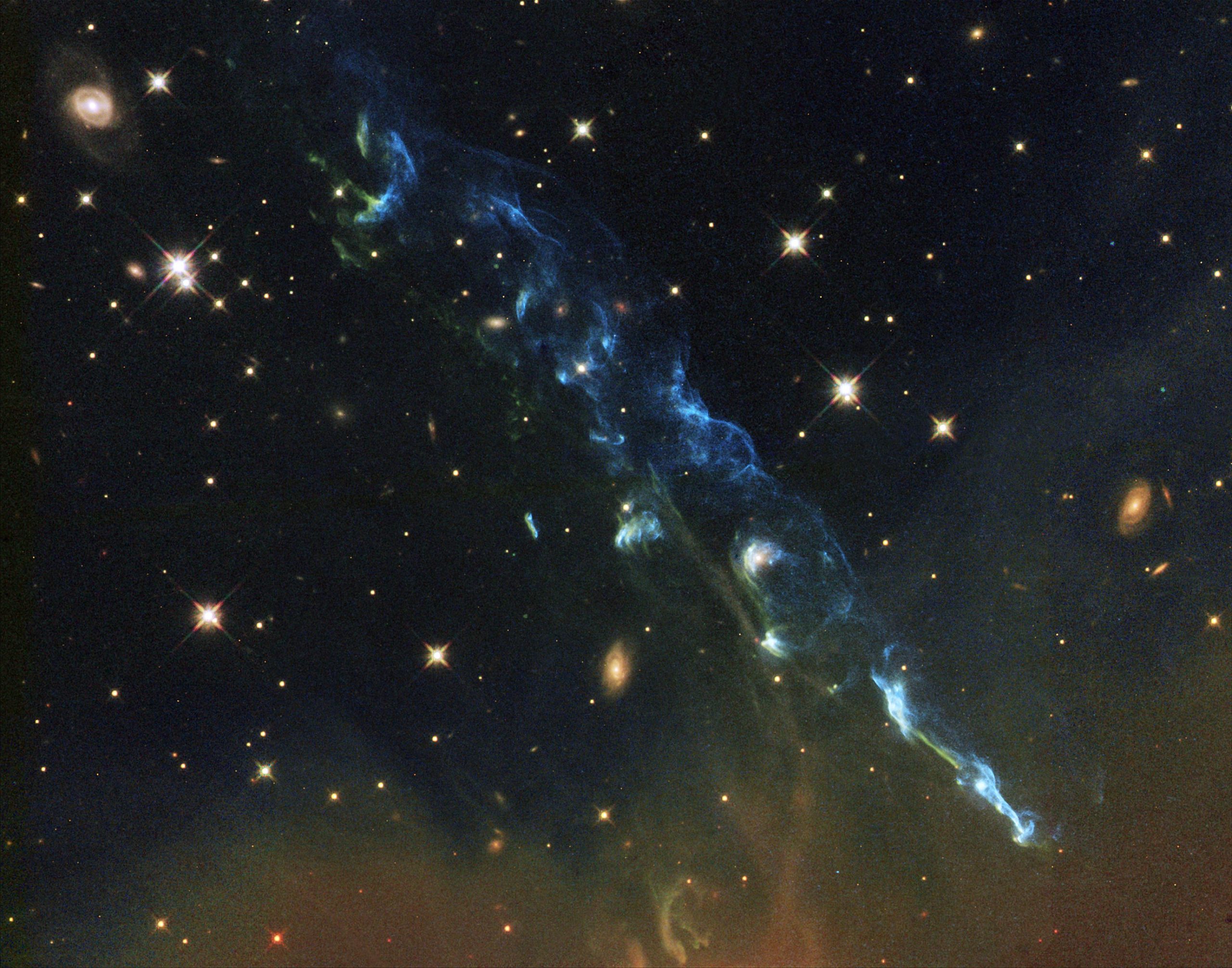
    The NASA/ESA Hubble Space Telescope has captured a new image of Herbig-Haro 110, a geyser of hot gas flowing from a newborn star. HH 110 appears different from most other Herbig-Haro objects: in particular, it appears on its own while they usually come in pairs. Astronomers think it may be a continuation of another object called HH 270, after it has been deflected off a dense cloud of gas. Credit: NASA, ESA, and the Hubble Heritage team (STScI/AURA)

    A new image from the Hubble Space Telescope shows Herbig-Haro 110, a geyser of hot gas flowing from a newborn star.

    Although Herbig–Haro (HH) objects come in a wide array of shapes, the basic configuration is usually the same. Twin jets of heated gas, ejected in opposite directions from a forming star, stream through interstellar space. These outflows are fueled by gas falling onto the young star, which is surrounded by a disc of dust and gas. If the disc is the fuel tank, the star is the gravitational engine, and the jets are the exhaust.

    In Hubble’s image of HH 110, one such turbulent streamer of gas can clearly be seen streaking across the frame.

    The intricate structures within HH 110 and other Herbig–Haro objects exist because the jets are not being blown through a pure vacuum. When the energetic and fast-moving Herbig–Haro jets slam into colder gas, they form shock fronts that look and behave much like the bow waves that form in front of a boat. These so-called bow shocks, which glow thanks to very high temperatures, are a distinctive feature of Herbig-Haro objects.

    The structure of HH 110 and other objects like it acts like a ticker-tape, recording the activity of the star that is the origin of the jet. Erratic outbursts from the star happen at times when more matter is falling in, and these are recorded as brighter knots or blobs within the Herbig-Haro object, which move along the jet over the years. Although the jets are very fast-moving, they are also very large: the streamer of gas in this image is around half a light-year in length. This means that the motion appears quite slow from our vantage point, even when measured over years.

    By measuring the current speed and positions of blobs within a Herbig-Haro object, astronomers can rewind time, projecting the motion of the knots backward to the moment when they were emitted. This in turn tells the scientists about the environment directly around the forming star.

    Never miss a breakthrough: Join the SciTechDaily newsletter.
    Follow us on Google and Google News.

    Astronomy European Space Agency Hubble Space Telescope NASA
    Share. Facebook Twitter Pinterest LinkedIn Email Reddit

    Related Articles

    Hubble’s Newest Discovery Isn’t a Star, It’s a Window Into the Dark Universe

    This Nearby Galaxy Shows How Frozen Clouds Ignite Into Stars

    This Chaotic Spiral Galaxy Is Still Recovering From a Cosmic Collision

    This Strange Spiral Galaxy Is Hiding a Massive Black Hole

    Hubble Zooms In on a Galaxy That Maps the Universe’s Expansion

    Hubble Captures a Dazzling Spiral Galaxy Alive With Birth and Destruction

    Hubble Spots a Glowing “Ring of Fire” in a Distant Spiral Galaxy

    Dust, Light & Ancient Collisions: The Sombrero Galaxy Like You’ve Never Seen It

    Star Formation in Motion: Hubble Reveals Spiraling Stars and Sculpted Nebulae

    Leave A Reply Cancel Reply

    • Facebook
    • Twitter
    • Pinterest
    • YouTube

    Don't Miss a Discovery

    Subscribe for the Latest in Science & Tech!

    Trending News

    Wasp Colonies Explode Into Violence After Losing Their Queen

    Scientists Create “Living Plastic” That Self-Destructs in Just Six Days

    Your Blood May Carry a 700-Million-Year-Old Secret

    Scientists Discover Some “Zombie Cells” May Actually Help You Live Longer

    Earth May Be Seeding Venus With Life, According to New Research

    What Scientists Found Inside a 117-Year-Old Woman Reveals New Clues to Long Life

    Scientists Discover Mysterious Creature Living in the Great Salt Lake – and It Exists Nowhere Else on Earth

    It’s Alive? Surprising Discovery Changes What We Know About Fog

    Follow SciTechDaily
    • Facebook
    • Twitter
    • YouTube
    • Pinterest
    • Newsletter
    • RSS
    SciTech News
    • Biology News
    • Chemistry News
    • Earth News
    • Health News
    • Physics News
    • Science News
    • Space News
    • Technology News
    Recent Posts
    • Vitamin D Drug Shows Surprising Promise Against One of the Deadliest Cancers
    • Scientists Crack Major Ammonia Problem With a Platinum Catalyst Breakthrough
    • MIT Engineers Solve a Major Lidar Problem That Has Stumped Researchers for Years
    • NASA’s X-59 Sonic Boom Killer Is Ready for Its Biggest Test Yet
    • Why Some Cancers Turn Deadly: Researchers Uncover a Hidden Trigger
    Copyright © 1998 - 2026 SciTechDaily. All Rights Reserved.
    • Science News
    • About
    • Contact
    • Editorial Board
    • Privacy Policy
    • Terms of Use

    Type above and press Enter to search. Press Esc to cancel.