
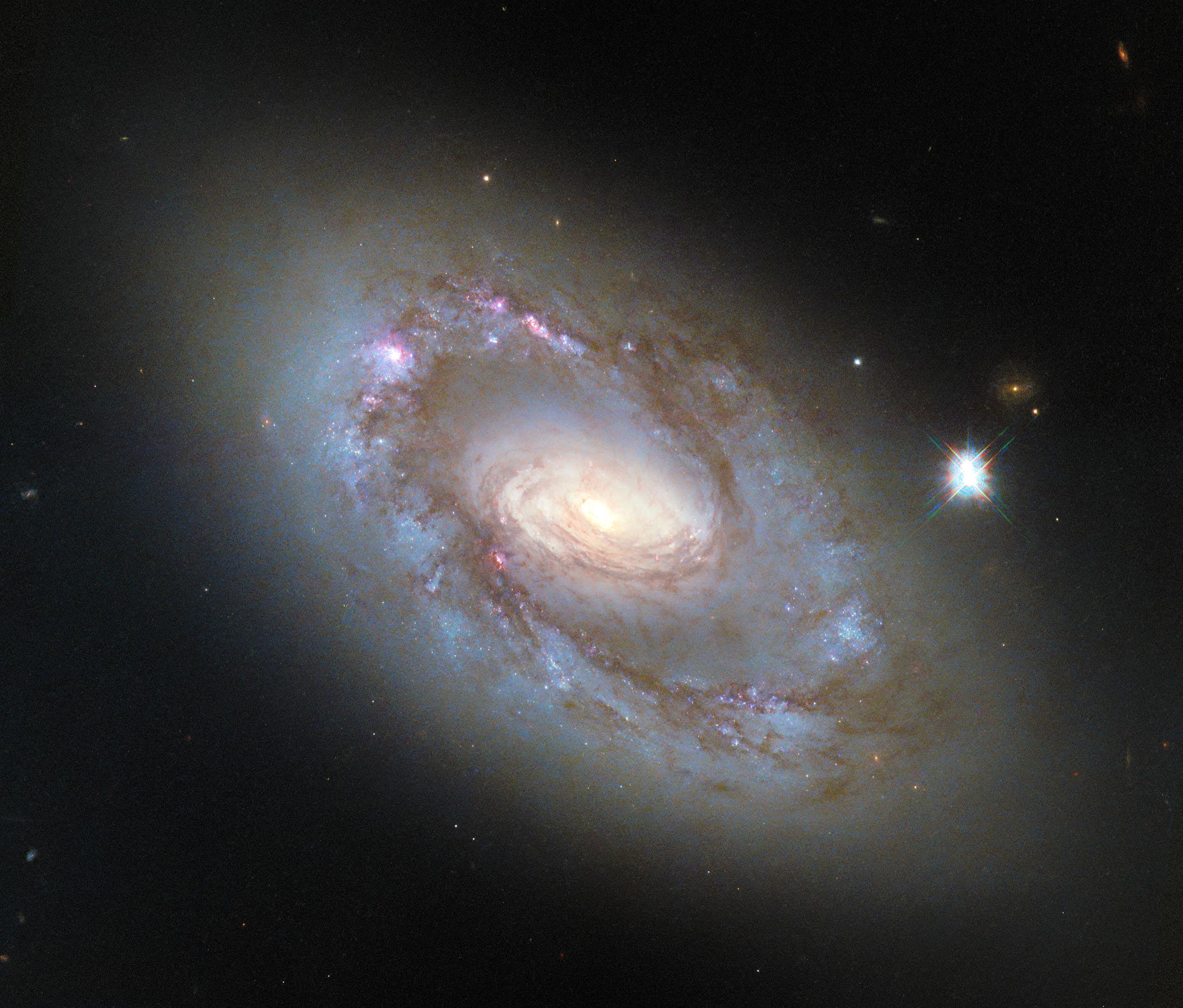
Hubble’s stunning view of NGC 4102 reveals a seemingly calm spiral galaxy hiding a quietly powerful supermassive black hole at its center.
Wrapped in thick gas, the galaxy’s core glows softly across multiple wavelengths, betraying the activity within.
A Hidden Power Source in a Spiral Galaxy
What could be located at the center of this unusually shaped spiral galaxy? NGC 4102, highlighted in this Hubble Picture of the Week, contains what astronomers refer to as an active galactic nucleus. These energetic regions mark the cores of galaxies where supermassive black holes, holding millions to a billion times the mass of the Sun, dominate the environment. As the black holes pull in nearby gas with their strong gravitational force, the gas becomes extremely hot, producing radiation that spans everything from X-rays to radio waves.
A Nearby Target for Studying Active Galactic Nuclei
Located only 56 million light-years away in the constellation Ursa Major (The Great Bear), NGC 4102 is close enough to allow detailed studies of how active galactic nuclei influence their host galaxies. These nuclei appear in a wide range of forms, from intensely bright varieties that rapidly devour surrounding material and launch jets of charged particles, to more subdued versions that gather gas slowly and emit a softer glow.
NGC 4102 seems to belong to this quieter group. It is categorized as Compton-thick — meaning its center is hidden behind a dense curtain of gas — and as a LINER, short for low-ionization nuclear emission-line region. Galaxies of this type show emission lines from weakly ionized elements and can be powered by a supermassive black hole that is gradually drawing in gas from its surroundings.
Sharper New View from Hubble and Chandra
An earlier image of NGC 4102, created using data from Hubble’s Wide Field Planetary Camera 2 (WFPC2), was released in 2014. The updated image offers a clearer and more detailed look at the galaxy, thanks to observations from the Wide Field Camera 3, which replaced WFPC2 in 2009 and provided better resolution and a wider field of view. These new data are part of a project that pairs Hubble’s visible-light imagery with X-ray observations from the Chandra X-ray Observatory to explore how NGC 4102 and its active galactic nucleus interact.
Never miss a breakthrough: Join the SciTechDaily newsletter.
Follow us on Google and Google News.
1 Comment
Memo 2511160407_Source 1. Reinterpretation Storytelling 【】
Source 1.
https://scitechdaily.com/this-strange-spiral-galaxy-is-hiding-a-massive-black-hole/
1.
_This Strange Spiral Galaxy Is Hidden by a Massive Black Hole
_A new Hubble image of NGC 4102 reveals the faint glow of a supermassive black hole hidden behind a dense blanket of gas. The galaxy’s delicate spiral structure contrasts with the quiet activity unfolding at its center.
_A striking Hubble image of NGC 4102 reveals a seemingly tranquil spiral galaxy, yet at its center lurks a quiet yet powerful supermassive black hole.
_The galaxy’s thick gas-filled center glows softly across multiple wavelengths, revealing the activity within.
2. The Hidden Energy Source of Spiral Galaxies
What lies at the center of this unusually shaped spiral galaxy? NGC 4102, highlighted in this week’s Hubble image, contains what astronomers call an active galactic nucleus.
This energetic region represents the core of a galaxy, dominated by a supermassive black hole weighing millions to billions of times the mass of the Sun. As the black hole pulls on surrounding gas with its intense gravity, the gas becomes extremely hot, generating radiation ranging from X-rays to radio waves.
3. A Nearby Target for Active Galactic Nucleus Studies
Just 56 million light-years away in the constellation Ursa Major, NGC 4102 is close enough to study in detail how an active galactic nucleus affects its host galaxy.
These galactic nuclei vary in appearance, from intensely luminous nuclei that rapidly engulf surrounding matter and spew out charged particles to fainter nuclei that slowly gather gas and emit a soft glow.
3-1.
NGC 4102 appears to belong to this quiet group of galaxies. It is classified as a Compton-thick galaxy, with a center hidden behind a dense gas curtain, and a LINER galaxy, short for “low-ionization nuclear emission line region.”
These types of galaxies emit emission lines of weakly ionized elements and derive their energy from the energy of supermassive black holes that slowly suck in gas from their surroundings.
[msbase(eqpms)] Do galaxies derive their energy from the energy they draw from black holes qvix(2,3,4)? I think I just found sufficient evidence to support this…
>>>>Of course, I don’t have the time (it was just a little while ago…) to thoroughly examine the connection right now… Momo… I don’t have that, and this isn’t Yut Nori… Anyway, it seems intuitively right. Oh my.
>>>> Speaking of the sample3 series… I realized a mysterious principle an hour ago using qvixer, which subtracts the 1s from 11, 111, and 1111 to represent the number of 1s.
From ±(1), 01(x.down)
From ±(11), the absolute value of the meson 0,2(z) is obtained,
and from ±(111), the meson 3,2(x.up) is obtained.
From ±(1111), the integer 0234 is obtained. An isosceles rectangle-shaped vector appears, unable to produce the integer 1. Oh my. It was a bit difficult to organize.
>>
[Galactic nuclei are represented in various forms, from intensely bright nuclei that rapidly engulf surrounding matter and spew out charged particles, to faint nuclei that slowly gather gas and emit a soft glow] The source of energy is also the qvixer inverse energy.
_NGC 4102 appears to belong to this quiet galaxy group. It is classified as a Compton-thick galaxy with a central region hidden behind a dense gas curtain, and a LINER galaxy, short for low-ionization nuclear emission line region.]
>>>> It is likely easily exposed to the qvixer (quasi-vixer.blackhole).meson path.
>>>>>The energy absorption path of a quasi-blackhole: dark_energy.eqpms.qvixer(1_11-111_1111).1_0,-2,_3,-4_0-2_3,
>>>>Anyway, qvixer, as a quasi-black hole, provides the absolute energy of its meson vector to surrounding galaxies in the order of 10->02->23->4023. It’s not yet proven, but it seems to be a very important path. Hmm.
(I’ve been concentrating on this for three straight hours since I said it was just a moment ago… I’m tired! This isn’t a quick post. I’ve changed my mind more than ten times…)
】