
Close Menu
    Facebook X (Twitter) Instagram
    SciTechDaily
    • Biology
    • Chemistry
    • Earth
    • Health
    • Physics
    • Science
    • Space
    • Technology
    Facebook X (Twitter) Pinterest YouTube RSS
    SciTechDaily
    Home»Space»Hubble Spots a Glowing “Ring of Fire” in a Distant Spiral Galaxy
    Space

    Hubble Spots a Glowing “Ring of Fire” in a Distant Spiral Galaxy

    By ESA/HubbleOctober 24, 20251 Comment2 Mins Read
    Facebook Twitter Pinterest Telegram LinkedIn WhatsApp Email Reddit
    Share
    Facebook Twitter LinkedIn Pinterest Telegram Email Reddit
    Spiral Galaxy NGC 6951
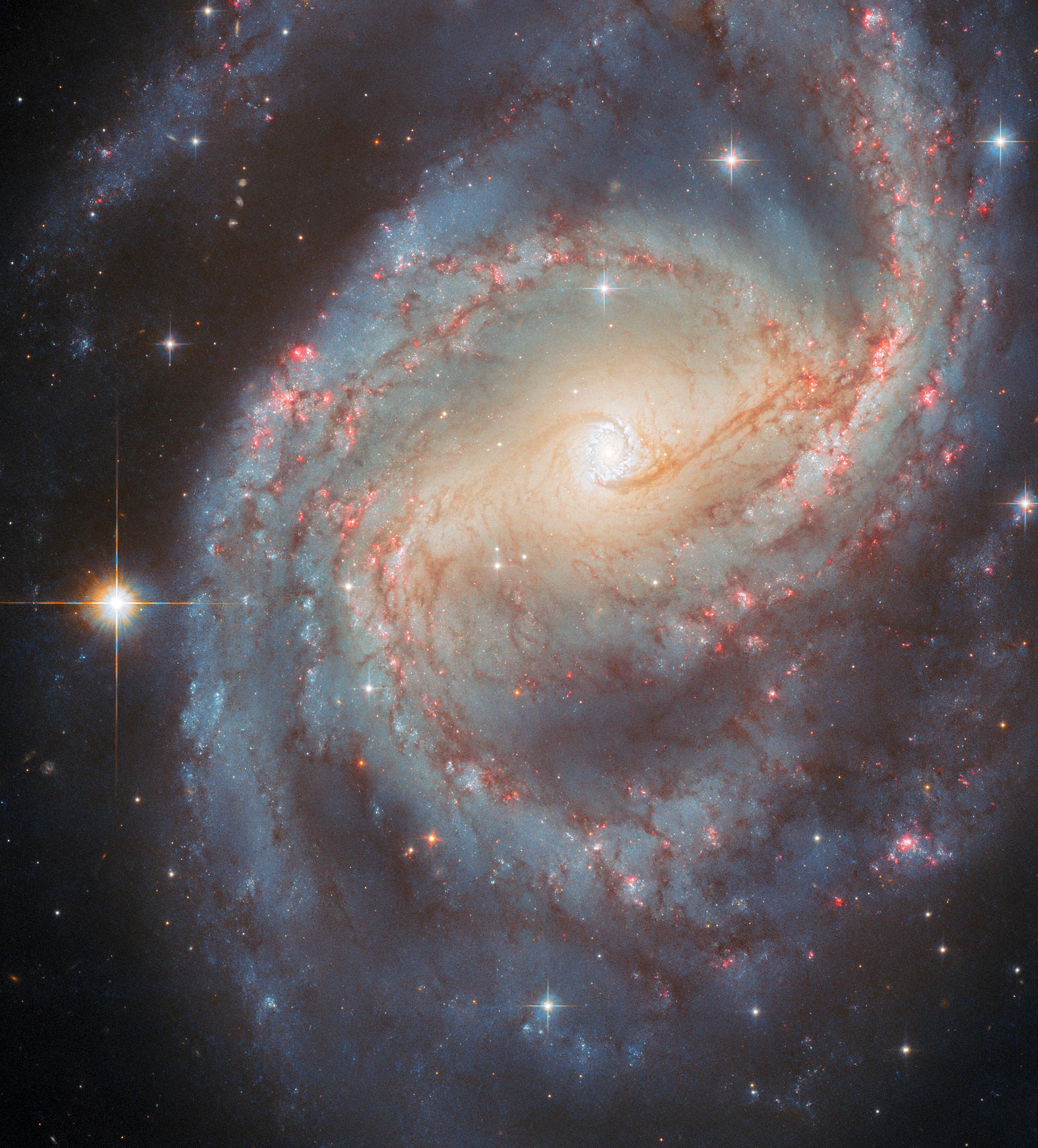
    About 70 million light-years away, the stunning spiral galaxy NGC 6951 glows with swirling arms of stars and dust and a radiant golden center. At its heart lies a brilliant circumnuclear starburst ring, where gas funneled by a central bar fuels a frenzy of star birth. Credit: ESA/Hubble & NASA, L. C. Ho, G. Brammer, A. Filippenko, C. Kilpatrick

    NGC 6951 shines 70 million light-years away, its spiral arms feeding a brilliant central starburst ring bursting with new stars. This cosmic powerhouse reveals how bars shape galaxies and sustain stellar creation across eons.

    The brilliant galaxy featured in this Hubble Space Telescope Picture of the Week is NGC 6951, located roughly 70 million light-years from Earth in the constellation Cepheus.

    This image reveals NGC 6951 as a striking spiral galaxy filled with intricate structures. Its most prominent features are the sweeping spiral arms, dotted with glowing red nebulae, luminous blue stars, and wisps of dark dust. These arms wrap gracefully around a radiant golden center, where older stars shine together in a warm glow. The central region also appears stretched and elongated, showing the presence of a slowly rotating bar made of stars.

    The Mystery of the Starburst Ring

    Astronomers believe this bar plays a key role in shaping one of NGC 6951’s most fascinating features: a pale, bluish-white ring that surrounds its bright core. Known as a circumnuclear starburst ring, it marks a region of intense star formation encircling the galaxy’s nucleus. The bar channels gas inward toward the center, where it gathers into a ring about 3,800 light-years wide. Two dark lanes of dust that run alongside the bar trace where this gas flows into the ring.

    A Stellar Nursery in Full Bloom

    This dense ring of gas provides the ideal conditions for creating vast numbers of new stars. Using Hubble observations, scientists have pinpointed more than 80 likely star clusters within NGC 6951’s ring. Many of these stars are relatively young, having formed less than 100 million years ago, while the ring itself may have persisted for an astonishing 1–1.5 billion years.

    A Favorite Target for Astronomers

    Hubble has returned to NGC 6951 many times for different studies, including research on the distribution of dust in nearby galaxies, investigations into the structure of galactic centers, and observations of recent supernovae (NGC 6951 has hosted five or six such stellar explosions).

    Never miss a breakthrough: Join the SciTechDaily newsletter.
    Follow us on Google and Google News.

    Astronomy European Space Agency Hubble Space Telescope NASA
    Share. Facebook Twitter Pinterest LinkedIn Email Reddit

    Related Articles

    Hubble’s Newest Discovery Isn’t a Star, It’s a Window Into the Dark Universe

    This Nearby Galaxy Shows How Frozen Clouds Ignite Into Stars

    This Chaotic Spiral Galaxy Is Still Recovering From a Cosmic Collision

    This Strange Spiral Galaxy Is Hiding a Massive Black Hole

    Hubble Zooms In on a Galaxy That Maps the Universe’s Expansion

    Hubble Captures a Dazzling Spiral Galaxy Alive With Birth and Destruction

    Dust, Light & Ancient Collisions: The Sombrero Galaxy Like You’ve Never Seen It

    Star Formation in Motion: Hubble Reveals Spiraling Stars and Sculpted Nebulae

    Hubble Captures New Image of Messier 9

    1 Comment

    1. David zaragoza on October 25, 2025 5:26 pm

      BEAUTIFUL

      Reply
    Leave A Reply Cancel Reply

    • Facebook
    • Twitter
    • Pinterest
    • YouTube

    Don't Miss a Discovery

    Subscribe for the Latest in Science & Tech!

    Trending News

    Millions Take These IBS Drugs, But a New Study Finds Serious Risks

    Scientists Unlock Hidden Secrets of 2,300-Year-Old Mummies Using Cutting-Edge CT Scanner

    Bread Might Be Making You Gain Weight Even Without Eating More Calories

    Scientists Discover Massive Magma Reservoir Beneath Tuscany

    Europe’s Most Active Volcano Just Got Stranger – Here’s Why Scientists Are Rethinking It

    Alzheimer’s Symptoms May Start Outside the Brain, Study Finds

    Millions Take This Popular Supplement – Scientists Discover a Concerning Link to Heart Failure

    The Universe Is Expanding Too Fast and Scientists Can’t Explain Why

    Follow SciTechDaily
    • Facebook
    • Twitter
    • YouTube
    • Pinterest
    • Newsletter
    • RSS
    SciTech News
    • Biology News
    • Chemistry News
    • Earth News
    • Health News
    • Physics News
    • Science News
    • Space News
    • Technology News
    Recent Posts
    • Simple Blood Test May Predict Alzheimer’s Years Before Brain Scans Show Signs
    • Scientists Say Adding This Unusual Seafood to Your Diet Could Reverse Signs of Aging
    • U.S. Waste Holds $5.7 Billion Worth of Crop Nutrients
    • Scientists Say a Hidden Structure May Exist Inside Earth’s Core
    • Doctors Surprised by the Power of a Simple Drug Against Colon Cancer
    Copyright © 1998 - 2026 SciTechDaily. All Rights Reserved.
    • Science News
    • About
    • Contact
    • Editorial Board
    • Privacy Policy
    • Terms of Use

    Type above and press Enter to search. Press Esc to cancel.