

Hubble’s 35‑year celebration brings a vibrant reimagining of the Sombrero Galaxy, revealing hidden dust lanes and far‑flung stars.
This iconic “Mexican hat” quietly forms almost no new stars while hosting a colossal yet calm black hole. Delicate chemical clues in its halo suggest a monumental merger shaped its striking silhouette.
Hubble’s 35th: New Views of Iconic Targets
As part of the Hubble 35th anniversary celebration, the European Space Agency (ESA) is releasing a special image series that revisits some of the most striking objects Hubble has observed. These updated views combine the latest Hubble data with advanced image processing techniques to reveal new levels of detail.
The first image in the series focused on NGC 346. Now, the team is turning their attention to a longtime favorite: the Sombrero Galaxy. The newly processed image brings out finer structures in the galaxy’s disk and reveals more distant background stars and galaxies than ever before.
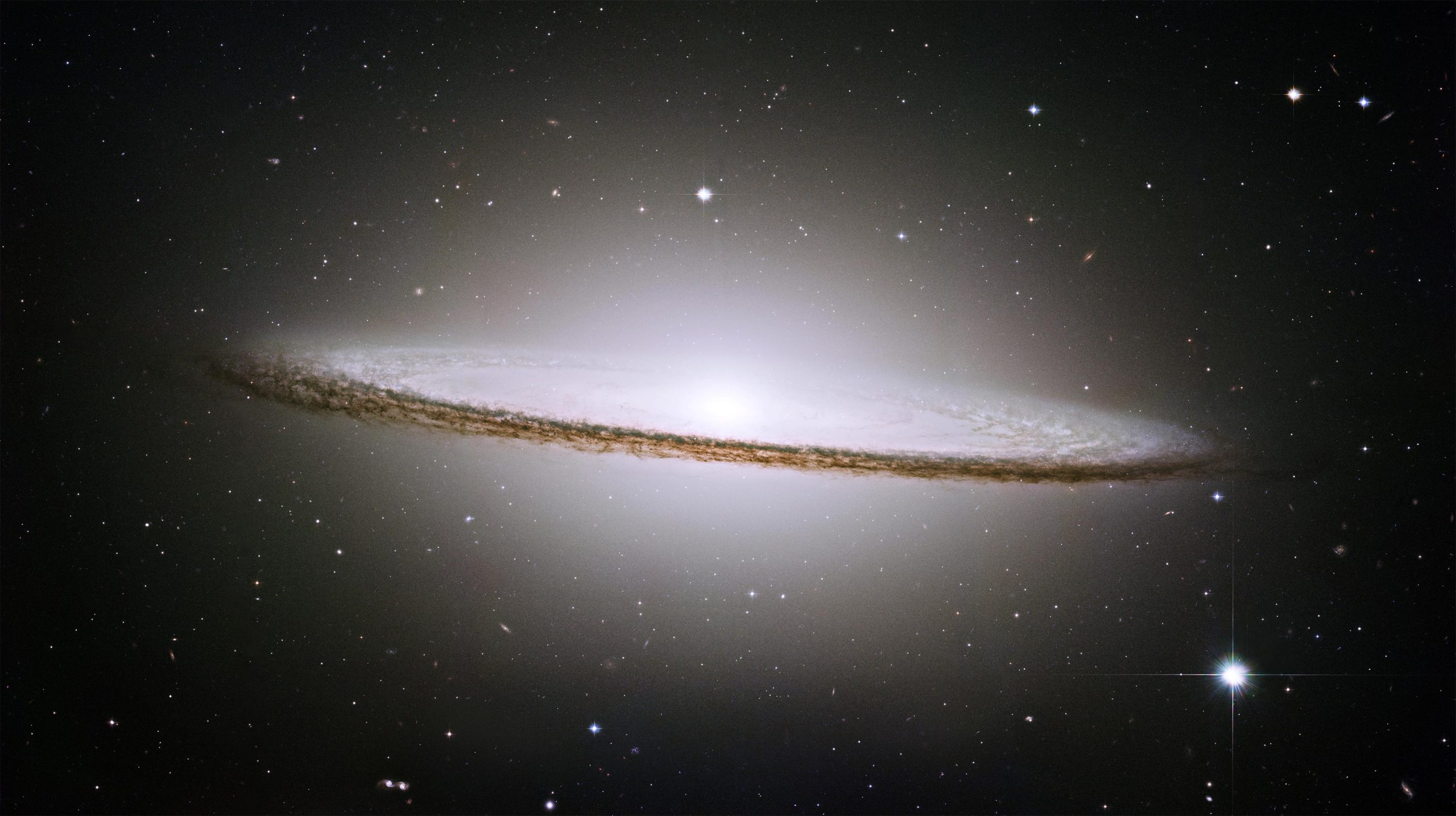
Hubble has captured several images of the Sombrero Galaxy over the past 20 years, including a widely recognized version released in October 2003 (see image below). More recently, in November 2024, the James Webb Space Telescope (a collaboration between NASA, ESA, and CSA) provided a dramatically different view of this iconic galaxy.
Sombrero Galaxy: Distance, Dynamics, and Visibility
Located about 30 million light-years away in the constellation Virgo, the Sombrero Galaxy is known for its distinctive appearance. Seen almost edge-on, its bright central bulge and sharply defined disk resemble the crown and brim of a sombrero, giving the galaxy its memorable name.
Though packed with stars, the Sombrero Galaxy is surprisingly not a hotbed of star formation. Less than one solar mass of gas is converted into stars within the knotted, dusty disk of the galaxy each year. Even the galaxy’s central supermassive black hole, which at nine billion solar masses is more than 2,000 times more massive than the Milky Way’s central black hole, is fairly calm.
The galaxy is too faint to spot with the unaided eye, but it is readily viewable with a modest amateur telescope. Seen from Earth, the galaxy spans a distance equivalent to roughly one-third the diameter of the full Moon. The galaxy’s size on the sky is too large to fit within Hubble’s narrow field of view, so this image is actually a mosaic of several images stitched together.
Structural Mysteries and Merger Clues
One of the things that makes this galaxy especially notable is its viewing angle, which is inclined just six degrees off of the galaxy’s equator. From this vantage point, intricate clumps and strands of dust stand out against the brilliant white galactic nucleus and bulge, creating an effect not unlike Saturn and its rings — but on an epic galactic scale.
At the same time, this extreme angle makes it difficult to discern the structure of the Sombrero Galaxy. It’s not clear whether it’s a spiral galaxy, like our own Milky Way, or an elliptical galaxy. Curiously, the galaxy’s disk seems like a fairly typical disk for a spiral galaxy, and its spheroidal bulge and halo seem fairly typical for an elliptical galaxy — but the combination of the two components resembles neither a spiral nor an elliptical galaxy.
Researchers used Hubble to investigate the Sombrero Galaxy, measuring the metals (what astronomers call elements heavier than helium) in stars in the galaxy’s expansive halo. This type of measurement can help astronomers better understand a galaxy’s history, potentially revealing whether it merged with other galaxies in the past. In the case of the Sombrero Galaxy, extremely metal-rich stars in the halo point to a possible merger with a massive galaxy several billion years ago. An ancient galactic clash, hinted at by Hubble’s sensitive measurements, could explain the Sombrero Galaxy’s distinctive appearance.

The Hubble Space Telescope has been exploring the universe for more than 30 years, revolutionizing our understanding of space with its detailed images and groundbreaking discoveries. A joint project between NASA and the European Space Agency (ESA), Hubble is managed by NASA’s Goddard Space Flight Center in Greenbelt, Maryland, with mission operations supported by Lockheed Martin Space in Denver. Scientific operations are handled by the Space Telescope Science Institute in Baltimore, operated by the Association of Universities for Research in Astronomy. Hubble continues to be one of the most important tools in astronomy, providing insights into everything from the formation of galaxies to the expansion of the universe.
Never miss a breakthrough: Join the SciTechDaily newsletter.
Follow us on Google and Google News.