
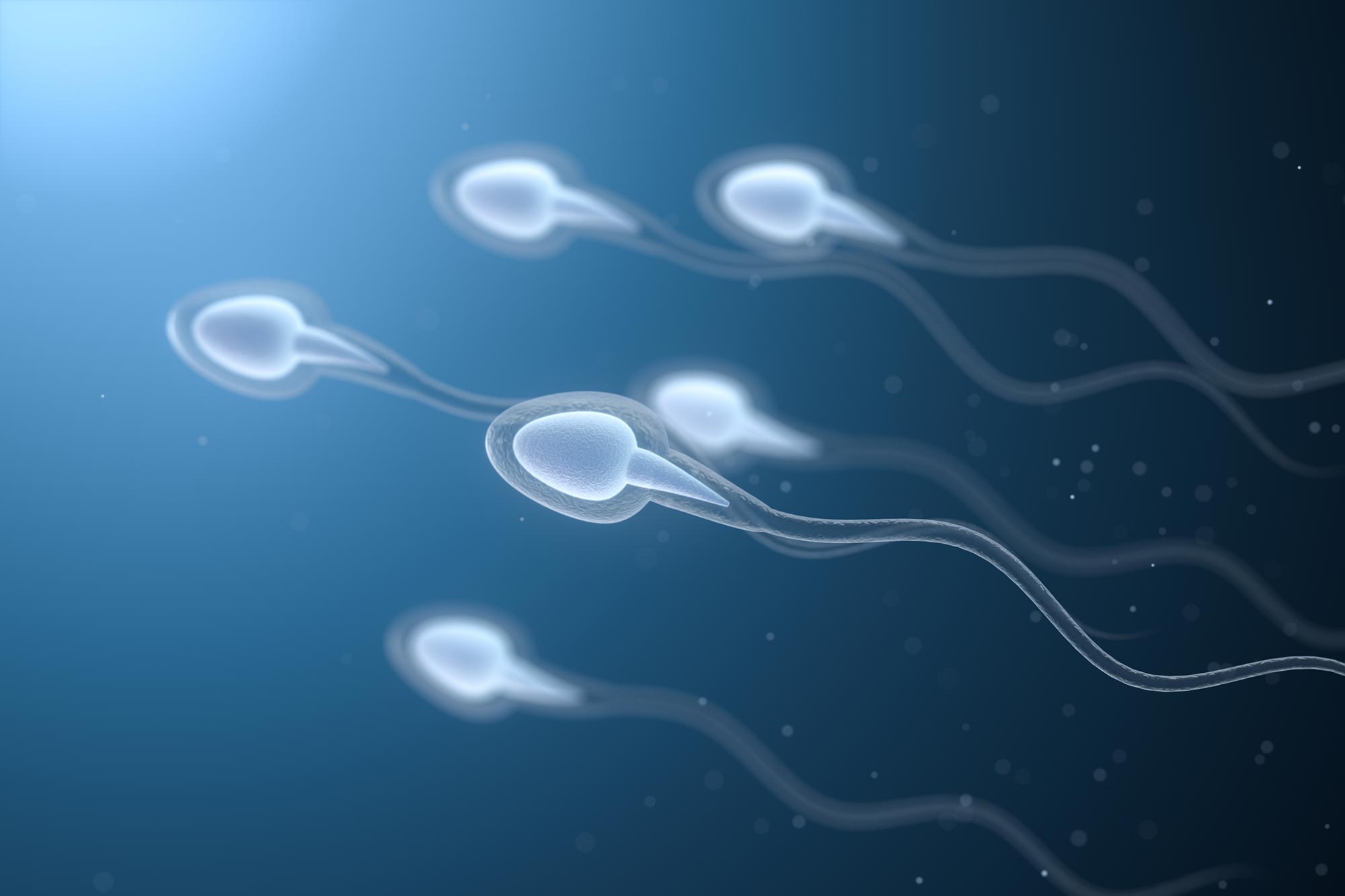
Sperm cells move through fluids that should stop them almost instantly, yet new research suggests they succeed by exploiting unusual properties of active living matter.
A sperm cell should not be a strong swimmer.
At microscopic scales, fluid does not behave like water in a pool. It acts more like a thick barrier, stopping motion almost instantly. Yet sperm cells still push forward with waving tails, even through fluids that should strongly resist them.
A study led by Kyoto University mathematical scientist Kenta Ishimoto suggests that sperm accomplish this by exploiting a strange feature of living matter. Their motion appears to sidestep the usual action-and-reaction symmetry described by Newton’s third law.
Newton’s third law is often summarized as, “for every action, there is an equal and opposite reaction.” That principle works well for everyday objects, such as two marbles colliding and bouncing apart. But sperm are active systems. They constantly add energy to their own motion.
As the researchers write, “Newton’s third law may be violated when we regard it as an open system, with its mechanical energy being injected from microscopic active units.”
In other words, sperm are not breaking physics. They are revealing what happens when living systems pump energy into their surroundings from within.
Why Tiny Swimmers Face a Different Kind of Physics
For sperm, there is no gliding between strokes. At their scale, inertia is almost irrelevant and viscosity dominates. If the tail stops beating, the cell stops moving almost immediately.
That creates a problem known as the scallop theorem. A microscopic swimmer cannot move through a viscous fluid by simply repeating a motion and then reversing it. To make progress, it needs a stroke that is not perfectly reversible.
Sperm solve this with flagella, the thin flexible tails that send traveling waves along their length. Green algae such as Chlamydomonas use similar structures to swim.
These waves are powered by molecular motors inside the flagellum. Because those motors inject energy into the tail, it behaves less like a passive spring and more like an active material.
The “Odd” Elasticity Behind the Motion
The study focuses on a property called odd elasticity. In ordinary elastic materials, force and response are reciprocal. Bend or stretch them, and they push back in a predictable way.
Odd elasticity allows a different kind of response. In active materials, internal energy sources can produce forces that do not simply mirror the forces acting on them. That non-reciprocal behavior can help sustain waves, even when thick fluid drains energy from motion.
To describe this process, the researchers developed a framework called odd elastohydrodynamics. They say it “provides a unified framework for the study of nonlocal, non-reciprocal interactions of an elastic material in a viscous fluid.”
This approach helped them separate what the surrounding fluid does from what is happening inside the flagellum. That distinction matters because drag can hide the internal mechanics that actually generate the wave.
The team also introduced an odd-elastic modulus, a mathematical tool for distinguishing ordinary elastic behavior from the active, non-reciprocal forces that drive motion.
What the Researchers Found
The team applied its model to human sperm data and to Chlamydomonas, a green alga with beating flagella. The results suggest that these swimmers use internal activity to create traveling waves through their flexible tails.
In the human sperm model, internal activity helped generate the flagellar wave, while passive elasticity appeared to stabilize and relax it. In Chlamydomonas, the non-reciprocal response matched the wave pattern of the flagellar beat, suggesting that odd elasticity helps power the motion.
The researchers concluded that their framework can reveal “nonlocal, non-reciprocal inner interactions within the material.”
Put simply, a sperm tail is not just a tiny whip. It is an energy-consuming structure whose internal mechanics help it move through a world where ordinary back-and-forth motion would fail.
The findings could help scientists understand how living systems move, from single cells to groups of coordinated swimmers. They may also guide the design of tiny self-assembling robots, artificial microswimmers, or soft materials that imitate living motion.
Reference: “Odd Elastohydrodynamics: Non-Reciprocal Living Material in a Viscous Fluid” by Kenta Ishimoto, Clément Moreau and Kento Yasuda, 11 October 2023, PRX Life.
DOI: 10.1103/PRXLife.1.023002
Never miss a breakthrough: Join the SciTechDaily newsletter.
Follow us on Google and Google News.
10 Comments
Just out curiosity but, were these Japanese scientist jerking off on microscope slide for months?
No. women inserted micro-cams in–er, strategic locations to film the little swimmers.
The basic Law of Physics I think they violate is being attracted to modern women!
Funny this is the political situation where KGB paid for people like steinhum to destroy the American family.
Again, life is underestimated by those who think too much and experience being, too little.
Is there a similarity in the sperm movement technique,to the Lyme disease and syphillis spitochtal bacteria when they move about the body from one type of cell to another?
You blew away my Top-Secret submarine and torpedo propulsion method patent.
Don’t forget how the big shot big brain ended up with his submarine…
I thought the tails whipped like a corkscrew thus forward motion.
I think it is now obvious to all of our great brains that the constituents of the atom have this cine qua non to advance into a life form which unfortunately became a human 😭💥