
Close Menu
    Facebook X (Twitter) Instagram
    SciTechDaily
    • Biology
    • Chemistry
    • Earth
    • Health
    • Physics
    • Science
    • Space
    • Technology
    Facebook X (Twitter) Pinterest YouTube RSS
    SciTechDaily
    Home»Biology»Evidence That Earth’s First Cells – 3.8 Billion Years Ago – Could Have Made Specialized Compartments
    Biology

    Evidence That Earth’s First Cells – 3.8 Billion Years Ago – Could Have Made Specialized Compartments

    By Biophysical SocietyFebruary 24, 20211 Comment3 Mins Read
    Facebook Twitter Pinterest Telegram LinkedIn WhatsApp Email Reddit
    Share
    Facebook Twitter LinkedIn Pinterest Telegram Email Reddit
    Protocell Special Compartments
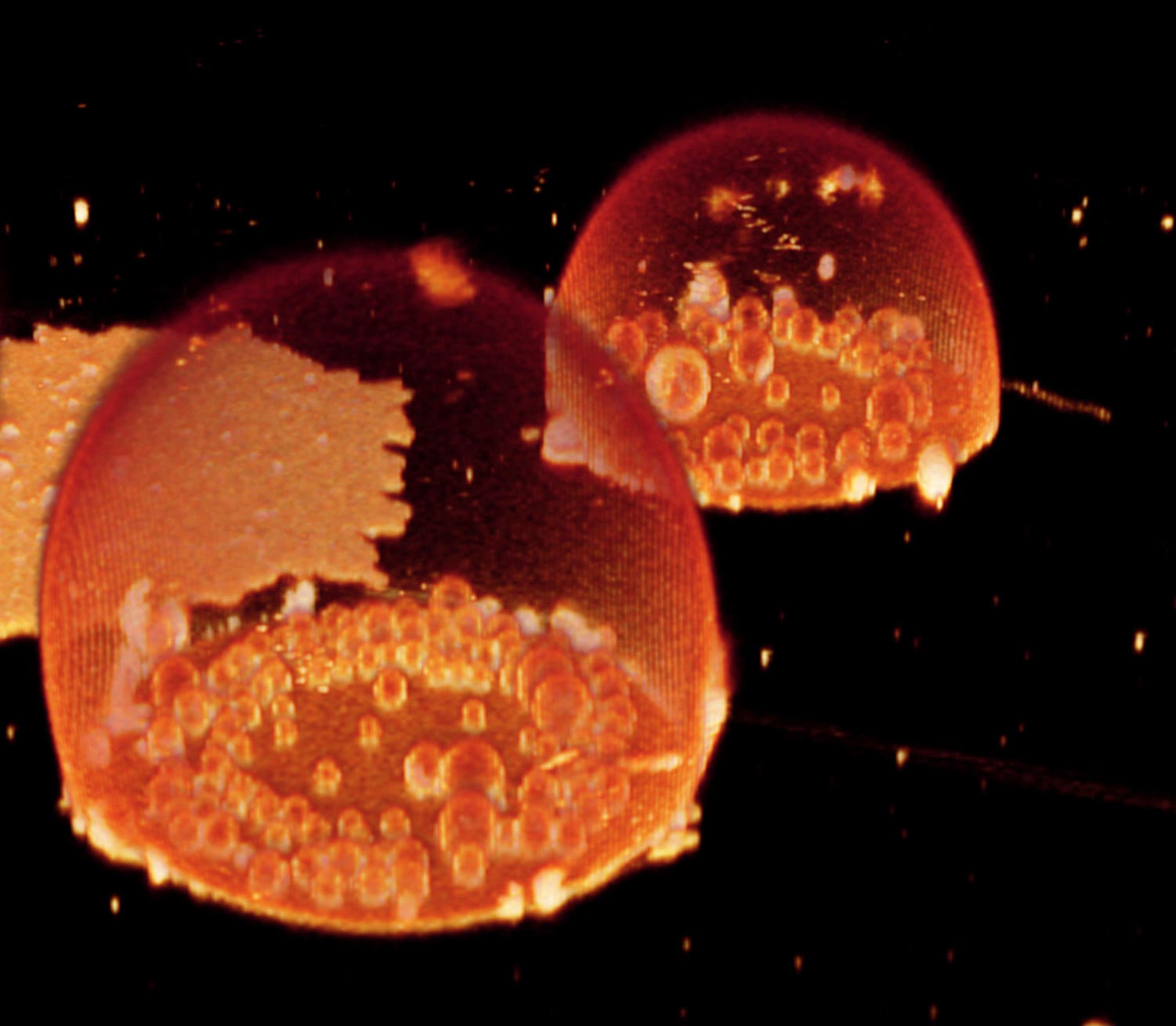
    “Protocells” containing bubble-like compartments formed spontaneously on a mineral-like and encapsulated fluorescent dye. This could have been what happened 3.8 billion years ago when cells first began to form. Credit: Image courtesy of Karolina Spustova

    New research by the University of Oslo provides evidence that the “protocells” that formed around 3.8 billion years ago, before bacteria and single-celled organisms, could have had specialized bubble-like compartments that formed spontaneously, encapsulated small molecules, and formed “daughter” protocells.

    Scientists have long speculated about the features that our long-ago single-celled ancestors might have had, and the order in which those features came about. Bubble-like compartments are a hallmark of the superkingdom to which we, and many other species including yeast, belong. But the cells in today’s superkingdom have a host of specialized molecules that help make and shape these bubbles inside our cells. Scientists wondered what came first: the bubbles or the shaping molecules? New research by Karolina Spustova, a graduate student, and colleagues in the lab of Irep Gözen at the University of Oslo, shows that with just a few key pieces these little bubbles can form on their own, encapsulate molecules, and divide without help. Spustova will present her research, which was published in January, on Wednesday, February 24 at the 65th Annual Meeting of the Biophysical Society.

    A Billion-Year-Old Mystery: Bubbles Before Bacteria?

    3.8 billion years ago is about when our long ago single-cell ancestor came to be. It would have preceded not only complex organisms in our superkingdom, but also the more basic bacteria. Whether this “protocell” had bubble-like compartments is a mystery. For a long time, scientists thought that these lipid-bubbles were something that set our superkingdom apart from other organisms, like bacteria. Because of this, scientists thought that these compartments might have formed after bacteria came to exist. But recent research has shown that bacteria have specialized compartments too, which led Gözen’s research team to wonder–could the protocell that came before bacteria and our ancestors have them? And if so, how could they have formed?

    The research team mixed the lipids that form modern cell compartments, called phospholipids, with water and put the mix on a mineral-like surface. They found that large bubbles spontaneously formed, and inside those bubbles, were smaller ones. To test whether those compartments could encapsulate small molecules, as they would need to do to have specialized functions, the team added fluorescent dyes. They observed that these bubbles were able to take up and hold onto the dyes. They also saw instances where the bubbles split, leaving smaller “daughter” bubbles, which is “something like simple division of the first cells,” Spustova says. All of this occurred without any molecular machines, like those we have in our cells, and without added energy.

    Early Earth Was Ready for Bubble Biology

    The idea that this could have happened on Earth 3.8 billion years ago is not inconceivable. Gözen explained that water would have been plentiful, plus “silica and aluminum, which we used in our study, are present in natural rocks.” Research shows that the phospholipid molecules could have been synthesized under early Earth conditions or reached Earth with meteorites. Gözen says, “these molecules are believed to have reached sufficient concentrations to form phospholipid compartments.” So, it is possible that the ancient “protocell” that came before all the organisms currently on Earth, had everything it needed for bubble-like compartments to form spontaneously.

    Never miss a breakthrough: Join the SciTechDaily newsletter.
    Follow us on Google and Google News.

    Biophysical Society Biophysics Biotechnology Cell Biology
    Share. Facebook Twitter Pinterest LinkedIn Email Reddit

    Related Articles

    Scientists Uncover New Details of SARS-CoV-2 Coronavirus Interactions with Human Cells

    Bowl-Shaped Nanoparticles Help Untangle Alzheimer’s Disease Amyloid Beta Plaques

    DNA Origami Used to Monitor CRISPR Gene Targeting

    SARS vs. COVID-19: Why Some Coronavirus Strains Are More Infectious Than Others

    New Technique Allows Scientists to Switch ATP Synthase On and Off Using UV Light

    Researchers Decipher the Structure of the MHC-I Peptide-Loading Complex

    Laminin Alpha 5 is Crucial to Adolescent Brain Maturation

    MIT Develops a Synthetic Gene Circuit to Trigger Immune System Attack on Cancer

    New Method for Detecting Unwanted DNA Breaks in Human Cells

    1 Comment

    1. Samuel Bess on August 21, 2024 10:27 am

      Speculation. Again, observed “evidence” suggests a creator and a young world..not uniformitarian gobbkedy gook.

      Reply
    Leave A Reply Cancel Reply

    • Facebook
    • Twitter
    • Pinterest
    • YouTube

    Don't Miss a Discovery

    Subscribe for the Latest in Science & Tech!

    Trending News

    Just a Few Breathless Minutes a Day Could Slash Your Risk of 8 Major Diseases

    This Simple Habit Could Cut Your Risk of Dementia by 30%

    Scientists Debunk Rattlesnake Myth That Fooled Hikers and Doctors for Decades

    Scientists Discover Plants Can “Count” – and May Be Smarter Than We Thought

    New Research Reveals Ancient Mars May Have Been Warm, Wet – and Possibly Alive

    This Surprising Daily Habit Could Cut Dementia Risk by 35%

    Just 10 Minutes a Day: Scientists Say This Ancient Chinese Practice Shows Powerful Blood Pressure Benefits

    Scientists Say This Popular Food Could Help Your Body Get Rid of Microplastics

    Follow SciTechDaily
    • Facebook
    • Twitter
    • YouTube
    • Pinterest
    • Newsletter
    • RSS
    SciTech News
    • Biology News
    • Chemistry News
    • Earth News
    • Health News
    • Physics News
    • Science News
    • Space News
    • Technology News
    Recent Posts
    • Semaglutide Shows Surprising Mental Health Benefits in Massive 100,000-Person Study
    • This Little-Known Japanese Fruit Could Help Stop Lung Cancer Before It Starts
    • Scientists Uncover Giant Lava Fields From an Active Underwater Volcano
    • Baffling Geologists for 150 Years: New Study Finally Solves Green River Mystery
    • Are Your Vegetables Safe? Scientists Uncover Hidden Chemical Risks in Crops
    Copyright © 1998 - 2026 SciTechDaily. All Rights Reserved.
    • Science News
    • About
    • Contact
    • Editorial Board
    • Privacy Policy
    • Terms of Use

    Type above and press Enter to search. Press Esc to cancel.