
Close Menu
    Facebook X (Twitter) Instagram
    SciTechDaily
    • Biology
    • Chemistry
    • Earth
    • Health
    • Physics
    • Science
    • Space
    • Technology
    Facebook X (Twitter) Pinterest YouTube RSS
    SciTechDaily
    Home»Space»The Sun Won’t Become a Black Hole – Here’s Why
    Space

    The Sun Won’t Become a Black Hole – Here’s Why

    By Sarah Frazier, NASA’s Goddard Space Flight CenterOctober 13, 20191 Comment3 Mins Read
    Facebook Twitter Pinterest Telegram LinkedIn WhatsApp Email Reddit
    Share
    Facebook Twitter LinkedIn Pinterest Telegram Email Reddit
    Solar Eruption
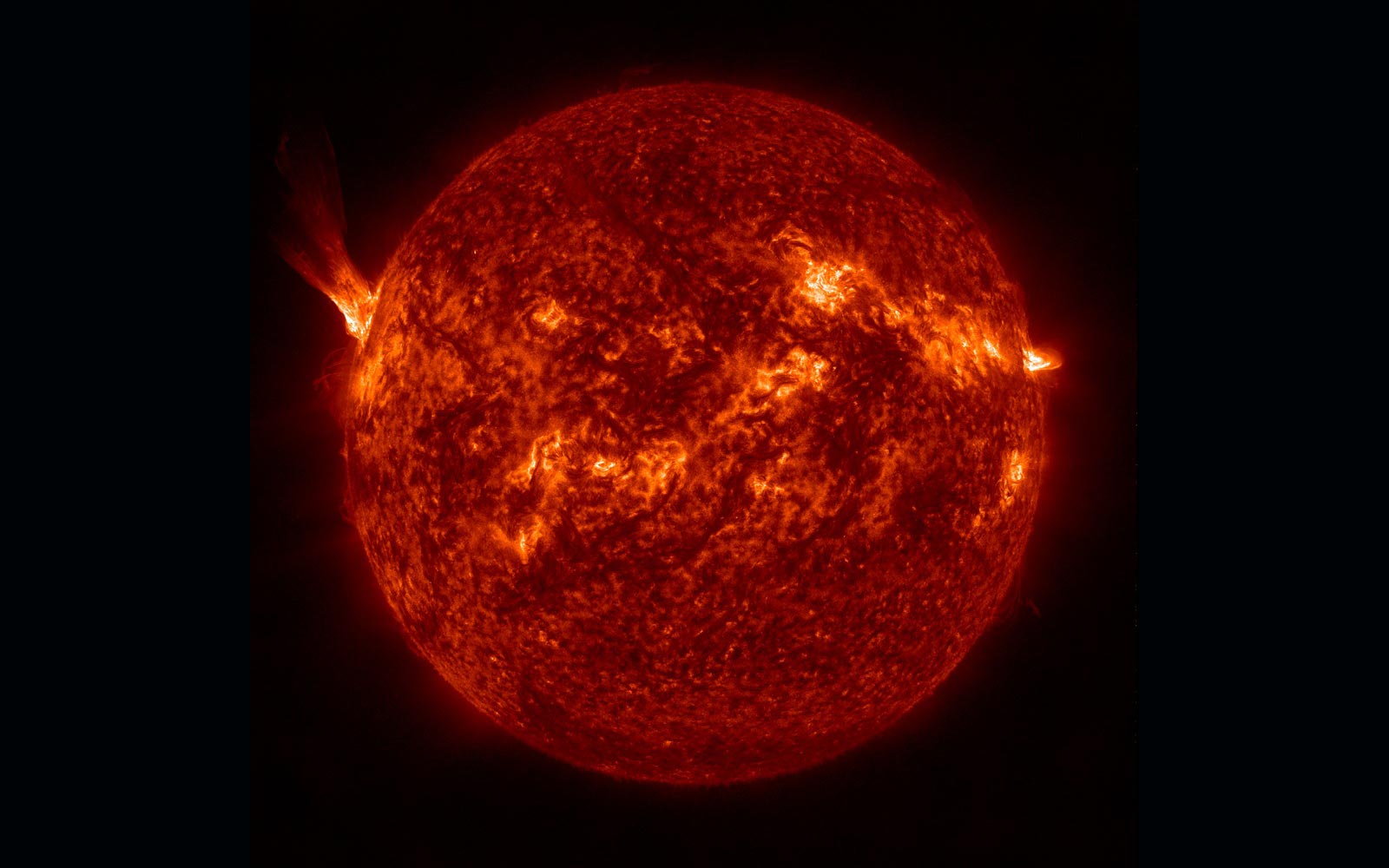
    NASA’s Solar Dynamics Observatory captured this view of a solar eruption on April 21, 2015. Credit: NASA/SDO

    Will the Sun become a black hole? No, it’s too small for that!

    The Sun would need to be about 20 times more massive to end its life as a black hole. Stars that are born this size or larger can explode into a supernova at the end of their lifetimes before collapsing back into a black hole, an object with a gravitational pull so strong that nothing, not even light, can escape. Some smaller stars are big enough to go supernova, but too small to become black holes — they’ll collapse into super-dense structures called neutron stars after exploding as a supernova. But the Sun’s not big enough for this fate, either: It has only about one-tenth of the mass needed to eventually become a neutron star.

    So what will happen to the Sun? In some 6 billion years it will end up as a white dwarf — a small, dense remnant of a star that glows from leftover heat. The process will start about 5 billion years from now when the Sun begins to run out of fuel.

    Like most stars, during the main phase of its lifetime, the Sun creates energy by fusing hydrogen atoms in its core. In about 5 billion years, the Sun will start to run out of hydrogen in its core to fuse, and it will begin to collapse. This will let the Sun start to fuse heavier elements in the core, along with fusing hydrogen in a shell wrapped around the core. When this happens, the Sun’s temperature will increase, and the outer layers of the Sun’s atmosphere will expand so far out into space that they’ll engulf Earth. (This would make Earth uninhabitable for life as we know it — though other factors in planetary evolution might make it uninhabitable before that point.) This is the red giant phase, and it will last about a billion years, before the Sun collapses into a white dwarf.

    Basic Facts About The Sun

    The sun is a star, a hot ball of glowing gases at the heart of our solar system. Its influence extends far beyond the orbits of distant Neptune and Pluto. Without the sun’s intense energy and heat, there would be no life on Earth. And though it is special to us, there are billions of stars like our sun scattered across the Milky Way galaxy. If the sun were as tall as a typical front door, the Earth would be the size of a U.S. nickel. The temperature at the sun’s core is about 27 million degrees Fahrenheit.

    • Average diameter: 864,000 miles (1,390,000 kilometers), about 109 times the size of the Earth.
    • Rotation period at equator: About 27 days.
    • Rotation period at poles: About 36 days.
    • Surface temperature: 10,000 degrees Fahrenheit (5,500 degrees Celsius).
    • Composition: Hydrogen, helium.

    Never miss a breakthrough: Join the SciTechDaily newsletter.
    Follow us on Google and Google News.

    Astrophysics Black Hole NASA NASA Goddard Space Flight Center Popular Sun
    Share. Facebook Twitter Pinterest LinkedIn Email Reddit

    Related Articles

    Twin Titans: NASA Tracks Two Monster Black Holes Tearing Up a Distant Galaxy [Video]

    Hypnotic New NASA Visualization Probes the Light-Bending Dance of Binary Black Holes

    Astronomers May Have Spotted a Nanoflare on the Sun – First Predicted 48 Years Ago to Solve a Major Mystery

    A New Look at Sunspots is Helping NASA Understand Life Around Other Stars

    Gas Far Outside of Our Galaxy Illuminated by Enormous Burst of Energy Unleashed by Milky Way’s Black Hole

    10 Amazing Discoveries About the Sun From NASA’s Solar Dynamics Observatory

    Understanding Black Holes: 5 Things to Know [Video]

    Magnetic Explosions Observed on Sun – Unlike Anything Seen Before [Video]

    5 Astonishing New Discoveries From NASA’s Parker Solar Probe [Video]

    1 Comment

    1. John H. POPENHUSEN on July 17, 2025 5:12 pm

      Our sun is too small to produce a black hole. However, could it explode and create a Neutron star?

      Reply
    Leave A Reply Cancel Reply

    • Facebook
    • Twitter
    • Pinterest
    • YouTube

    Don't Miss a Discovery

    Subscribe for the Latest in Science & Tech!

    Trending News

    Scientists Warn That This Common Pet Fish Can Wreck Entire Ecosystems

    Scientists Make Breakthrough in Turning Plastic Trash Into Clean Fuel Using Sunlight

    This Popular Supplement May Interfere With Cancer Treatment, Scientists Warn

    Scientists Finally Solved One of Water’s Biggest Mysteries

    Could This New Weight-Loss Pill Disrupt the Entire Market? Here’s What You Should Know About Orforglipron

    Earth’s Crust Is Tearing Open in Africa, and It Could Form a New Ocean

    Breakthrough Bowel Cancer Trial Leaves Patients Cancer-Free for Nearly 3 Years

    Natural Compound Shows Powerful Potential Against Rheumatoid Arthritis

    Follow SciTechDaily
    • Facebook
    • Twitter
    • YouTube
    • Pinterest
    • Newsletter
    • RSS
    SciTech News
    • Biology News
    • Chemistry News
    • Earth News
    • Health News
    • Physics News
    • Science News
    • Space News
    • Technology News
    Recent Posts
    • Scientists Debunk 100-Year-Old Belief About Brain Cells, Rewriting Textbooks
    • This Simple Home Device May Boost Brain Power in Adults Over 40
    • Ancient Roman Ship Coating Reveals Secrets Hidden for 2,200 Years
    • Enormous Prehistoric Insects Puzzle Scientists
    • College Student Identifies Bizarre New Carnivorous Dinosaur Three Times Older Than T. rex
    Copyright © 1998 - 2026 SciTechDaily. All Rights Reserved.
    • Science News
    • About
    • Contact
    • Editorial Board
    • Privacy Policy
    • Terms of Use

    Type above and press Enter to search. Press Esc to cancel.