
Close Menu
    Facebook X (Twitter) Instagram
    SciTechDaily
    • Biology
    • Chemistry
    • Earth
    • Health
    • Physics
    • Science
    • Space
    • Technology
    Facebook X (Twitter) Pinterest YouTube RSS
    SciTechDaily
    Home»Biology»Fascinating Study of Carnivorous Plants Captures Universal Rules of Leaf Making [Video]
    Biology

    Fascinating Study of Carnivorous Plants Captures Universal Rules of Leaf Making [Video]

    By John Innes CentreOctober 13, 2019No Comments3 Mins Read
    Facebook Twitter Pinterest Telegram LinkedIn WhatsApp Email Reddit
    Share
    Facebook Twitter LinkedIn Pinterest Telegram Email Reddit
    Carnivorous Plant Traps
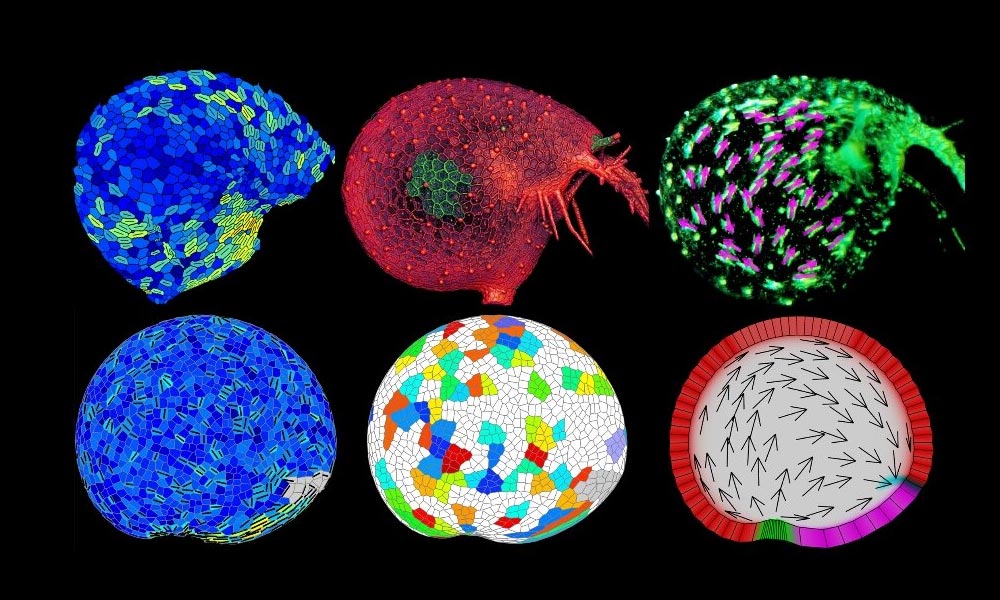
    Imaging and mathematical modeling of the bladderwort Utricularia gibba show how carnivorous plant traps shape themselves in 3D by growth oriented by a tissue polarity field. Credit: Karen Lee, Yohei Koide, John Fozard and Claire Bushell.

    Leaves display a remarkable range of forms from flat sheets with simple outlines to the cup-shaped traps found in carnivorous plants.

    A general question in developmental and evolutionary biology is how tissues shape themselves to create the diversity of forms we find in nature such as leaves, flowers, hearts, and wings.

    Study of leaves has led to progress in understanding the mechanisms that produce the simpler, flatter forms. But it’s been unclear what lies behind the more complex curved leaf forms of carnivorous plants.

    Previous studies using the model species Arabidopsis thaliana which has flat leaves revealed the existence of a polarity field running from the base of the leaf to the tip, a kind of inbuilt cellular compass which orients growth.

    To test if an equivalent polarity field might guide growth of highly curved tissues, researchers analyzed the cup-shaped leaf traps of the aquatic carnivorous plant Utricularia gibba, commonly known as the humped bladderwort.

    The team of Professor Enrico Coen used a combination of 3D imaging, cell and clonal analysis, and computational modeling to understand how carnivorous plant traps are shaped.

    These approaches showed how Utricularia gibba traps grow from a near-spherical ball of cells into a mature trap capable of capturing prey.

    By measuring 3D snapshots of traps at various developmental stages and exploring computational growth models they showed how differential rates and orientations of growth are involved.

    The team used fluorescent proteins to monitor cellular growth directions and 3D imaging at different developmental stages to study the changing shape of the trap.

    The computational modeling used to account for oriented growth invokes a polarity field comparable to that proposed for Arabidopsis leaf development, except that here it propagates within a curved sheet.

    Analysis of the orientation of quadrifid glands, which in Utricularia gibba are used for nutrient absorption, confirmed the existence of the hypothesized polarity field.

    The study which appears in the Journal PLOS Biology concludes that simple modulation of mechanisms underlying flat leaf development can also account for the shaping of more complex 3D shapes.

    One of the lead authors Karen Lee said, “A polarity field orienting growth of tissue sheets may provide a unified explanation behind the development of the diverse range of leaves we find in nature.”

    ###

    The study, done in collaboration with the group of Minlong Cui at Zhejiang University in China, appears in PLOS Biology: Shaping of a three-dimensional carnivorous trap through modulation of a planar growth mechanism.

    The work was funded by the European Research Council (Carnomorph grant number 323028) and the Biological Sciences Research Council (grant nos. BB/M023117/1, BB/L008920/1, BB/P020747/1 and BBS/E/J/000PR978

    Reference: “Shaping of a three-dimensional carnivorous trap through modulation of a planar growth mechanism” by Karen J. I. Lee, Claire Bushell, Yohei Koide, John A. Fozard, Chunlan Piao, Man Yu, Jacob Newman, Christopher Whitewoods, Jerome Avondo, Richard Kennaway, Athanasius F. M. Marée, Minlong Cui and Enrico Coen, 10 October 2019, PLOS Biology.
    DOI: 10.1371/journal.pbio.3000427

    Never miss a breakthrough: Join the SciTechDaily newsletter.
    Follow us on Google and Google News.

    Evolutionary Biology John Innes Centre Plant Science
    Share. Facebook Twitter Pinterest LinkedIn Email Reddit

    Related Articles

    How Ants Took Over the World

    The Hidden Secrets of Flowers – Understanding Floral Evolution

    Remarkable Regenerative Powers: Scientists Solve the Grass Leaf Conundrum

    Genetics Discovery Reveals How Legumes Give Oxygen to Symbiotic Bacteria in Their Roots

    Microbial Molecule Turns Plants Into Zombies: The Curse That Might Contain a Cure

    How Information Beyond the Genetic Sequence Is Encoded in Plant Sperm and Passed Down the Generations

    Solving a Long-Standing Biological Mystery: How Cells Measure Themselves

    Virus Infection Cycle Revealed in Incredible Dynamic Detail

    The First Frost Is the Deepest – New Discovery May Help Us Grow Crops in Fluctuating Climate

    Leave A Reply Cancel Reply

    • Facebook
    • Twitter
    • Pinterest
    • YouTube

    Don't Miss a Discovery

    Subscribe for the Latest in Science & Tech!

    Trending News

    Scientists Warn That This Common Pet Fish Can Wreck Entire Ecosystems

    Scientists Make Breakthrough in Turning Plastic Trash Into Clean Fuel Using Sunlight

    This Popular Supplement May Interfere With Cancer Treatment, Scientists Warn

    Scientists Finally Solved One of Water’s Biggest Mysteries

    Could This New Weight-Loss Pill Disrupt the Entire Market? Here’s What You Should Know About Orforglipron

    Earth’s Crust Is Tearing Open in Africa, and It Could Form a New Ocean

    Breakthrough Bowel Cancer Trial Leaves Patients Cancer-Free for Nearly 3 Years

    Natural Compound Shows Powerful Potential Against Rheumatoid Arthritis

    Follow SciTechDaily
    • Facebook
    • Twitter
    • YouTube
    • Pinterest
    • Newsletter
    • RSS
    SciTech News
    • Biology News
    • Chemistry News
    • Earth News
    • Health News
    • Physics News
    • Science News
    • Space News
    • Technology News
    Recent Posts
    • Kratom Use Explodes in the US, With Life-Changing Consequences
    • Scientists Uncover Fatal Weakness in “Zombie Cells” Linked to Cancer
    • World-First Study Reveals Human Hearts Can Regenerate After a Heart Attack
    • Why Your Dreams Feel So Real Sometimes and So Strange Other Times
    • Scientists Debunk 100-Year-Old Belief About Brain Cells, Rewriting Textbooks
    Copyright © 1998 - 2026 SciTechDaily. All Rights Reserved.
    • Science News
    • About
    • Contact
    • Editorial Board
    • Privacy Policy
    • Terms of Use

    Type above and press Enter to search. Press Esc to cancel.