
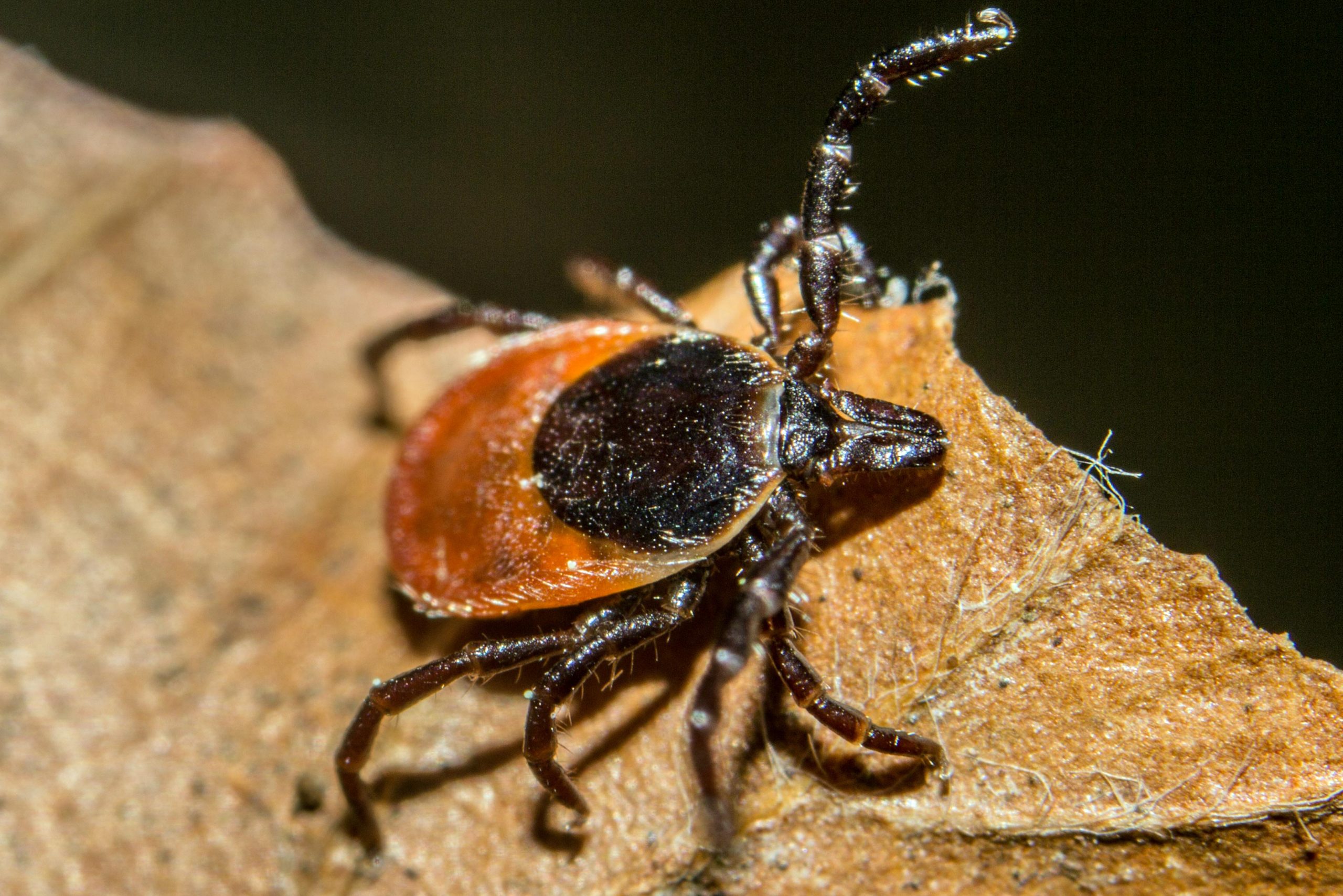
Raking leaves out to the yard edge may increase tick numbers there.
If you cleared fallen leaves from your lawn last fall, did you deposit them along the edge of your lawn, where grass meets woods? If you did, you might have unwittingly created an ideal habitat for blacklegged ticks.
In areas of the United States where ticks that carry Lyme disease-causing bacteria are prevalent, residential properties often intermingle with forested areas, and ticks thrive in the “edge habitats” where lawn and woods meet. While many homeowners heed the advice to clear their lawns of fallen leaves in autumn to avoid creating tick-friendly habitat in high-use areas, a new study on tick abundance in leaf litter says raking or blowing leaves just out to the forest edge is not enough.
“Our study showed that the common fall practice of blowing or raking leaves removed from lawns and landscaping to the immediate lawn/woodland edges can result in a three-fold increase in blacklegged tick numbers in these areas the following spring,” says Robert Jordan, Ph.D., research scientist at the Monmouth County (New Jersey) Mosquito Control Division and co-author of the study published today (March 18, 2020) in the Journal of Medical Entomology.
Instead, Jordan and co-author Terry Schulze, Ph.D., an independent medical entomologist, suggest homeowners either take advantage of municipal curbside leaf pickup (if available), compost their leaves, or remove leaves to a location further into the woods or further away from high-use areas on their property. “The thing homeowners need to keep in mind is that accumulations of leaves and other plant debris provide ideal host-seeking and survival conditions for immature blacklegged ticks,” says Jordan.
In their new study, Jordan and Schulze set up test plots on three residential properties in Monmouth County, New Jersey, in the fall of 2017 and 2018. Each property had plots at both the forest edge and deeper within the wooded area. Some edge plots were allowed to accumulate leaves naturally, while others received additional leaves via periodic raking or leaf blowing. These “managed” edge plots resulted in leaf-litter depths two to three times that of the natural edge and forest plots.
The researchers then compared the presence of nymphal (juvenile) blacklegged ticks (Ixodes scapularis) and lone star ticks (Amblyomma americanum) in the test plots the following spring. In both years, the results for lone star tick nymphs were inconsistent, but the number of blacklegged tick nymphs in the managed edge plots was approximately three times that of the natural edge and forest plots.
“While we expected to see more ticks along lawn edges with deeper leaf-litter accumulation, we were surprised about the magnitude of the increase in ticks that resulted from leaf blowing or raking,” Jordan says.
Fallen leaves provide blacklegged ticks with suitable habitat via higher humidity and lower temperatures within the leaf litter, as well as protection from exposure over winter. Previous research, meanwhile, has shown that people more commonly encounter ticks on their own properties than in parks or natural areas. And that, Jordan says, is a major reason why he and Schulze have been evaluating a variety of residential tick-prevention strategies in recent years. Landscape management is an important–and affordable–strategy to keep ticks at bay, he says.
“On properties with considerable leaf fall, the best option would be complete removal of leaves from areas most frequently used–such as lawns, outdoor seating areas, and in and around play sets,” Jordan says. “If this is not possible or practical, leaf piles should be placed in areas least frequently used. Where neither of these options is possible, or where leaf fall is minimal, mulching in place may be a good option, since this encourages rapid decomposition of leaves, which may reduce habitat suitability for ticks.”
Reference: “Artificial Accumulation of Leaf Litter in Forest Edges on Residential Properties via Leaf Blowing is Associated with Increased Numbers of Host-seeking Ixodes scapularis (Acari: Ixodidae) Nymphs” by Robert A Jordan and Terry L Schulze, Ph.D., 18 March 2020, Journal of Medical Entomology.
DOI: 10.1093/jme/tjaa033
Never miss a breakthrough: Join the SciTechDaily newsletter.
Follow us on Google and Google News.
1 Comment
The higher leaf density also would increase field mouse populations–the nymphal tick first host.