
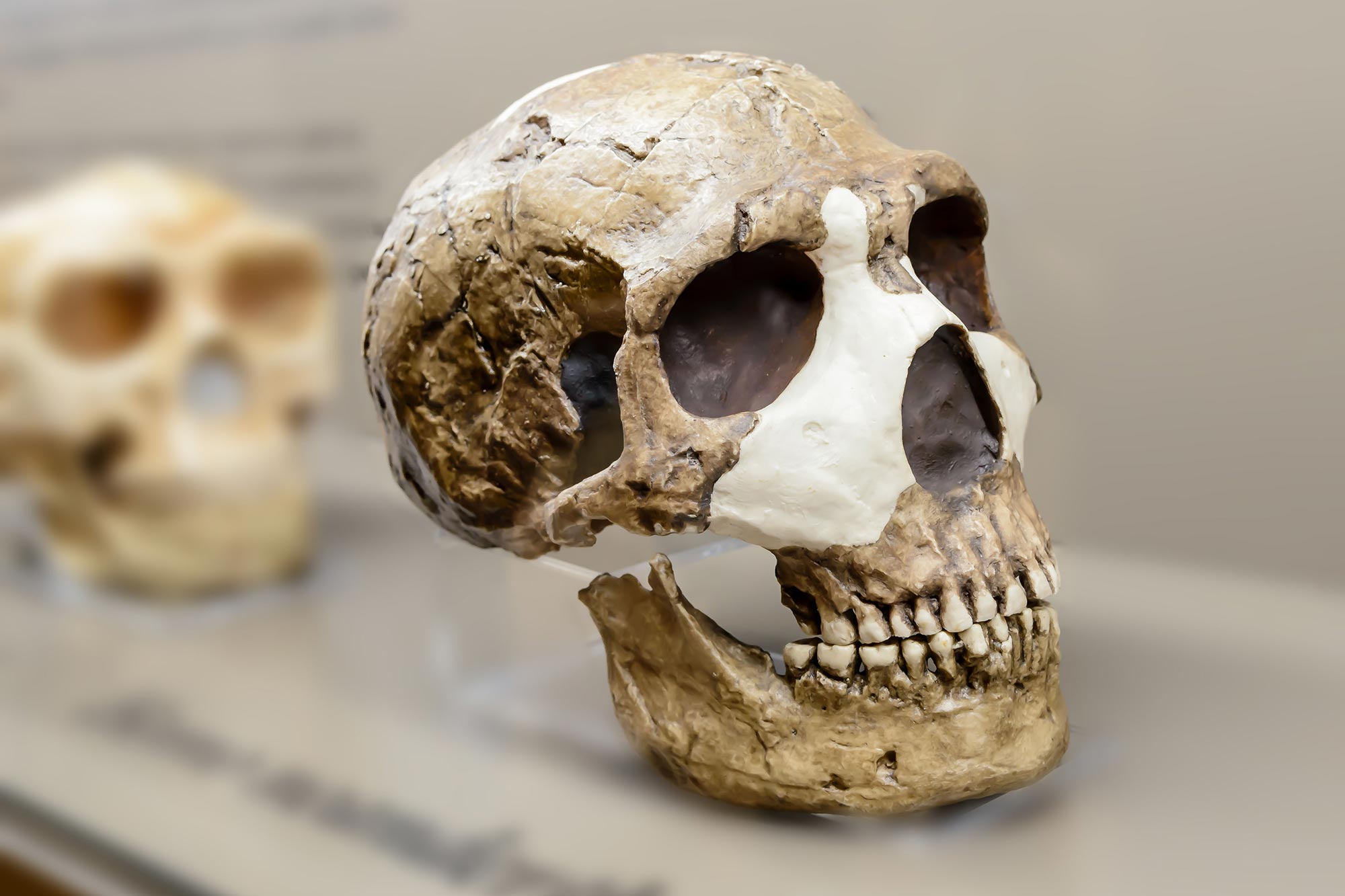
Homo sapiens’ interconnected networks gave them a survival edge over more isolated Neanderthals amid environmental changes.
A new modeling study suggests that stronger links between groups may have helped Homo sapiens outlast Neanderthals. Scientists still do not fully understand why Neanderthals disappeared while modern humans established a lasting presence in Europe. The explanation likely involves multiple factors, but this research introduces a new perspective using methods inspired by digital ecology.
The study was led by Ariane Burke, an anthropology professor at the Université de Montréal and head of the Hominin Dispersals Research Group in Quebec. Working with doctoral researchers Benjamin Albouy and Simon Paquin, she adapted tools commonly used to map plant and animal distributions and applied them to early human populations, drawing on both archaeological and ethnographic evidence.
The team focused on Europe during the last glacial cycle, between 60,000 and 35,000 years ago. This period was marked by major climate swings between colder (stadial) and warmer (interstadial) phases. It also includes the arrival of Homo sapiens in the archaeological record and the final disappearance of Neanderthals.
Climate, Competition, and Complex Factors
The findings suggest that neither climate stress nor direct competition alone can explain Neanderthal extinction. Instead, their decline appears to have resulted from a combination of environmental conditions, geographic constraints, population dynamics, and interactions between species, which varied across regions.
To investigate this, the researchers used species distribution models, which estimate where a species can live based on known locations. Instead of observing living animals, they used archaeological sites as indicators of where Neanderthals and Homo sapiens once lived.
The study involved several modeling steps. Burke first built four habitat suitability models for each species using techniques from conservation biology and geomatics. These models combined archaeological evidence with geographic data and measures of climate variability.
Mapping Ancient Human Habitats
She then compared the models to identify “core” regions, defined as areas large and productive enough to support stable populations and connected to other such regions.
“Obviously, we don’t have precise demographic data for populations living 35,000 years ago, so we used ethnographic data from better-documented ancient hunter-gatherer groups to set parameters for the geomatics tools and generate these models,” Burke explained. “For example, these data show that the typical annual territory of a local group of 25 to 50 individuals, moving seasonally and maintaining regional connections with other groups, would be about 2,500 km².”
At this stage, clear differences between Neanderthals and Homo sapiens began to emerge.
Connectivity Advantage of Homo Sapiens
Regions suitable for Homo sapiens were more interconnected than those associated with Neanderthals. Burke notes that this connectivity allowed populations to form networks, making it easier for individuals to move between related groups when facing environmental or demographic challenges.
“These networks act as a safety net,” explained Burke. “They allow for the exchange of information on resources and animal migrations, the forming of partnerships, and temporary access to other territories in the event of a crisis.”
She emphasized that Neanderthals also maintained connections across groups, as shown by the movement of materials and other archaeological evidence. However, the models indicate that these links were weaker, especially in Central and Eastern Europe.
Climate Variability and Human Survival
The research also found that rapid and unpredictable climate shifts had a greater impact on populations than steady changes in temperature or rainfall.
“Climate variability appears to have played a major role. So it turns out that humans have been sensitive to environmental variability throughout our history,” said Burke.
Still, climate alone cannot explain the disappearance of Neanderthals, since they survived earlier glacial periods.
Regional Differences in Neanderthal Decline
According to Burke, their extinction likely resulted from a combination of climate instability, population pressures, and social structure, with different factors playing larger roles in different regions.
The study indicates that Neanderthal populations in Europe were split into western and eastern groups.
In Eastern Europe, weaker connections may have left groups isolated as conditions worsened. On the Iberian Peninsula, however, stronger links between core regions may have helped populations survive longer.
Interactions Between Species and Legacy
The situation was likely even more complex.
“In western areas, the arrival of Homo sapiens may have added further stress, especially for Neanderthal populations that were already demographically vulnerable,” said Burke. “Because the two species were capable of producing offspring together, their interactions were likely complex, involving competition, occasional interbreeding, and other subtle population dynamics.”
Burke believes these findings also speak to broader human patterns.
“Human migration has always existed, facilitated by mobility and social networks,” she noted. “Even today, despite the complexities of borders, population densities, and social inequalities, humans continue to migrate for the same fundamental reasons: to find more favorable areas, reunite with loved ones, and join mutual aid networks.”
The results highlight a lasting lesson. As in the past, human survival depends not only on technology and intelligence but also on social connections.
Reference: “Spatial resilience and population replacement in Europe during MIS 3: a comparative study of Neanderthals and H. sapiens” by Ariane Burke, Emma Pomeroy, Timothée Poisot, Benjamin Albouy and Simon Paquin, 12 February 2026, Quaternary Science Reviews.
DOI: 10.1016/j.quascirev.2026.109850
Never miss a breakthrough: Join the SciTechDaily newsletter.
Follow us on Google and Google News.