
Neanderthal-Denisovan ancestors interbred with a distantly related hominin 700,000 years ago.
For three years, anthropologist Alan Rogers has attempted to solve an evolutionary puzzle. His research untangles millions of years of human evolution by analyzing DNA strands from ancient human species known as hominins. Like many evolutionary geneticists, Rogers compares hominin genomes looking for genetic patterns such as mutations and shared genes. He develops statistical methods that infer the history of ancient human populations.
In 2017, Rogers led a study that found that two lineages of ancient humans, Neanderthals, and Denisovans, separated much earlier than previously thought and proposed a bottleneck population size. It caused some controversy — anthropologists Mafessoni and Prüfer argued that their method for analyzing the DNA produced different results. Rogers agreed but realized that neither method explained the genetic data very well.
“Both of our methods under discussion were missing something, but what?” asked Rogers, professor of anthropology at the University of Utah.
The new study has solved that puzzle and in doing so, it has documented the earliest known interbreeding event between ancient human populations — a group known as the “super-archaics” in Eurasia interbred with a Neanderthal-Denisovan ancestor about 700,000 years ago. The event was between two populations that were more distantly related than any other recorded. The authors also proposed a revised timeline for human migration out of Africa and into Eurasia. The method for analyzing ancient DNA provides a new way to look farther back into the human lineage than ever before.
“We’ve never known about this episode of interbreeding and we’ve never been able to estimate the size of the super-archaic population,” said Rogers, lead author of the study. “We’re just shedding light on an interval on human evolutionary history that was previously completely dark.”
The paper was published today (February 20, 2020), in the journal Science Advances.
Out of Africa and interbreeding
Rogers studied the ways in which mutations are shared among modern Africans and Europeans, and ancient Neanderthals and Denisovans. The pattern of sharing implied five episodes of interbreeding, including one that was previously unknown. The newly discovered episode involves interbreeding over 700,000 years ago between a distantly related “super-archaic” population which separated from all other humans around two million years ago, and the ancestors of Neanderthals and Denisovans.
The super-archaic and Neanderthal-Denisovan ancestor populations were more distantly related than any other pair of human populations previously known to interbreed. For example, modern humans and Neanderthals had been separated for about 750,000 years when they interbred. The super-archaics and Neanderthal-Denisovan ancestors were separated for well over a million years.
“These findings about the timing at which interbreeding happened in the human lineage is telling something about how long it takes for reproductive isolation to evolve,” said Rogers.
The authors used other clues in the genomes to estimate when the ancient human populations separated and their effective population size. They estimated the super-archaic separated into its own species about two million years ago. This agrees with human fossil evidence in Eurasia that is 1.85 million years old.
The researchers also proposed there were three waves of human migration into Eurasia. The first was two million years ago when the super-archaics migrated into Eurasia and expanded into a large population. Then 700,000 years ago, Neanderthal-Denisovan ancestors migrated into Eurasia and quickly interbred with the descendants of the super-archaics. Finally, modern humans expanded to Eurasia 50,000 years ago where we know they interbred with other ancient humans, including the Neanderthals.
“I’ve been working for the last couple of years on this different way of analyzing genetic data to find out about history,” said Rogers. “It’s just gratifying that you come up with a different way of looking at the data and you end up discovering things that people haven’t been able to see with other methods.”
Reference: “Neanderthal-Denisovan ancestors interbred with a distantly related hominin” by Alan R. Rogers, Nathan S. Harris and Alan A. Achenbach, 20 February 2020, Science Advances.
DOI: 10.1126/sciadv.aay5483
Nathan S. Harris and Alan A. Achenbach from the Department of Anthropology at the University of Utah also contributed to the study.
Never miss a breakthrough: Join the SciTechDaily newsletter.
Follow us on Google and Google News.
16 Comments
H erectus? We know they persisted in South East Asia for a long time, what about Asia Minor? The more modern humans (neanderthal and denisovan) would have had breeding opportunities during the period when they were displacing the erectus population.
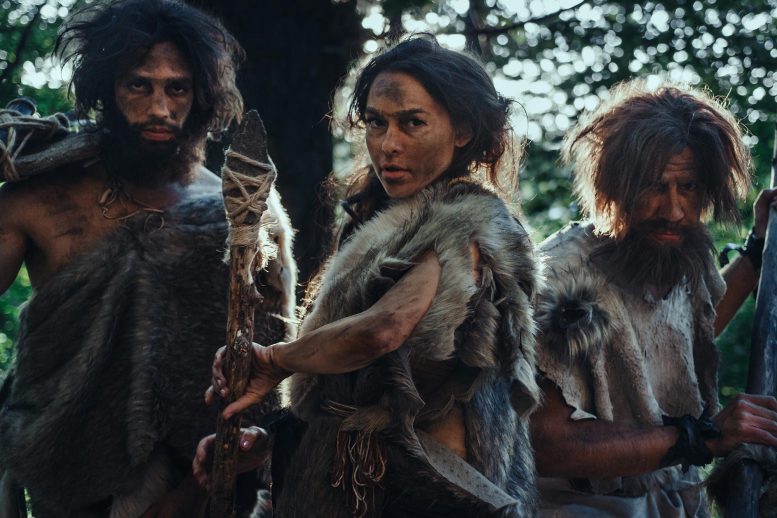
Interesting article. But the photo looks like something out of a 60s TV show.
According to the story of creation in the Bible, God created Adam and Eve and they had two sons, Cain and Able. Cain killed Able and was banished from the Garden of Eden and went to the land of “Nod”, where ever that is, and took a wife. So who were the people in the land of Nod? Probably Neanderthals. So Cain may have taken a Neanderthal woman for a wife and had children by her. We know that Humans and Neanderthals inbred because humans today carry Neanderthal DNA.
Does your brain hurt much?
You don’t think that an actual photograph from 700,00 years ago exists do you?
“Finally, modern humans expanded to Eurasia 50,000 years ago where we know they interbred with other ancient humans, including the Neanderthals.”
And modern humans are supposed to have migrated to Australia 65 000 years ago? H sapiens is alleged to have got to Papua New Guinea 40 000 years ago. Something doesn’t seem to make sense.
The model for species expansion proffered is consistently one of populations of homogeneous groups, or “tribes,” expanding on a trek out of an originating area through either migration or population expansion into other areas – new arrivals that change the scene.
It’s at least as reasonable to consider not migration, but rather evolution in place, as the means by which differentiated “species” appear in an area. Apes certainly could have had an expanded range all over Eurasia over a period of millions of years – differentiated by both geographic isolation of breeding groups and novel adaptations to vegetation and climate, predator and prey, across the variability of the span of territory they occupied.
Apes could well have formed the core breeding stock in an area from which humans of various types evolved independently, but unified by their common genetic base and perhaps constrained by the limited scope of the functional mutations allowable by nature.
The image of mass migrations of tribes of humans is not necessary to produce geographic diversity of a particular phenotype. Ape precursors could have expanded their range and formed the veneer of life from which the human variants evolved in place. We think of humans as “migratory” and nomadic, and apes as creatures content to sit in their jungle and munch bananas. But the mathematics of geographic expansion over the spans of time involved in human evolution belie that imagery.
A group of apes that expands its range by no more than a football field in the course of an entire year – 100 yards – would, over a thousand years, have expanded its range by 60 miles. By a million years, however, that’s three times around the earth. So a relatively leisurely drift, not involving a dedicated march from one place to another in the form of “exploration” could certainly, in these evolutionary periods under consideration, account for wide distribution thenceforth of in-place mutation and development of new “species.”
Wqe married goats Tunisia is not one it is losar
But, you notice how throughout the millions of years of interbreeding and evolution; today’s humans are just as ignorant and hateful towards others, as their ancient ancestors were; where “interbreeding” must have meant mass rape events, just as it does now, with the final show down on the near horizon that will test our ability to survive a nuclear war. I honestly don’t see what the humans have actually accomplished in the past 4 million years.
The whole evolution of humanity debate has to go back to the individuals who had spliced chromosomes changing their chromosome number. Is it possible that there were individuals with that mutation in several species that were only barely fertile in their population, but much more capable of producing fertile offspring when they happened to mate with another individual with the same mutation? In an environment with large numbers of individuals who were more or less similar to each other, it would still be amazing that any of those with what would amount to a trisomy would happen to encounter each other and produce offspring, but that would also explain the bottleneck. The others would have evolved into other species which either became the various great apes or became extinct.
An “ancient human species known as hominins.” Hominins refers to a group of species. I’ll read the rest of the article, but that is a basic definition that any enthusiast or expert would understand.
Do all of these hominins have the same chromosome number?
Are the super archaic humans a theoretical group that may have been the oldest ancestors of Homo sapiens that no one has yet found a single tooth or other type specimen of?
Изолированные племена, улучшают наследственно передавая технологии, обогащают словарный запас. расширяют применение местных ресурсов способы добычи пропитания. Но накапливают генетическую усталость. Наследственные болезни. В то время как подвижные группы смешиваясь с успешными племенами, адаптируются и ассимилируются весьма успешно. Обновление генетического фонда ведет к прогрессу. Как и сегодня.
I think the find is an incredible one! That many specimens in one area. It at least proves group living, family groups if you will. The DNA shows a close relationship. But if you are focusing entirely on the fact that they were enter breeding, perhaps due to infertility and they wanted to build their numbers. Well remember the biblical comment regarding Cain and Able? Think about this…When Eve took the fruit from the forbidden tree and God cast Adam and Eve from the garden of Eden, He said, “Go forth, become fruitful and Multiply!” He was ANGRY when he told them to do this! Perhaps there was a reason for their infertility. So, I do not think that is what it was. 😂😂
However, I find this all very interesting! The time gaps and the great distances between them. It really is fascinating!
I think the find is an incredible one! That many specimens in one area. It at least proves group living, family groups if you will. The DNA shows a close relationship. But if you are focusing entirely on the fact that they were enter breeding, perhaps due to infertility and they wanted to build their numbers. Well remember the biblical comment regarding Cain and Able? Think about this…When Eve took the fruit from the forbidden tree and God cast Adam and Eve from the garden of Eden, He said, “Go forth, become fruitful and Multiply!” He was ANGRY when he told them to do this! Perhaps there was a reason for their infertility. So, I do not think that is what it was. 😂😂
However, I find this all very interesting! The time gaps and the great distances between them. It really is fascinating!