
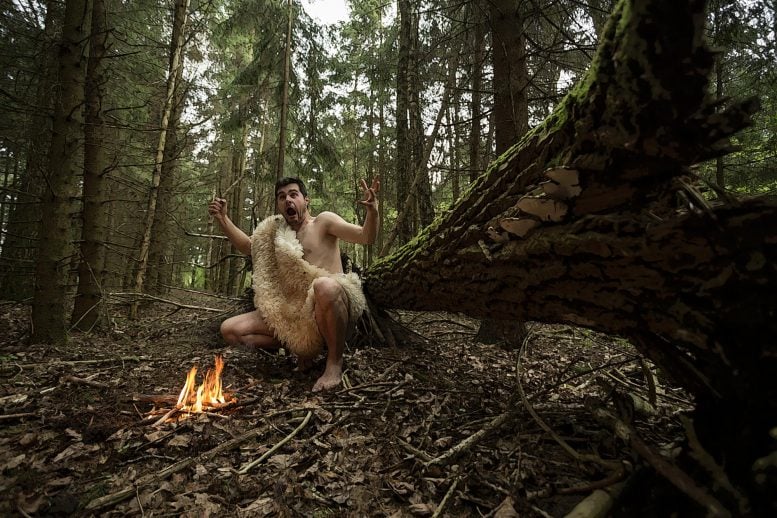
New study on early human fire acquisition squelches debate.
Fire starting is a skill that many modern humans struggle with in the absence of a lighter or matches. The earliest humans likely harvested fire from natural sources, yet when our ancestors learned the skills to set fire at will, they had newfound protection, a means of cooking, light to work by, and warmth at their fingertips.
Just when this momentous acquisition of knowledge occurred has been a hotly debated topic for archaeologists.
Now, a team of University of Connecticut researchers, working with colleagues from Armenia, the U.K., and Spain, has found compelling evidence that early humans such as Neanderthals not only controlled fire, but also mastered the ability to generate it.
“Fire was presumed to be the domain of Homo sapiens but now we know that other ancient humans like Neanderthals could create it,” says co-author Daniel Adler, associate professor in anthropology. “So perhaps we are not so special after all.”
Their work, published October 25, 2019, in Scientific Reports, pairs archaeological, hydrocarbon, and isotope evidence of human interactions with fire, with what the climate was like tens of thousands of years ago.
Using specific fire-related molecules deposited in the archaeological record and an analysis of climatological clues, the researchers examined Lusakert Cave 1 in the Armenian Highlands.
“Fire starting is a skill that has to be learned — I never saw anyone who managed to produce fire without first being taught. So the assumption that someone has the capability to set fire at will is a source of debate,” says Gideon Hartman, associate professor of anthropology, and study co-author.
The research team looked at sediment samples to determine the abundance of polycyclic aromatic hydrocarbons (PAHs), which are released when organic material is burned.
One type of PAH called light PAHs, disperse widely and are indicative of wildfires while others, called heavy PAHs, disperse narrowly and remain much closer to the source of fire.
“Looking at the markers for fires that are locally made, we start to see other human activity correlating with more evidence of locally-made fire,” says lead author Alex Brittingham, a UConn doctoral student in anthropology.
Evidence of increased human occupation at the site, such as concentrations of animal bones from meals and evidence of tool making, correlated with increased fire frequency and the increased frequency of heavy PAHs.
Researchers also needed to rule out the possibility that unsettled weather, which gives rise to lightning, had ignited the fires.
To do so, they analyzed hydrogen and carbon isotope composition of the waxy cuticles of ancient plant tissues preserved in sediments. The distribution of these leaf waxes indicates what kind of climate the plants grew in.
They could not find any evidence of a link between overall paleoclimatic conditions and the geochemical record of fire, says Michael Hren, study author and associate professor of geosciences.
“In order to routinely access naturally caused fires, there would need to have been conditions that would produce lighting strikes at a relative frequency that could have ignited wildfires,” says Hren.
By pairing the climate data with the evidence found in the archaeological record, the researchers then determined the cave’s inhabitants were not living in drier, wildfire-prone conditions while they were utilizing fires within the cave.
In fact, there were fewer wildfires for these ancient humans to harvest at the time when fire frequency and heavy PAH frequency were high in the cave, says Brittingham.
“It seems they were able to control fire outside of the natural availability of wildfires,” says Brittingham.
Brittingham is now applying the same research techniques to analyze other caves occupied by early humans. He is currently working with a team in Georgia, among other locations, to determine whether fire was developed independently by groups in different geographic areas.
“Was it something that people in Armenia could do but people in France could not do? Was it developed independently?” asks Brittingham.
###
Reference: “Geochemical Evidence for the Control of Fire by Middle Palaeolithic Hominins” by Alex Brittingham, Michael T. Hren, Gideon Hartman, Keith N. Wilkinson, Carolina Mallol, Boris Gasparyan & Daniel S. Adler, 25 October 2019, Scientific Reports.
DOI: 10.1038/s41598-019-51433-0
Additional authors include Keith N. Wilkinson, University of Winchester, U.K.; Carolina Mallol, Universidad de La Laguna, Tenerife, Spain; and Boris Gasparyan, National Academy of Sciences of the Republic of Armenia.
Funding for this project was provided by ACS-PRF 56306-ND2 and National Science Foundation NSFEAR-1338256 and by the Geological Society of America Graduate Student Research Grant, the L.S.B. Leakey Foundation, and the University of Connecticut Norian Armenian Programs Committee.
Never miss a breakthrough: Join the SciTechDaily newsletter.
Follow us on Google and Google News.
15 Comments
Intriguing
“Fire starting is a skill that has to be learned — I never saw anyone who managed to produce fire without first being taught. So the assumption that someone has the capability to set fire at will is a source of debate,” what a crock. Lame brain thinking.
What twaddle. The skill of fire-lighting was clearly discovered in 2000 by Tom Hanks in the film Castaway. So there.
And first evidence of rock n roll when he sang a song about fire
And farmers insurance was there.
If fire starting must be taught in order to accomplish
Who taught the first hominid to start a fire .
Who taught the teacher
That was a nonsensencle utterance from a educated but stupid person
Trivia 1: the first people who started fire had figured that out.
Trivia 2: they were unlikely to come up with the solution using theory of friction.
Given the above, we can think of what experience they were likely to have to make the connection. Knapping stones creates heat and sparks. Shaping objects (spears, drilling shell holes, rubbing stones to polish surfaces, and other activities unknown to us) may generate impressive heat. That may have ‘sparked’ an insight. Pre sapiens hominins might have the capacity and time to make successful connections. The interesting question is which one – was it erectus?
LEARN TO DISCERN.
SO, YET AGAIN, ANTHROPOLOGY DE-EVOLVES BACK TO “HEIDELBERGENSIS.”
FIND A BONE, GIVE IT A NAME.
NOW TELL US HAIR COLOR, FAVE TV SHOW, FRIENDS, AND THE NAME OF ITS’ PET ZEBRA.
ADD 100 YEARS: STILL WRONG !
FIRE CONTROL? KNAPPPING.
IDIOTS. OLDEST WORKED TOOL= FIRE.
From my own fascination with primitive fire starting, in my early teenage years through the present, I have made some observations..
Take away a ferrite rod and it’s nearly impossible to start a fire from a spark without a piece of iron or steel. A flint on flint spark just isn’t hot enough.
A friction fire on the other hand
I could see being discovered by accident.
If you try to make a hole in a piece of wood with a bow and a hard dowel, it is relatively easy to get smoke and a bit of hot black, smoking dust.
A bit of a breeze at the right time, and somebody notices some of this smoking dust start to glow.
Suppose Captain Cave Man start to get curious about this glowing stuff.
If he dumps it in his hand, he gets burned some times.
So he makes a little nest of dry grass to hold it while he studies it up close.
As he holds it close to his face he notices that trying to blow the smoke away makes it glow more… Andrew smoke more…
Strange…
Let’s make it glow a LOT.
This is pretty cool…
POOF!
You have discovered fire.
You run to get your fishing buddies to show them what you found .
By the time you get back, the tiny bit of grass is burned out..
Your buddies tell you that you are nuts, but you insist that you are telling me truth, and you show them.
Everyone stares in awe as another boy of grass disappears.
Ernie finishes his can of beer, crusher it and throws it over his shoulder.
*You know what would be really cool “?
” We could make a great big pile of grass and try using it to light up our bamboo hut tonight. While we are eating our fish.”
So it came to pass that ma.n invented fire, burned down his village and had his first fish fry.
His wife wouldn’t speak to him for a month, and his drinking buddies would forever after refer to him as ‘The God of Fire ‘.
Otzi the iceman had his firestarting kit with him when he froze, including flint, tinder, and pieces of iron pyrite with which to strike the flint. I know that was just over 5,000 years ago, but still pre-iron age and not friction, so iron pyrite will do the trick
AI or photoshopped image thumbnail
AI or photoshopped image thumbnail!!!! Italy sucks
AI or photoshopped image thumbnail!!!! Tunisia sucks
I’m impressed with the photo, I’m surprised they had colour that early.
You can use my name as a reference for pier review.