
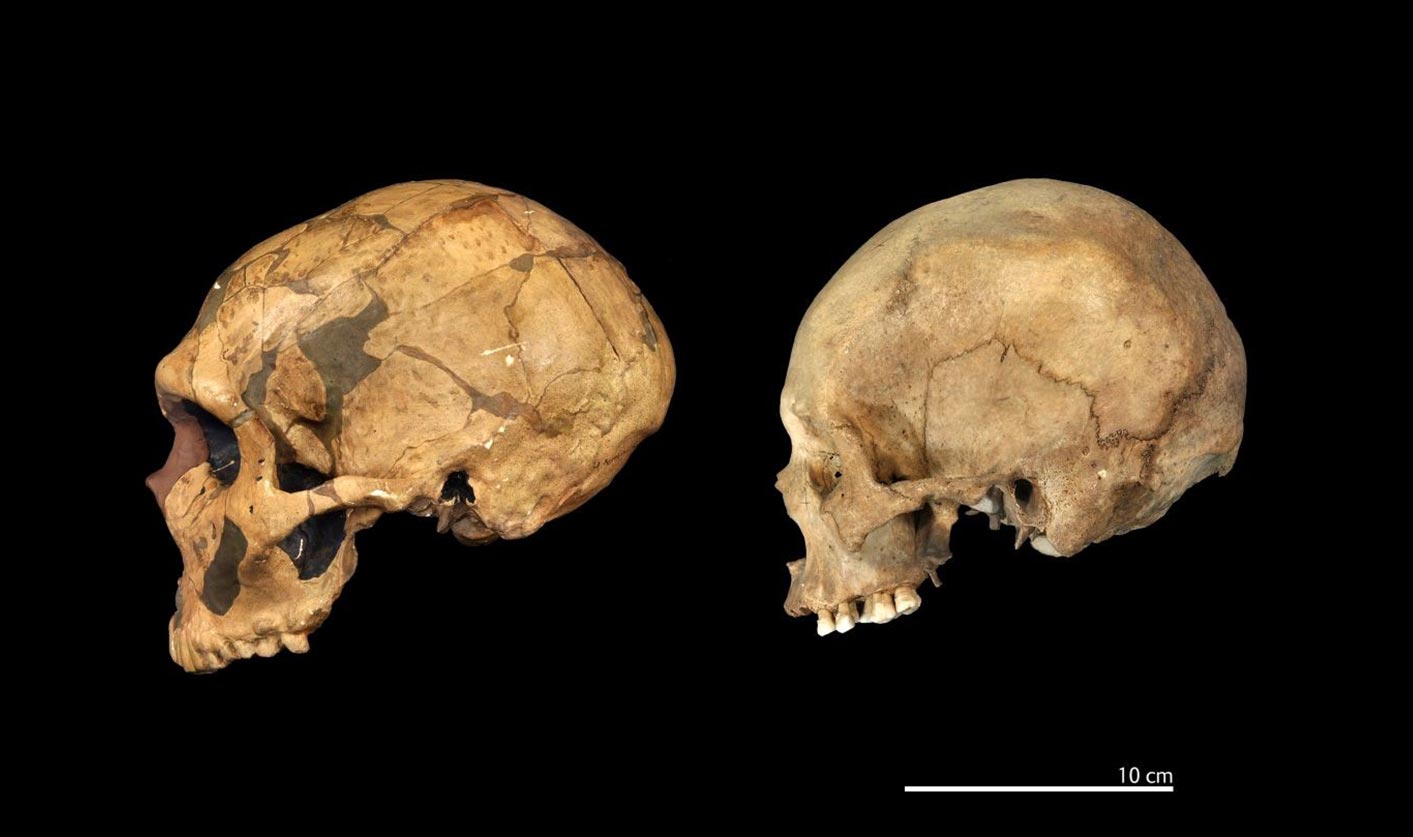
A study suggests that by the time H. sapiens expanded, the differentiation between the two species had progressed to the extent that they were distinct and recognizable as separate species.
A recent study conducted by researchers from London’s Natural History Museum and the Institute of Philosophy at KU Leuven has strengthened the argument that Neanderthals and modern humans (Homo sapiens) should be classified as distinct species to more accurately trace our evolutionary history.
Different researchers have different definitions as to what classifies as a species. It is undisputed that H. sapiens and Neanderthals originate from the same parental species, however studies into Neanderthal genetics and evolution have reignited the debate over whether they should be classed as separate from H. sapiens or rather a subspecies (H. sapiens neanderthalensis).
Evidence Supporting Species Distinction
Advocating the former, Chris Stringer (Natural History Museum, London) and Andra Meneganzin (Institute of Philosophy, KU Leuven, Belgium) state that despite the inherent limitations of the fossil record, there is enough morphological, ecological, genetic, and temporal evidence to justify this categorization, and claim that this evidence reflects the complexity of the speciation process, in which populations from one parent species progressively diverge to become different descendant species. Taxonomic disagreement, they claim, is best explained by how the speciation process is modeled in the record, rather than conflicts between evidence types.
Dr. Andra Meneganzin, Post-doctoral Fellow at the KU Leuven Institute of Philosophy and lead author of the study, says: “In the science of human origins, implicit and unrealistic theoretical assumptions can be just as limiting as the scarcity of data. Taxonomic disagreement over the classification of our species and Neanderthals offer a prime example of oversimplified expectations regarding the nature of speciation. Both in present and past taxa, speciation unfolds across space and time, through multiple stages involving the incremental acquisition of distinct characters. By reading the fossil records through the temporal and geographic dimensions that shaped past human diversity, available data can become increasingly informative rather than more limiting, and help move debates beyond unproductive deadlocks.
Professor Chris Stringer, Research Leader at the Natural History Museum and joint author of the paper, says: “In the context of Neanderthals and Homo sapiens, we need to regard speciation as a gradual process that occurred over more than 400,000 years. It is correct that the two interbred where they were not geographically separate, but over time differentiation continued to a point where the two were distinctly different species. When the Neanderthals died out around 40,000 years ago, the two species were in the final stage of the speciation process and were developing reproductive isolation from each other.”
Challenges in Mapping Speciation
Mapping speciation over a 400,000-year period from palaeontological and archaeological evidence has proven challenging for scientists, as in the later stages of speciation H. sapiens and Neanderthals continued to interbreed and exchange genes and behaviours. However, to reliably trace modern human evolution, categorizations need to be made about anatomical and geographical developments. The study claims that if interbreeding was the final word in determining species status, then hundreds of distinct species of mammals and birds today would have their separate species status revoked and that without recognizing patterns in evolution and subsequent categorization, the question of when a species first appeared becomes more intractable.
Fossil records show that H. sapiens developed in Africa, whilst Neanderthals evolved in Eurasia for at least 400,000 years, with interbreeding occurring as H. sapiens expanded out of the former region. However, the study argues that by the time of H. sapiens expansion and subsequent interbreeding, differentiation between the two species had occurred to the point where they were distinguishable species. One striking example of differentiation is that their ecological profiles were distinguishable and associated with “minimally different” habitats.
Neanderthals were better equipped to cope with colder climates – an adaptation which even today we have not yet fully developed without the use of technology. They had to be more physically active and for longer periods, to gather the resources they needed for survival, which helps to explain morphological differences including ribcage and pelvis shapes, inferring bigger internal organs such as the lungs, heart, and liver – amongst a wide range of anatomical distinctions. This may have been a factor in their extinction, as the more gracile skeleton of H. sapiens suggests a more economical physiology, less demanding of energy and resources, and aided by complex technology. This could have made the difference between survival and extinction when there was rapid climate change, or a strong competition for resources where the two coexisted.
An ever-evolving field of research, this bold new paper hopes to provide an explicit theoretical framework for future study, calling for a more nuanced chronological and evolutionary contextualisation of the available fossil record.
Reference: “Homo sapiens, Neanderthals and Speciation Complexity in Palaeoanthropology” by Andra Meneganzin and Chris Stringer, 14 November 2024, Evolutionary Journal of the Linnean Society.
DOI: 10.1093/evolinnean/kzae033
Never miss a breakthrough: Join the SciTechDaily newsletter.
Follow us on Google and Google News.
86 Comments
Yet, there are claims that we interbred!
Lions and Tigers are separate species that can interbreed…
Well that’s what we are then – the interbred between the sapiens and neanderthalensis. And we need a new name.
Ain’t that the truth.
Neanderman, Humanderthal…
Yes, and James Watson is 100% correct that there are huge differences in homo sapiens to justify reclassification as well.
This is Priceless… I want the choices on Federal Documents realigned!!! 👍🫡🤗
They never have been “the same soecies”, only the same genus.
Well all this seems to be old news that is gone unnoticed by the mainstream. All over you tube is the Graham Hancocks and the what’s his face with the big beard that is conceived that our ancient ancestors were more sophisticated than what the mainstream belives..I just read 5 articles that hl there case.
Prejudice prevails in this case. Much more to be discovered. We of the present day may be on our way out. Due to greed and disrespect of the living.
I uh gtfrrr㊗️
Don’t let the stripes distract you.
The study argues that Sapiens and Neandertals are seperate species, not shows, and in doing so, makes the distinction about species less important. It is not a new argument but a decades old argument. The concession that the two groups interbred makes me wonder what sciemtific purpose is served by the insistence that the two groups are different species
They can “cross” but not interbreed. The product is always a sterile female.
Think horses and donkeys. There are no mules descended from other mules.
It is clear that Neanderthal-cromagnon children could continue the lineage.
Then why does Neanderthals dna show up in our dna? The only way that could happen is thru having kids who passed it on thru the ages
There are male mules and mules do, on rare occasion, give birth. Look it up.
Yes but it is very rare and isn’t likely to produce a live birth. 9.5 x out of 10 mules are born sterile.
Science is just learning this. I have been talking and telling people this for nearly 60 years. They are just confirming what I already knew. The answers are in all of us if we can just get out of the way. Reduce the distractions of everyday life , the noise of life and allow the knowledge to come forth.
I thought that 2% was considered average. DNA search came back with 4%. I am Caucasian. Ancestors from Eastern Europe. Tall, thin lipped, no heavy brow yet somewhere in the evolution line my ancestry mixed with them.
I said the same thing to myself. And if they want to do a comparison why use a modern human skull. Get one from the same period.
Thank you for revealing your utter ignorance of science. Science isn’t “just learning this”, you moron. Scientific process requires rigorous evidence to back up a claim, and this evidence needs to be cross-checked and tested by independent researchers. Some President/CEO Shadow Mountain Productions LLC mouthing off unconfirmed hypotheses doesn’t count as evidence. If you weren’t home-schooled, you would probably know this.
Here’s the hitch: the progeny only occurs when the father is a Homo sapiens (sapiens). Either Neanderthal men couldn’t impregnate H.s.s. females or for some unknown reason, they didn’t leave their y chromosomes in our genomes. But Neanderthal maternal mitochondrial DNA persisted for a time gradually pushed out by modern mutations.
Eek I have that completely wrong… The Heck is correct 💯💯💯
Typically, hybrids are infertile, meaning that they don’t produce viable offspring. Thus, the hybrids are not self-sustaining. What I have read suggests that the H. sapiens and H. neanderthalensis did produce viable offspring with DNA offering proof.
The operative word is “typically”.
But their offspring can’t. So it’s a genetically dead end. It’s not the same.
Where is the basis for this assumption?
Their offspring are sterile and short lived. Neanderthals didn’t go extinct, they were absorbed. We are not separate species
I thought that 2% was considered average. DNA search came back with 4%. I am Caucasian. Ancestors from Eastern Europe. Tall, thin lipped, no heavy brow yet somewhere in the evolution line my ancestry mixed with them.
Prejudice prevails in this case. Much more to be discovered. We of the present day may be on our way out. Due to greed and disrespect of the living. I’m
Through gene te
sts, I discovered I have a little Neanderthal in my genetic makeup
Not more than most Caucasians and Asians.
Fortunately, I do not look like them, but that is true today of most Caucasians and Asians. I believe it probably boosted our immunities as well as hybrid vigour. Probably it was HS males who mated with N. females
And it did leave fertile, viable offspring
If they interbreed and had fertile children, then by definition they are the same species.
No. The definition of species is not dependent on that test.
Yes, Neanderthals and Homo Sapiens were similar enough to interbreed and leave offspring apparently healthy and fertile.
So the two species must have been
similar enough for that.
I imagine females of the two groups because of losing females in childbirth they were in short supply
It must have been HS males who mated with N. women for the most part.
What can I say?
Yeah but I have 3% Neanderthal DNA so they didn’t go extinct. Am I a separate species from a sub-saharan African?
Even SSA have Neanderthal DNA.
No. Whyever would you think that? Some Subsaharan Africans do have Neanderthal DNA, because they moved into Europe and then back again, or rather their ancestors did. In any case, having 3% of dna from a different species is not enough to make you a different species to Subsaharan Africans.
We did.
That’s proven, the have skeletal evidence.
Yes, dumdum. Not just claims, but genomic evidence.
These “claims” are well supported by evidence carried within the DNA of humans across the planet. I am unaware of any scientist who works in the field who disputes this finding.
Neanderthals didn’t go extinct. Check your DNA. If we’re going to classify them as a separate species then we need to redefine the word “species”. Neanderthal morphology disappears from the fossil record 40kya because we assimilated them. They are us. “H. sapiens neanderthalensis” works just fine as a recognition of their distinct morphology and culture.
We did classify them as a separate species. About a hundred years ago. But they only invented click-bait late in the last millennium. And to make it perfect, we only have this generation of kids finally being ignorant enough to support this crap Idiocracy!
That’s not what was just proven but yes of course you must be right.
Did you even read the story ffs?
Did you intentionally ignore the fact that KU means Catholic University of Leuven or were you just unaware?
And it’s an institute for *philosophy* on top of that, so one has to really worry about the “science” in their methods.
Dear Mr Bryan Schear, you are likely to be both right and wrong about Neanderthals but in different spatial and time eco zones. Let me explain. Going by the age range and spatial spread of fossils of Neanderthals and Homo Sapiens, thete appear to be three space-time zones, first being Eurasia before arrival of Homo Sapiens exclusively peopled only by Neanderthals, second parts of Eurasia in some when and where both Neanderthals and Homo Sapiens both overlappingly coexisted and interbred, and third parts of some space-time zones of Eurasia when snd where Neanderthals and Homo Sapiens co existed Neanderthals in mutually exclusive zones without interbreeding. Mr Schear is correct about interbreeding and assimilation only about the second zone and wrong about the third zone where in the space-time zone where Neanderthals lived exclusively after Homo Sapiens migrated to Eurasia the Nesnderthals died out possibly due to being pushed to harsher and remote areas of Eurasia where they died out, the first zone 👌🏼being out of our discussion purview here. In my view migration, separation snd isolated evolution of even the same species or related sub species have caused physical mutations beyond a limit where inter breeding stops and causes separation and formation of new species within the same genus that do not interbreed but which evolve separately or if unable to evolve in a harsh spatial zone become extinct gradually.
Sounds like you’re beating around the genetic fallacy bush. The authors, one not from KU, are imminently qualified to speak on a topic regarding biological taxonomy and speciation and presenting arguments and conclusions therefrom. The researcher from KU has doctoral backgrounds in both philosophy and hardcore biological science, both fields valuable in making an informed contribution to such a gnarly epistemological discussion.
Stringer has been anti Neanderthal since his earliest writings. He’s had to suck the lemon on multiple occasions as new anthropological archeology arises. Believe nothing he writes! His bias for a scientist is astounding.
Seems to me that how one chooses to define ‘different species’ makes the difference. Bison and cattle can be called subspecies of a spectrum that includes many different breeds of cattle and several non-domesticated species. In the same way, we can choose to ignore the possibility that many of the ancestors of our species were probably people we choose to call something other than people.
I wonder how the skeleton of a “pure” Australian Aboriginal would compare with that of a “pure” Greenland Eskimo? Especially if we used bits of one of the two Mungo skeletons found? Or bits of those Kau Creek skulls.
And yet, I learned not so long ago in this very magazine not only that there’s a neanderthal part in our DNA, but that it’s been linked to autism in people.
Exactly.
Neanderthals were simply humans with genetic disorders. They are not a different species. Also, adaptation is not evolution. Evolution has never been, and never will be, observed. It simply doesn’t exist. The Bible is clear on our origins.
Without positing a 𝘮𝘦𝘤𝘩𝘢𝘯𝘪𝘴𝘮, biological stratigraphy is very clear about evolution. The Bible has nothing to say about stratigraphy. The topic of sttratigraphy has never been observed in the Bible.
*the topic of stratigraphy…
Halelujah! Praise the lord and all that lickspittle for unseen imaginary entities!
Oh, the BIBLE is clear on our origins? Why didn’t you say before? Might as well all pack it in and go home! End of discussion, aye? – sheesh!
Yes, Neanderthals and Homo Sapiens were similar enough to interbreed and leave offspring apparently healthy and fertile.
So the two species must have been
similar enough for that.
I imagine females of the two groups because of losing females in childbirth they were in short supply
It must have been HS males who mated with N. women for the most part.
What can I say?
“Neanderthals were simply humans with genetic disorders.”
Where in the bible did you find that? It is also news to me that the various writers of the bible, who existed well before Gregor Mendel, knew anything about about genetics, let alone their disorders.
The Old Testament writers knew enough about rape, pillage and murder. Sounds familiar. If one goes back to Adam and Eve and their two sons………..a certain logic says something about behaviour beyond the pale in modern society and includes the potential genetic danger of inbreeding.
No, it was N males with HS females.
Which bible?
David,
Your beliefs are. entirely your own affair.
However, taking the biblical account of Genesis is your own fallacy.
And a whole bunch of geneticist and other scientists really do vehemently disagree with you as do I.
Due to genetic testing and fossil discoveries
evolution does for our species and all others,
like it or not.
Dave, did someone “teach” you that, in a classroom setting. Or was it part of your religious instruction?
Species – a group of individuals that are capable of interbreeding and producing viable offspring. This is a basic biology definition. If Neanderthals are a different species,why not the different races on earth currently? Are these Nazi scientists pushing this idea?
They’re just trying to get attention, Look what happened when they tried to demote pluto. Bad attention is still attention.
That isn’t the main definition of ‘Species’. Knowledge has moved on.
We still have knuckle dragging neanderthals around they are the Russian orcs.
Now about the USA’s recent presidential elections……
I’m totally confused by this. When were homo sapiens and neanderthal NOT different species???? I noticed in the comments that someone pointed out that we interbred with neanderthals and wondered if that made us a hybrid species. Well, sort of yes and mainly no. Speciation is messy and subjective. A mother never gives birth to a child who is not of the same species and yet, over many many generations, you can look back and see differences that you might decide are worthy of a new species. So there are many examples of inter species mating producing viable offspring. We should always remember that when looking at fossils, we are looking at a snapshot. If we had found a different fossil from a different point in development, we might well have classified the species differently. As I said, speciation is messy!
Ever herd of the herring gull; I think that is the bird. It spans the northern hemisphere from Alaska to Siberia via Europe and neighbouring populations of gulls can copulate with those living next door and can produce chicks that are healthy. But by the time we get to Vladivostok of wherever in Siberia it seems that they can’t breed with those in Alaska. That was back in the Scientific American way back when I was a young ‘un. Senator McCarthy would have approved; red genes in the land of blue jeans! Heavens to Betsy, Martha!
No doubt that type of restricted breeding could happen amongst we humans. Thank goodness for sailing ships for helping us iron-out globally the kinks in our DNA.
Now about the lack of cold adaptation in H sapiens: ever heard about the Yaghan indians of the Magellan Strait and Patagonia? They were very well adapted to a living naked in a hypothermic climate until our sailing ships turned up with European diseases including influenza and venereal disease.
Actually, most of them were shot, hunted down like animals by the men from the sailing ships.
Did the homo sapiens find the Neanderthals repulsive? Were they somewhat desperate,or simply sociable? We will never know,of course,but it appears indisputable that we were not separate species
Actually, most of them were shot, hunted down like animals by the men from the sailing ships.
I doubt it. They would have admired their physical strength. I don’t find them repulsive at all, but then I like big noses.
I still sleeping with those people lol..
Perhaps an punjabi gene helps lmfao
Although Neanderthal DNA is present in the human nuclear genome, Neanderthal mitochondrial DNA has not been observed in humans. Mitochondria are passed from the mother to the offspring. So we have not yet found human’s who had a Neanderthal great^x grandmother, although many of us seem to have had Neanderthal great^x grandfathers.
This would suggest that Neanderthal/human hybrids were only partially viable – that only hybrids with a Neanderthal father and a human mother were capable of leaving offspring.
Good answer I was unaware of that information and I often argue the point of offspring viability as indication sapiens, and Neanderthals being the same or subspecies but that information on the viability in light of mitochondria dna is provocative.
I don’t agree with the article state that species differentiation was almost complete during Neanderthals extinction because if I’m not mistaken, isn’t most of the crossbreeding occur during there decline into extinction
Or that it was mostly Neanderthal men mating with HS women.
Between this setup for “The people who have Neanderthal admixture (Europeans) are of a different sort than people that don’t” and the recent push for the theory humans originated in Europe not Africa, it’s clear the scientific r/a/cism narrative machine of old is getting ready to be re-oiled and cranked on again
The moment I read a word like “undisputed” in a science article, I skip the rest of the article as it is no longer a science article.
Stick to science only ! The “bible” is not going to prove anything . No fictional old tale is !!!
Stick to science regarding this issue . Leave the “Bible” out out of this ! Nothing will be proved by old fictional “tales ” !
Prejudice prevails in this case. Much more to be discovered. We of the present day may be on our way out. Due to greed and disrespect of the living by the rich.
More likely the disrespect of the rich by the living. Jealousy and backbiting are the fuse that ultimately blows up a society bereft of heroes to emulate.
No one is suggesting that 2% of Neanderthal makes someone a different species. Many in Africa have Neanderthal blood too. They crossed into Europe and some went back to Africa, or rather their ancestors did.
I recall reading a long time ago that the modern Herring Gull could breed with its next door neighbour all the way from the UK to far Siberia but the far-flung Siberian Herring Gull could not breed with its cousin in the UK. Which is saying a lot about genetic variation across distance.