
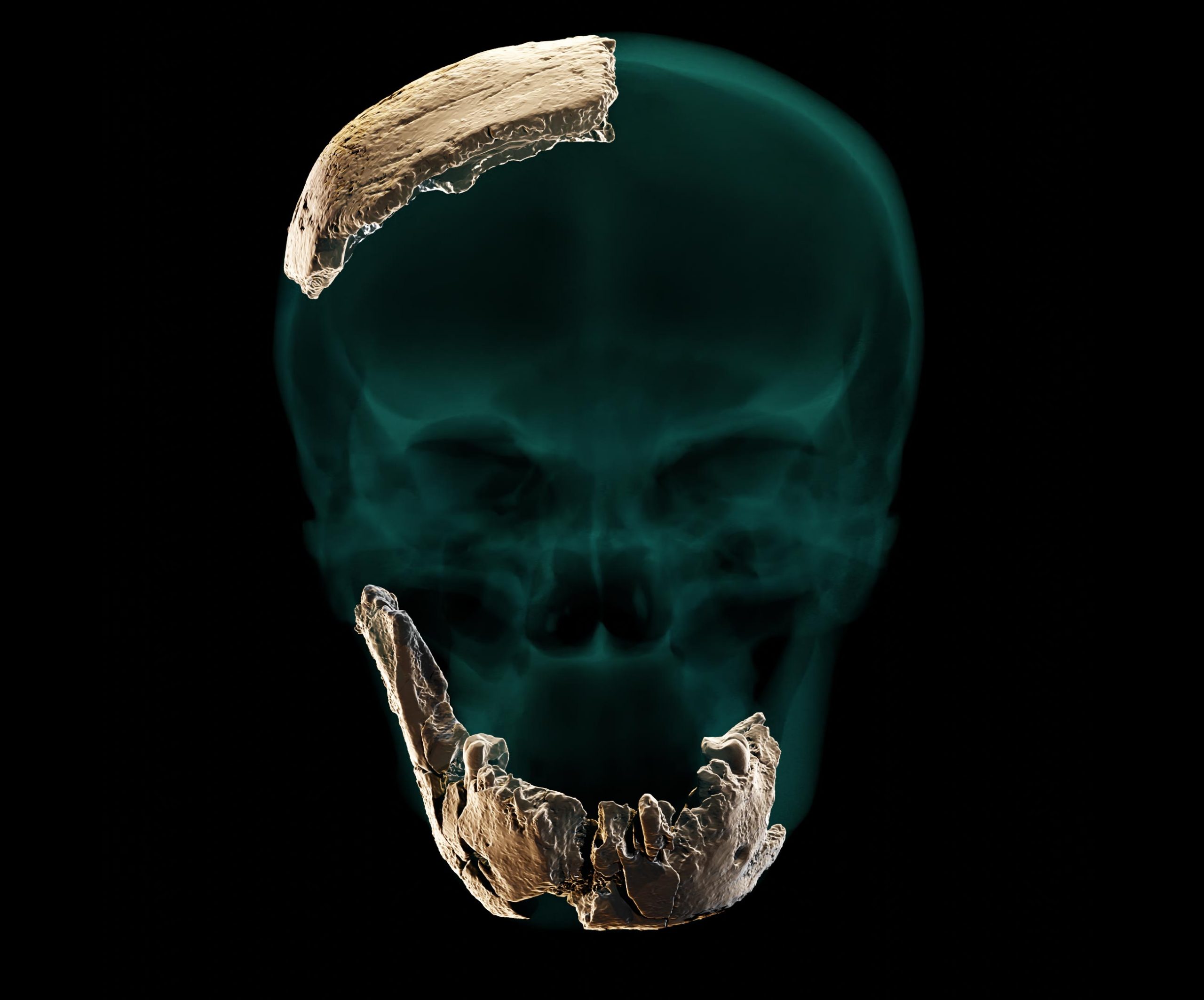
The Nesher Ramla Homo, an archaic hominin group found in Israel, reveals a complex intermingling of Eurasian and African hominins 140,000 years ago, altering perceptions of Neanderthal origins.
Researchers have uncovered a previously unknown population of archaic hominins, named “Nesher Ramla Homo,” at a recently excavated site in Israel. Dating back approximately 140,000 to 120,000 years ago, this group appears to represent the last survivors of Middle Pleistocene Homo. They exhibit a unique blend of Neanderthal and archaic human traits and technologies.
It’s been assumed that Neanderthals originated and thrived on the European continent well before the arrival of modern humans. However, recent evidence suggests a genetic contribution from a yet unknown non-European group, indicating a long and dynamic history of interaction between Eurasian and African hominin populations.
Eurasian and African Hominin Interactions
Here, Israel Hershkovitz, Yossi Zaidner, and colleagues present fossil, artifact, and radiometric evidence from the Levant region of the Middle East that illustrates this complexity. According to Hershkovitz et al., the newly discovered Nesher Ramla Homo exhibits anatomical features that are more archaic than contemporaneous Eurasian Neanderthals and the modern humans who also lived in the Levant. The findings indicate that this archaic lineage may represent one of the last surviving populations of Middle Pleistocene Homo in southwest Asia, Africa, and Europe.
Archaeological Context and Cultural Interactions
In the companion study, Zaidner et al. provide the archaeological context of the new fossils, reporting on the associated radiometric ages, artifact assemblages, and the behavioral and environmental insights they offer. The researchers show that the Nesher Ramla Homo were well-versed in technologies that were previously only known among H. sapiens and Neanderthals. Together, the findings provide archaeological support for close cultural interactions and genetic admixture between different human lineages before 120,000 years ago. This may help explain the variable expression of the dental and skeletal features of later Levantine fossils.
“The interpretation of the Nesher Ramla fossils and stone tools will meet with different reactions among paleoanthropologists. Notwithstanding, the age of the Nesher Ramla material, the mismatched morphological and archaeological affinities, and the location of the site at the crossroads of Africa and Eurasia make this a major discovery,” writes Marta Lahr in an accompanying Perspective.
For more on this research, see A Prehistoric Human Type Previously Unknown to Science.
References:
“A Middle Pleistocene Homo from Nesher Ramla, Israel” by Israel Hershkovitz, Hila May, Rachel Sarig, Ariel Pokhojaev, Dominique Grimaud-Hervé, Emiliano Bruner, Cinzia Fornai, Rolf Quam, Juan Luis Arsuaga, Viktoria A. Krenn, Maria Martinón-Torres, José María Bermúdez de Castro, Laura Martín-Francés, Viviane Slon, Lou Albessard-Ball, Amélie Vialet, Tim Schüler, Giorgio Manzi, Antonio Profico, Fabio Di Vincenzo, Gerhard W. Weber and Yossi Zaidner, 25 June 2021, Science.
DOI: 10.1126/science.abh3169
“Middle Pleistocene Homo behavior and culture at 140,000 to 120,000 years ago and interactions with Homo sapiens” by Yossi Zaidner, Laura Centi, Marion Prévost, Norbert Mercier, Christophe Falguères, Gilles Guérin, Hélène Valladas, Maïlys Richard, Asmodée Galy, Christophe Pécheyran, Olivier Tombret, Edwige Pons-Branchu, Naomi Porat, Ruth Shahack-Gross, David E. Friesem, Reuven Yeshurun, Zohar Turgeman-Yaffe, Amos Frumkin, Gadi Herzlinger, Ravid Ekshtain, Maayan Shemer, Oz Varoner, Rachel Sarig, Hila May and Israel Hershkovitz, 25 June 2021, Science.
DOI: 10.1126/science.abh3020
Never miss a breakthrough: Join the SciTechDaily newsletter.
Follow us on Google and Google News.
4 Comments
Thank you for this dearth of information. Please send me all articles re: Neanderthals, Denisovians,
It. fantastic thank.s so much for that
You may want to look up the current definition of the word “dearth”.
(You may not have used it in the way you intended.)
Unfortunately, this sounds like the same archaeological site that was discovered earlier this year and then disturbed by removing the bone fragments found within it, and putting them in storage, thus, essentially destroying the archeological integrity of the site for what I would guess would be for political reasons; a typical huminin practice among modern huminins.