
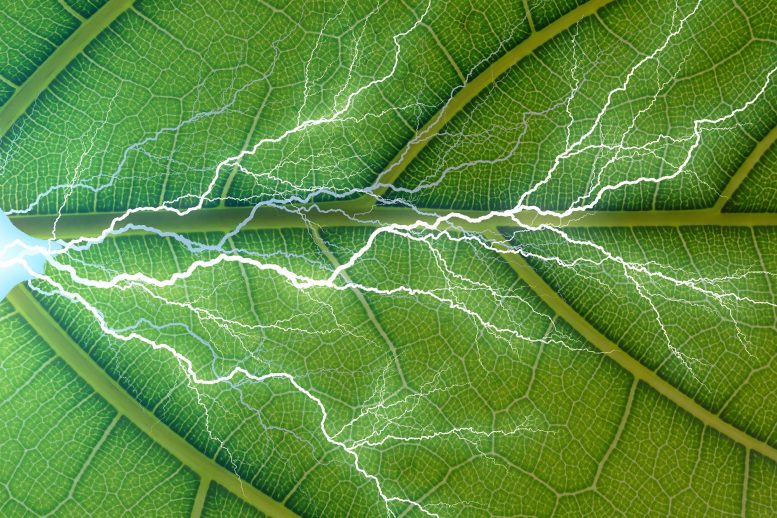
At the 245th National Meeting & Exposition of the American Chemical Society, Dr. Nocera described recent advances in the “artificial leaf,” such as the ability to self-heal and the use of less-expensive materials that are simple and inexpensive to mass produce.
Another innovative feature has been added to the world’s first practical “artificial leaf,” making the device even more suitable for providing people in developing countries and remote areas with electricity, scientists reported here today. It gives the leaf the ability to self-heal damage that occurs during production of energy.
Daniel G. Nocera, Ph.D., described the advance during the “Kavli Foundation Innovations in Chemistry Lecture” at the 245th National Meeting & Exposition of the American Chemical Society, the world’s largest scientific society. About 14,000 scientists and others are expected for the meeting, which continues through Thursday with almost 12,000 reports on advances in science.
Nocera, leader of the research team, explained that the “leaf” mimics the ability of real leaves to produce energy from sunlight and water. The device, however, actually is a simple catalyst-coated wafer of silicon, rather than a complicated reproduction of the photosynthesis mechanism in real leaves. Dropped into a jar of water and exposed to sunlight, catalysts in the device break water down into its components, hydrogen and oxygen. Those gases bubble up and can be collected and used as fuel to produce electricity in fuel cells.
“Surprisingly, some of the catalysts we’ve developed for use in the artificial leaf device actually heal themselves,” Nocera said. “They are a kind of ‘living catalyst.’ This is an important innovation that eases one of the concerns about initial use of the leaf in developing countries and other remote areas.”
Nocera, who is the Patterson Rockwood Professor of Energy at Harvard University, explained that the artificial leaf likely would find its first uses in providing “personalized” electricity to individual homes in areas that lack traditional electric power generating stations and electric transmission lines. Less than one quart of drinking water, for instance, would be enough to provide about 100 watts of electricity 24 hours a day. Earlier versions of the leaf required pure water, because bacteria eventually formed biofilms on the leaf’s surface, shutting down production.
“Self-healing enables the artificial leaf to run on the impure, bacteria-contaminated water found in nature,” Nocera said. “We figured out a way to tweak the conditions so that part of the catalyst falls apart, denying bacteria the smooth surface needed to form a biofilm. Then the catalyst can heal and re-assemble.”
Nocera said that about 3 billion people today live in areas that lack access to traditional electric production and distribution systems. That population will grow by billions in the decades ahead. About 1 billion people in the developing world already lack reliable access to clean water. Thus, a clear need exists for a simple device like the artificial leaf that’s compatible with local conditions.
“It’s kind of like providing ‘fast-food energy,’” he noted. “We’re interested in making lots of inexpensive units that may not be the most efficient, but that get the job done. It’s kind of like going from huge mainframe computers to a personal laptop. This is personalized energy.”
Earlier devices used rare, costly metals and other materials, involved complicated wiring and were expensive to manufacture. But Nocera’s artificial leaf uses less-expensive materials and incorporates a design — a so-called “buried junction” — that is simple and would be inexpensive to mass produce. And the leaf has advantages over solar panels, which are costly and produce energy only during daylight hours. The leaf’s hydrogen and oxygen, in contrast, can be stored and used at night.
“A lot of people are designing complicated, expensive energy-producing devices, and it is difficult to see them being adopted on a large scale,” he said. “Ours is simple, less expensive, and it works. And with that, I think we’ve changed the dialog in the field.”
Among the team’s priorities for further development of the device: integrating it with technology for converting the hydrogen into a liquid fuel that could run traditional portable electric generators or even cars.
Nocera acknowledged research funding from the National Science Foundation, the Department of Energy and the Air Force Office of Scientific Research.
Never miss a breakthrough: Join the SciTechDaily newsletter.
Follow us on Google and Google News.
1 Comment
Imagine creating a leaf that can break down Carbon Dioxide into its base elements, terraforming Mars here we come 🙂