
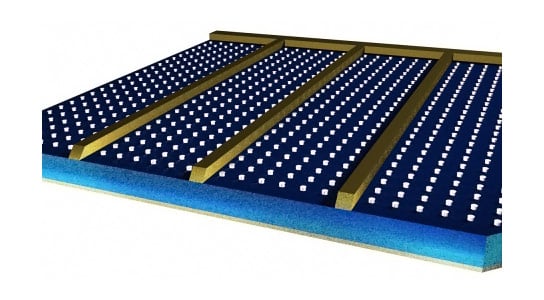
Scientists at the Imperial College London have shown that the efficiency of solar panel designs can be improved by up to 22 percent by covering their surface with aluminum studs.
Most solar cells used in homes and industry are made using thick layers of material to absorb sunlight, but have been limited in the past by relatively high costs. Many new, lower-cost designs are limited as their layer of light-absorbing material is too thin to extract enough energy.
In new research, scientists have demonstrated that the efficiency of all solar panel designs could be improved by up to 22 percent by covering their surface with aluminum studs that bend and trap light inside the absorbing layer.
At the microscopic level, the studs make the surface of the solar panels look similar to the interlocking building bricks played with by children across the world.
The study is published in the journal Scientific Reports by scientists from Imperial College London and international collaborators in Belgium, China, and Japan.
“In recent years both the efficiency and cost of commercial solar panels have improved but they remain expensive compared to fossil fuels. As the absorbing material alone can make up half the cost of a solar panel our aim has been to reduce to a minimum the amount that is needed,” said lead author Dr Nicholas Hylton from the Department of Physics at Imperial College London.
“The success of our technology, in combination with modern anti-reflection coatings, will take us a long way down the path towards highly efficient and thin solar cells that could be available at a competitive price.”
Dr Hylton and his colleagues attached rows of aluminum cylinders just 100 nanometers across to the top of the solar panel, where they interact with passing light, causing individual light rays to change course. More energy is extracted from the light as the rays become effectively trapped inside the solar panel and travel for longer distances through its absorbing layer.
In the past scientists have tried to achieve the light bending effect using silver and gold studs because those materials are known to strongly interact with light, however, these precious metals actually reduce the efficiency as they absorb some of the light before it enters the solar panel.
“The key to understanding these new results is in the way the internal structures of these metals interact with light. Gold and silver both have a strong effect on passing light rays, which can penetrate into the tiny studs and be absorbed, whereas aluminum has a different interaction and merely bends and scatters light as it travels past them into the solar cells.”
An additional advantage to this solution is that aluminum is cheaper and far more abundant than silver and gold.
The future success of this technology opens up the possibility of making flexible solar panels that could be applied to any flat or curved surface, which could be used to power everything from domestic appliances to portable electronics like laptops.
Reference: “Loss mitigation in plasmonic solar cells: aluminium nanoparticles for broadband photocurrent enhancements in GaAs photodiodes” by N. P. Hylton, X. F. Li, V. Giannini, K. -H. Lee, N. J. Ekins-Daukes, J. Loo, D. Vercruysse, P. Van Dorpe, H. Sodabanlu, M. Sugiyama and S. A. Maier, 7 October 2013, Scientific Reports.
DOI: 10.1038/srep02874
Never miss a breakthrough: Join the SciTechDaily newsletter.
Follow us on Google and Google News.
1 Comment
If these nanopillars have to avoid acquiring an oxide layer, how good are oxygen-blocking coating techniques? Panel lifespan is important.