
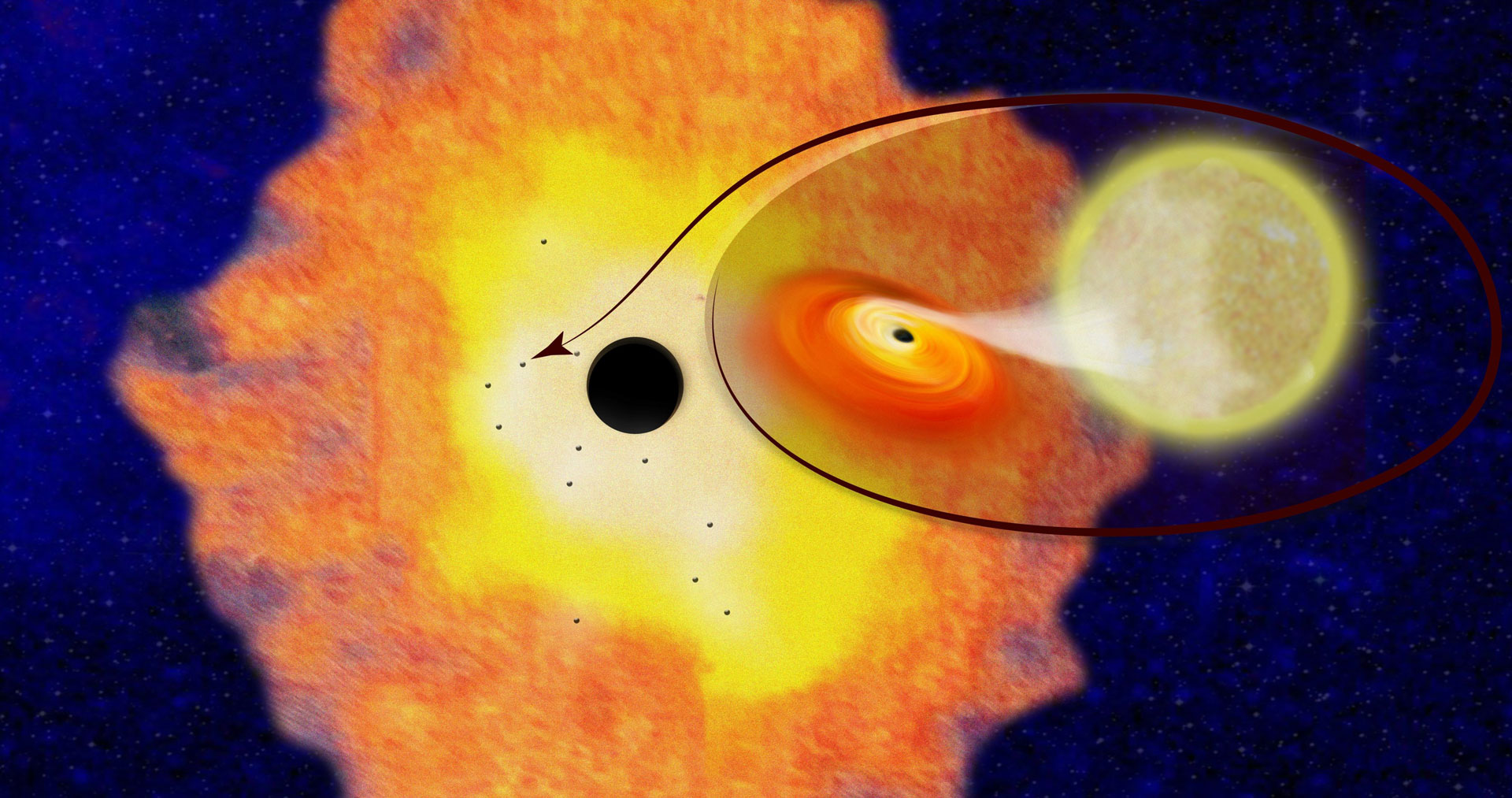
A Columbia University-led team of astrophysicists has discovered a dozen black holes gathered around Sagittarius A* (Sgr A*), the supermassive black hole in the center of the Milky Way Galaxy. The finding is the first to support a decades-old prediction, opening up myriad opportunities to better understand the universe.
“Everything you’d ever want to learn about the way big black holes interact with little black holes, you can learn by studying this distribution,” said Columbia Astrophysicist Chuck Hailey, co-director of the Columbia Astrophysics Lab and lead author on the study. “The Milky Way is really the only galaxy we have where we can study how supermassive black holes interact with little ones because we simply can’t see their interactions in other galaxies. In a sense, this is the only laboratory we have to study this phenomenon.”
The study appears in the April 5 issue of the journal Nature.
For more than two decades, researchers have searched unsuccessfully for evidence to support a theory that thousands of black holes surround supermassive black holes (SMBHs) at the center of large galaxies.
“There are only about five dozen known black holes in the entire galaxy — 100,000 light-years wide — and there are supposed to be 10,000 to 20,000 of these things in a region just six light-years wide that no one has been able to find,” Hailey said, adding that extensive fruitless searches have been made for black holes around Sgr A*, the closest SMBH to Earth and therefore the easiest to study. “There hasn’t been much credible evidence.”
He explained that Sgr A* is surrounded by a halo of gas and dust that provides the perfect breeding ground for the birth of massive stars, which live, die, and could turn into black holes there. Additionally, black holes from outside the halo are believed to fall under the influence of the SMBH as they lose their energy, causing them to be pulled into the vicinity of the SMBH, where they are held captive by its force.
While most of the trapped black holes remain isolated, some capture and bind to a passing star, forming a stellar binary. Researchers believe there is a heavy concentration of these isolated and mated black holes in the Galactic Center, forming a density cusp that gets more crowded as the distance to the SMBH decreases.
In the past, failed attempts to find evidence of such a cusp have focused on looking for the bright burst of X-ray glow that occurs when black holes mate with companion stars.
“It’s an obvious way to want to look for black holes,” Hailey said, “but the Galactic Center is so far away from Earth that those bursts are only strong and bright enough to see about once every 100 to 1,000 years.” To detect black hole binaries then, Hailey and his colleagues realized they would need to look for the fainter, but steadier X-rays emitted after the initial bonding, when the binaries are in an inactive state.
“It would be so easy if black hole binaries routinely gave off big bursts like neutron star binaries do, but they don’t, so we had to come up with another way to look for them,” Hailey said. “Isolated, unmated black holes are just black — they don’t do anything. So looking for isolated black holes is not a smart way to find them either. But when black holes mate with a low-mass star, the marriage emits X-ray bursts that are weaker, but consistent and detectable. If we could find black holes that are coupled with low mass stars and we know what fraction of black holes will mate with low mass stars, we could scientifically infer the population of isolated black holes out there.”
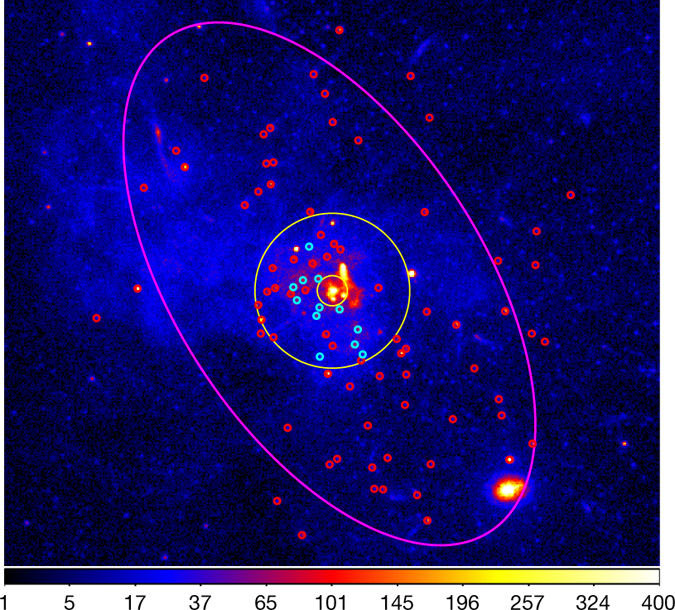
Hailey and colleagues turned to archival data from the Chandra X-ray Observatory to test their technique. They searched for X-ray signatures of black hole-low mass binaries in their inactive state and were able to find 12 within three light years, of Sgr A*. The researchers then analyzed the properties and spatial distribution of the identified binary systems and extrapolated from their observations that there must be anywhere from 300 to 500 black hole-low mass binaries and about 10,000 isolated black holes in the area surrounding Sgr A*.
“This finding confirms a major theory and the implications are many,” Hailey said. “It is going to significantly advance gravitational wave research because knowing the number of black holes in the center of a typical galaxy can help in better predicting how many gravitational wave events may be associated with them. All the information astrophysicists need is at the center of the galaxy.”
Hailey’s co-authors on the paper include: Kaya Mori, Michael E. Berkowitz, and Benjamin J. Hord, all of Columbia University; Franz E. Bauer, of the Instituto de Astrofísica, Facultad de Física, Pontificia, Universidad Católica de Chile, Millennium Institute of Astrophysics, Vicuña Mackenna, and the Space Science Institute; and Jaesub Hong, of Harvard-Smithsonian Center for Astrophysics.
Reference: “A density cusp of quiescent X-ray binaries in the central parsec of the Galaxy” by Charles J. Hailey, Kaya Mori, Franz E. Bauer, Michael E. Berkowitz, Jaesub Hong and Benjamin J. Hord, 5 April 2018, Nature.
DOI: 10.1038/nature25029
Never miss a breakthrough: Join the SciTechDaily newsletter.
Follow us on Google and Google News.