
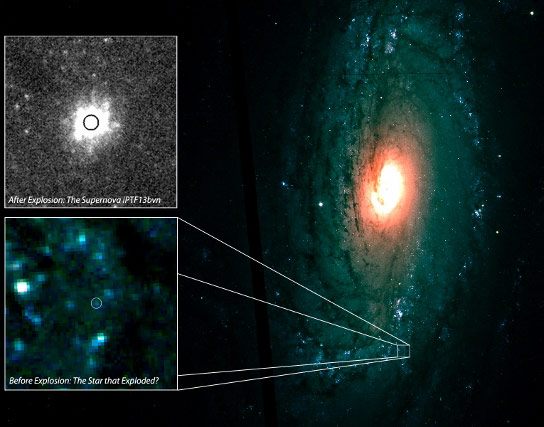
Using a novel astronomical survey software system, the intermediate Palomar Transient Factory (iPTF), astronomers have identified the first progenitor of a stripped envelope supernova.
In June of this year, supernova iPTF13bvn, surprised astrophysicists by revealing its parentage. To date, Type Ib supernovae have appeared to come from nowhere. Type Ib supernovae explosions appear in surveys, but a search back through the archived data has so far resulted in no evidence of a progenitor, likely because they are simply too faint. A recently documented search for progenitors on a dozen Type Ib supernovae resulted in a dozen non-detections.
Chain of Events
On June 16th, the intermediate Palomar Transient Factory (iPTF) — a robotic supernova search run by the California Institute of Technology — identified a new transient source in the nearby galaxy NGC 5806 (some 73 million light years from Earth) that was not there the previous evening. Astronomers rarely capture a supernova so soon after explosion, and so they eagerly trained their telescopes on the new event.
Using radio, optical, and spectroscopic sensors, a global team of astrophysicists led by Dr. Yi Cao of Caltech began the work of tracking and characterizing the new supernova. The team from Las Cumbres Observatory Global Telescope, organized by D. Andrew Howell, gathered several spectra of the supernova as it evolved using the robotic FLOYDS spectrographs on 2-meter LCOGT telescopes in Hawaii and Australia. The LCOGT 1-meter telescope was activated by Dr. Melissa Graham to observe the SN continuously. Dr. Stefano Valenti reduced the data in real-time from both the LCOGT 1-meter telescope network and the FLOYDS spectrograph, and worked with Caltech to analyze and characterize the data. The LCOGT data helped categorize the event as a Type Ib.
Texas Tech astrophysicist Dr. David Sand, who designed and implemented the robotic FLOYDS spectrograph, while working at LCOGT, points out that without FLOYDS, key data would have been missed. “This supernova was discovered when the moon was almost full. Because observing in the optical is very difficult when the moon is so bright, most telescopes in the world are configured to observe In the infrared. FLOYDS is on the telescope all of the time, and since it is robotic, we can get data at any time.”
While real-time observations continued on iPTF13bvn, high-resolution images of the event were carefully registered against Hubble Space Telescope images taken at the same location years beforehand for other purposes. Remarkably, a star was seen in the Hubble image at the exact location of the supernova years later, suggesting that it was the object that later exploded. Based on its brightness and color this ‘supernova progenitor’ was likely a massive, young Wolf-Rayet star. These stars, named for astronomers Charles Wolf and Georges Rayet who first described them in 1867, display strong, broad emission lines of helium. These are stars that have lost much of their envelope, or outer layers.
Valenti adds that “when we realized that the SN was a type Ib, we were quite exited, several times we searched in archival images for progenitors of this kind of SNe, but so far, we have never seen a single one.”
Type Ib supernovae are thought to be the explosions of massive stars that have lost their outer layers due to a stellar wind before explosion. Observations indicate they are devoid of hydrogen, but contain helium in the remaining outer layer of the star. They are roughly as bright as 5 billion Suns. Valenti said scientists can take another Hubble image at the location of the supernova after it has faded away. If the star identified as the progenitor to the supernova has disappeared, then they will know for sure that it was the star that died. Otherwise, if the star is still there, then the supernova came from some other object too faint for researchers to see, and the mystery continues.
Reference: “Discovery, Progenitor and Early Evolution of a Stripped Envelope Supernova iPTF13bvn” by Yi Cao, Mansi M. Kasliwal, Iair Arcavi, Assaf Horesh, Paul Hancock, Stefano Valenti, S. Bradley Cenko, S. R. Kulkarni, Avishay Gal-Yam, Evgeny Gorbikov, Eran O. Ofek, David Sand, Ofer Yaron, Melissa Graham, Jeffrey M. Silverman, J. Craig Wheeler, G. H. Marion, Emma S. Walker, Paolo Mazzali, D. Andrew Howell, K. L. Li, A. K. H. Kong, Joshua S. Bloom, Peter E. Nugent, Jason Surace, Frank Masci, John Carpenter, Nathalie Degenaar and Christopher R. Gelino, 30 August 2013, The Astrophysical Journal Letters.
DOI: 10.1088/2041-8205/775/1/L7
The intermediate Palomar Transient Factory project, which is a scientific collaboration with California Institute of Technology, Los Alamos National Laboratory, University of Wisconsin and several others, performs automated surveys of night skies specifically detecting transient supernovae events. The survey finds hundreds of new supernovae annually.
Never miss a breakthrough: Join the SciTechDaily newsletter.
Follow us on Google and Google News.