
The agricomb, a new laser-based tool, measures methane and ammonia emissions from cattle with high accuracy, promising better emission tracking and more sustainable farming.
After the optical frequency comb made its debut as a ruler for light, spinoffs followed, including the astrocomb to measure starlight and a radar-like comb system to detect natural gas leaks. And now, researchers have unveiled the “agricomb” to measure, ahem, cow burps.
The agricomb could help optimize agricultural processes to reduce production of heat-trapping greenhouse gases.
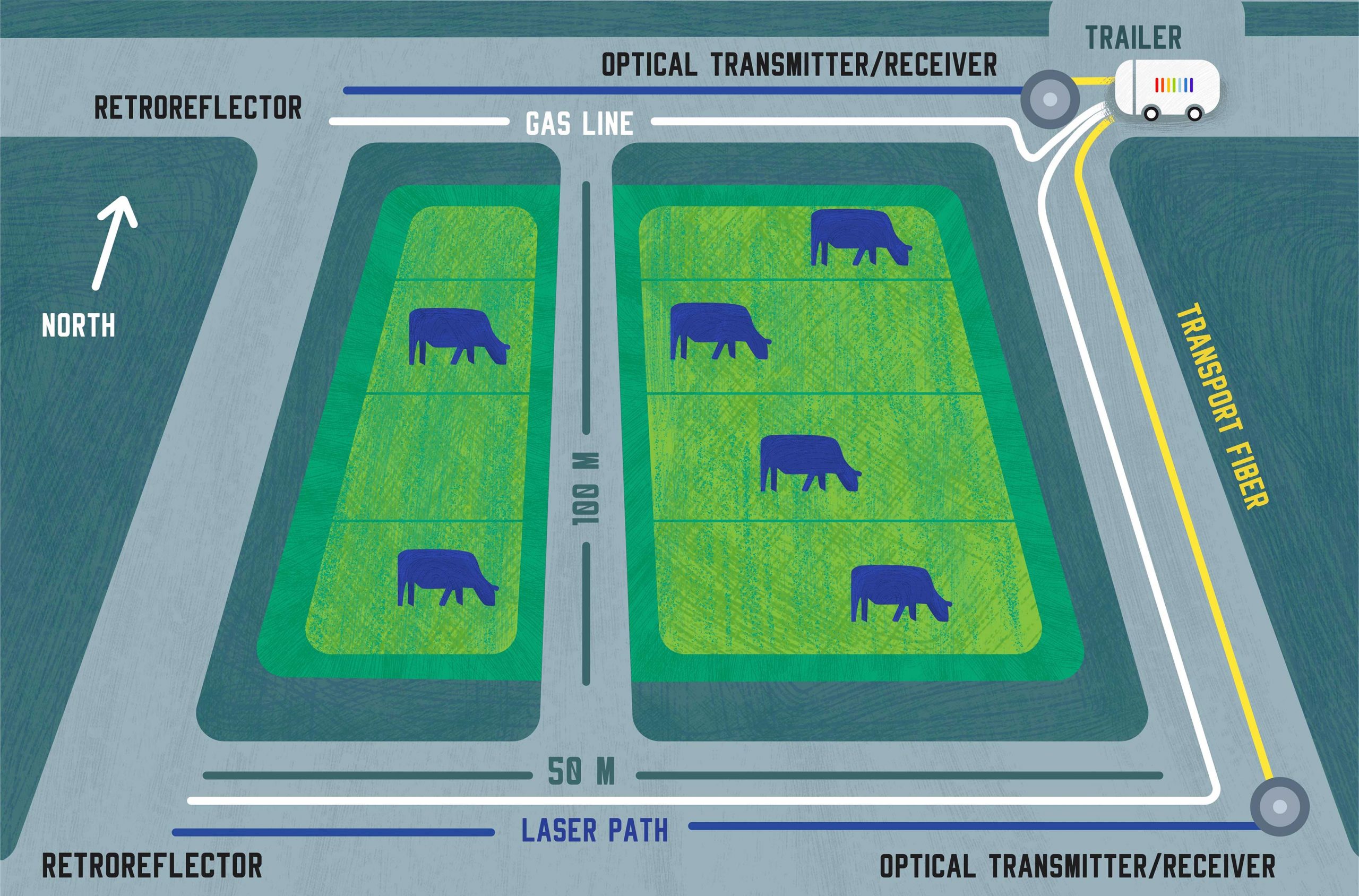
Researchers from the National Institute of Standards and Technology (NIST) and Kansas State University (KSU) used NIST’s agricomb to simultaneously measure emissions of methane, ammonia, carbon dioxide, and water vapor from the atmosphere around a beef cattle feedlot in Kansas. The NIST apparatus — a two-comb system — identifies trace gases based on the exact shades and amounts of infrared light absorbed by the atmosphere when the comb light is sent back and forth across open-air paths.
Described in the journal Science Advances, the demonstration was the first use of frequency combs in an agricultural setting. The portable system was set up inside a trailer parked next to the feedlot. The laser light was specially amplified and filtered to target specific gases.
Targeting Methane and Ammonia from Cattle
Researchers measured gases along two 100-meter paths both upwind and downwind from pens containing about 300 cows. The experiment focused on methane and ammonia because emissions from livestock, mainly cattle, are the largest U.S. source of human-induced methane, a major greenhouse gas, and ammonia is an important atmospheric pollutant.
The measurements captured emissions from both the cattle’s digestive processes and manure on the ground. The agricomb measured both methane and ammonia concentrations at parts-per-million levels with a precision of 25 parts per billion. The agricomb results for methane were comparable to those from a commercial sensor that sampled the air at multiple inlets along the edges of the feedlot. The comb system was particularly useful for ammonia because this gas is sticky and difficult to measure with systems that draw air into them. In addition, the agricomb can measure many gases simultaneously, which is challenging for conventional systems.
Finally, while the commercial sensors measured precise background levels faster, the agricomb more precisely captured downwind plumes and could then better characterize the gas sources, according to the paper. The increased precision will be critical for planned future measurements of methane from sparsely distributed cows in a pasture, which is a much more challenging problem.
The agreement of the old and new techniques inspires confidence that the agricomb can be used to accurately quantify gases in agricultural contexts, the paper suggests. Advantages of the agricomb include sensitivity to a broad range of infrared light, high precision, calibration-free detection of multiple gases at once, and flexibility of the measurement setup. Pairing two combs with different spacings of “teeth” for identifying the exact colors of light makes the analysis more precise.
Challenges in Livestock Emission Estimation
Estimating methane emissions from livestock is challenging because of variations in management practices and cattle characteristics in commercial farms. In addition, what the cattle eat affects emissions but is unaccounted for in national inventories, leading to large uncertainties in greenhouse gas emission models, according to the paper. The cattle at the Kansas feedlot ate a mix of hay and corn silage.
“For the future, our plan is to work with KSU to do a pasture measurement, where the cattle eat native grasses,” NIST physicist Brian Washburn said. “The different feed, plus microbial activity in grassland soils that consumes methane, may mean less atmospheric methane production in the pasture than in the feedlot. The cattle spend about 75% of their life in the pasture, so this measurement would be more representative of the net methane production. This would also be a harder measurement, since it would take place over a larger area, about 500 meters by 500 meters, with fewer animals, about 40 head.”
The researchers suggest the agricomb can support precision agriculture — the use of new technology to boost yields — by measuring many gases simultaneously over large spatial scales, making it possible to design cleaner and more productive farms.
Reference: “Precise multispecies agricultural gas flux determined using broadband open-path dual-comb spectroscopy” by Daniel I. Herman, Chinthaka Weerasekara, Lindsay C. Hutcherson, Fabrizio R. Giorgetta, Kevin C. Cossel, Eleanor M. Waxman, Gabriel M. Colacion, Nathan R. Newbury, Stephen M. Welch, Brett D. DePaola, Ian Coddington, Eduardo A. Santos and Brian R. Washburn, 31 March 2021, Science Advances.
DOI: 10.1126/sciadv.abe9765
This work was funded in part by the National Science Foundation, the ARPA-E MONITOR program, the William and Joan Porter Endowment, and the Habiger Heritage Fund.
Never miss a breakthrough: Join the SciTechDaily newsletter.
Follow us on Google and Google News.
2 Comments
… why to measure, when one can utilize the waist gas coming from the beautiful cows…
Leave the beautiful cows alone! How humiliating.