
A new method to incorporate light-capturing nanomaterials into future solar-panel designs could make it easier for engineers to boost the efficiency and reduce the costs of photovoltaic solar cells.
Although the domestic solar-energy industry grew by 34 percent in 2014, fundamental technical breakthroughs are needed if the U.S. is to meet its national goal of reducing the cost of solar electricity to 6 cents per kilowatt-hour.
In a study published in Nature Communications, scientists from Rice’s Laboratory for Nanophotonics (LANP) describe a new method that solar-panel designers could use to incorporate light-capturing nanomaterials into future designs. By applying an innovative theoretical analysis to observations from a first-of-its-kind experimental setup, LANP graduate student Bob Zheng and postdoctoral research associate Alejandro Manjavacas created a methodology that solar engineers can use to determine the electricity-producing potential for any arrangement of metallic nanoparticles.
LANP researchers study light-capturing nanomaterials, including metallic nanoparticles that convert light into plasmons, waves of electrons that flow like a fluid across the particles’ surface. For example, recent LANP plasmonic research has led to breakthroughs in color-display technology, solar-powered steam production and color sensors that mimic the eye.
“One of the interesting phenomena that occurs when you shine a light on a metallic nanoparticle or nanostructure is that you can excite some subset of electrons in the metal to a much higher energy level,” said Zheng, who works with LANP Director and study co-author Naomi Halas. “Scientists call these ‘hot carriers’ or ‘hot electrons.’”
Halas, Rice’s Stanley C. Moore Professor of Electrical and Computer Engineering and professor of chemistry, bioengineering, physics and astronomy, and materials science and nanoengineering, said hot electrons are particularly interesting for solar-energy applications because they can be used to create devices that produce direct current or to drive chemical reactions on otherwise inert metal surfaces.
Today’s most efficient photovoltaic cells use a combination of semiconductors that are made from rare and expensive elements like gallium and indium. Halas said one way to lower manufacturing costs would be to incorporate high-efficiency light-gathering plasmonic nanostructures with low-cost semiconductors like metal oxides. In addition to being less expensive to make, the plasmonic nanostructures have optical properties that can be precisely controlled by modifying their shape.
“We can tune plasmonic structures to capture light across the entire solar spectrum,” Halas said. “The efficiency of semiconductor-based solar cells can never be extended in this way because of the inherent optical properties of the semiconductors.”
The plasmonic approach has been tried before but with little success.
Zheng said, “Plasmonic-based photovoltaics have typically had low efficiencies, and it hasn’t been entirely clear whether those arose from fundamental physical limitations or from less-than-optimal designs.”
He and Halas said Manjavacas, a theoretical physicist in the group of LANP researcher Peter Nordlander, conducted work in the new study that offers a fundamental insight into the underlying physics of hot-electron-production in plasmonic-based devices.
Manjavacas said, “To make use of the photon’s energy, it must be absorbed rather than scattered back out. For this reason, much previous theoretical work had focused on understanding the total absorption of the plasmonic system.”
He said a recent example of such work comes from a pioneering experiment by another Rice graduate student, Ali Sobhani, where the absorption was concentrated near a metal semiconductor interface.
“From this perspective, one can determine the total number of electrons produced, but it provides no way of determining how many of those electrons are actually useful, high-energy, hot electrons,” Manjavacas said.
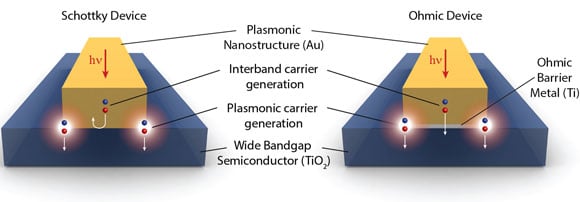
He said Zheng’s data allowed a deeper analysis because his experimental setup selectively filtered high-energy hot electrons from their less-energetic counterparts. To accomplish this, Zheng created two types of plasmonic devices. Each consisted of a plasmonic gold nanowire atop a semiconducting layer of titanium dioxide. In the first setup, the gold sat directly on the semiconductor, and in the second, a thin layer of pure titanium was placed between the gold and the titanium dioxide. The first setup created a microelectronic structure called a Schottky barrier and allowed only hot electrons to pass from the gold to the semiconductor. The second setup allowed all electrons to pass.
“The experiment clearly showed that some electrons are hotter than others, and it allowed us to correlate those with certain properties of the system,” Manjavacas said. “In particular, we found that hot electrons were not correlated with total absorption. They were driven by a different, plasmonic mechanism known as field-intensity enhancement.”
LANP researchers and others have spent years developing techniques to bolster the field-intensity enhancement of photonic structures for single-molecule sensing and other applications. Zheng and Manjavacas said they are conducting further tests to modify their system to optimize the output of hot electrons.
Halas said, “This is an important step toward the realization of plasmonic technologies for solar photovoltaics. This research provides a route to increasing the efficiency of plasmonic hot-carrier devices and shows that they can be useful for converting sunlight into usable electricity.”
Additional co-authors include Hangqi Zhao and Michael McClain, both of Rice. The research was supported by the Welch Foundation, the Office of Naval Research, and the Air Force Office of Science and Research.
Reference: “Distinguishing between plasmon-induced and photoexcited carriers in a device geometry” by Bob Y. Zheng, Hangqi Zhao, Alejandro Manjavacas, Michael McClain, Peter Nordlander and Naomi J. Halas, 13 July 2015, Nature Communications.
DOI: 10.1038/ncomms8797
Never miss a breakthrough: Join the SciTechDaily newsletter.
Follow us on Google and Google News.