

Scientists have uncovered an early brain mechanism that may help explain why people carrying the APOE4 gene face a higher risk of Alzheimer’s disease.
For millions of people who carry the APOE4 gene, the strongest known genetic risk factor for Alzheimer’s disease, changes in brain activity may start years before memory problems become noticeable. Researchers at Gladstone Institutes have now mapped out a series of molecular events that may explain these early brain changes and identified a possible way to reverse them.
In a study published in Nature Aging, scientists used mouse models to show that APOE4 increases production of a protein called Nell2. Elevated Nell2 levels caused neurons to shrink and become unusually overactive. Mice with greater neuron hyperactivity early in life later developed more severe memory problems.
When researchers reduced Nell2 production, neurons returned to a more normal size and activity pattern, even in adult mice carrying APOE4. The findings suggest that drugs targeting Nell2 could one day help lower Alzheimer’s risk in people with the APOE4 gene.
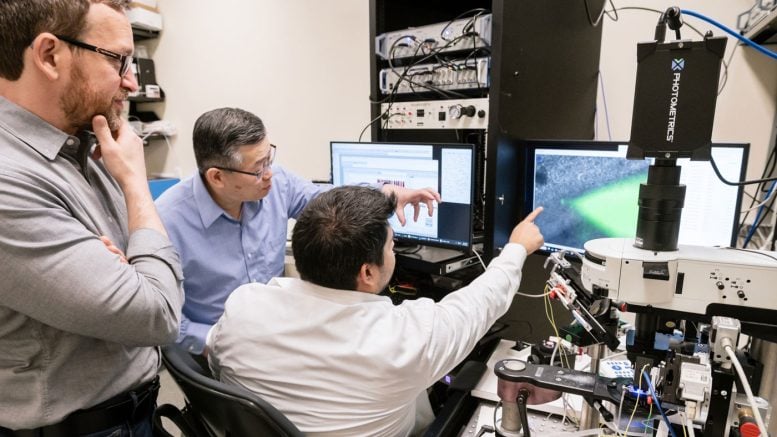
“To the best of our knowledge, this is the first study that has directly examined what APOE4 does to the function of neurons at different ages,” says Misha Zilberter, PhD, principal staff research scientist at Gladstone and a senior author of the study. “We found fundamental changes in brain circuits occurring in young mice that still had normal learning and memory, and importantly, that those changes predicted the development of cognitive deficits at older ages.”
APOE4’s Link to Alzheimer’s Risk and Brain Hyperactivity
APOE4 is one of three major forms of the APOE gene and is considered the most significant genetic risk factor for Alzheimer’s disease. About one in four people carry the variant, and it is found in an estimated 60% to 75% of Alzheimer’s patients.
“This study is a big breakthrough for the field of Alzheimer’s research,” says Yadong Huang, MD, PhD, associate director of the Gladstone Institute of Neurological Disease and a senior author of the study. “It opens the door to a better understanding of how APOE4 alters the function of neurons at a young age to increase risk of cognitive decline and to the development of therapies that could block the detrimental effects of APOE4 early on.”
Earlier studies showed that people with APOE4 can develop unusually high brain activity before middle age and that this hyperactivity may predict later cognitive decline. However, scientists had not fully understood how APOE4 caused these cellular changes or how they contributed to Alzheimer’s risk later in life.
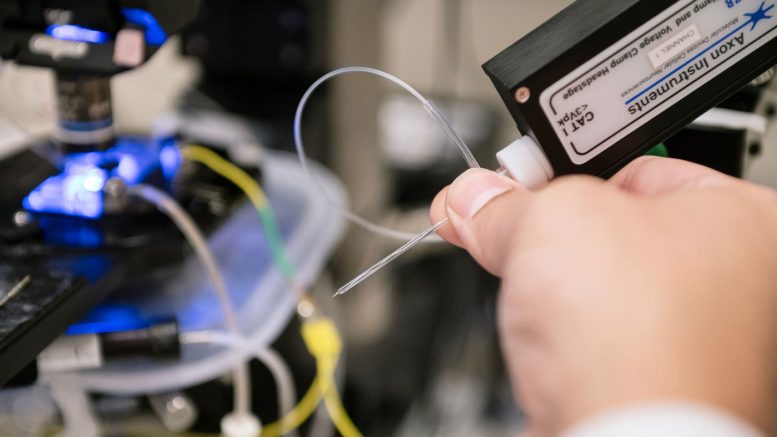
To investigate, researchers recorded brain activity in young mice and examined individual neurons. Mice carrying APOE4 showed hyperactivity in two regions of the hippocampus, a brain area critical for memory. These same regions have also been shown to be overactive in people with the APOE4 gene.
Hyperactive Neurons Predict Future Cognitive Decline
“We found that the extent of hyperactivity in young mice predicted how poorly they performed on spatial learning and memory tests later in life,” says Dennis Tabuena, PhD, a scientist co-mentored by Zilberter and Huang, and first author of the new paper.
The team also studied mice carrying APOE3, a version of the gene linked to lower Alzheimer’s risk. Neurons in APOE4 mice were smaller than those in APOE3 mice in the affected brain regions. Because smaller neurons are more easily activated, they are more likely to become hyperactive.

Mice with APOE3 also showed increased neuron excitability in the hippocampus, but only at older ages.
“This suggests APOE4 accelerates a process that resembles normal aging, and could explain why people with the gene variant are more likely to develop Alzheimer’s disease earlier in life,” Huang says.
Neuron-Produced APOE4 Drives Harmful Brain Hyperactivity
Most APOE4 in a healthy brain is produced by astrocytes, support cells that help neurons function properly. Scientists had long suspected that APOE4 increased Alzheimer’s risk mainly through its effects in astrocytes. However, the new study found that neuron-produced APOE4 was responsible for the hippocampal hyperactivity.
“When we deleted the APOE4 gene from astrocytes, nothing changed,” Zilberter says. “But when we deleted it from neurons, the cells became larger and started functioning normally again.”
The researchers then analyzed gene activity in individual hippocampal cells and identified unusually high levels of Nell2 in APOE4 neurons.

Nell2 Emerges as a Promising Alzheimer’s Treatment Target
Using CRISPRi, a method that lowers gene activity without permanently changing DNA, the team reduced Nell2 levels in adult mice carrying APOE4. After treatment, neurons became larger and less excitable, demonstrating that Nell2 directly contributes to neuron hyperactivity in APOE4 brains.
Although Nell2 had not previously been studied in relation to APOE4, earlier research found elevated Nell2 levels in the brains of Alzheimer’s patients, where higher amounts were linked to worse cognitive performance.
“What’s exciting about Nell2 is that we were able to reverse the disease manifestations in adult mice by lowering its level,” Huang says. “That tells us the damage is not irreversible, and that there may be a window for intervention even after disease processes have been triggered.”
Reference: “Neuronal APOE4-induced early hippocampal network hyperexcitability in Alzheimer’s disease pathogenesis” by Dennis R. Tabuena, Sung-Soo Jang, Brian Grone, Oscar Yip, Emily A. Aery Jones, Jessica Blumenfeld, Zherui Liang, Rajkamalpreet S. Mann, Yaqiao Li, Deanna Necula, Nicole Koutsodendris, Antara Rao, Leonardo Ding, Alex R. Zhang, Yanxia Hao, Qin Xu, Seo Yeon Yoon, Samuel De Leon, Yadong Huang and Misha Zilberter, 3 April 2026, Nature Aging.
DOI: 10.1038/s43587-026-01096-0
The work was supported by the National Institute on Aging (R01AG061150, R01AG087323, R01AG092390, R01AG085468, R01AG055682, R01AG071697, P01AG073082, F32AG0859612), the National Institute of Neurological Disorders and Stroke (K99NS134734), and the National Center for Research Resources (C06 RR018928).
Never miss a breakthrough: Join the SciTechDaily newsletter.
Follow us on Google and Google News.