

New noninvasive tools reveal that subtle shifts in brain blood flow and oxygen use may mirror key markers of Alzheimer’s risk.
Small shifts in how blood circulates through the brain and how brain cells use oxygen could signal a higher risk of Alzheimer’s disease, according to researchers at the Mark and Mary Stevens Neuroimaging and Informatics Institute (Stevens INI) at the Keck School of Medicine of USC.
In a study published in Alzheimer’s and Dementia: The Journal of the Alzheimer’s Association, investigators reported that simple, noninvasive measures of brain blood flow and oxygen use were tied to key biological features of Alzheimer’s in older adults, regardless of whether they had cognitive impairment. Those features included amyloid plaque accumulation and shrinkage of the hippocampus, a structure that plays a central role in memory. The results suggest that the condition of the brain’s blood vessels may influence the disease process early on and could help flag people at risk before noticeable symptoms develop.
“Amyloid and tau are often considered the primary players in Alzheimer’s disease, but blood flow and oxygen delivery are also critical,” said Amaryllis A. Tsiknia, lead author of the study and USC PhD candidate. “Our results show that when the brain’s vascular system functions more like it does in healthy aging, we also see brain features that are linked to better cognitive health.”
Measuring Blood Flow and Oxygenation
To explore this connection, the team relied on two techniques that can be used while a person rests quietly. One method, transcranial Doppler ultrasound, tracks the speed of blood moving through the brain’s major arteries. The other, near-infrared spectroscopy, estimates how effectively oxygen reaches tissue near the outer layer of the brain.
Researchers then applied advanced mathematical modeling to combine these readings into summary measures. These indicators reflect how well the brain regulates circulation and oxygen delivery in response to normal changes in blood pressure and carbon dioxide.
Participants whose scores suggested healthier vessel function tended to have lower amounts of amyloid plaques and larger hippocampal volumes. Both characteristics are associated with reduced Alzheimer’s risk.
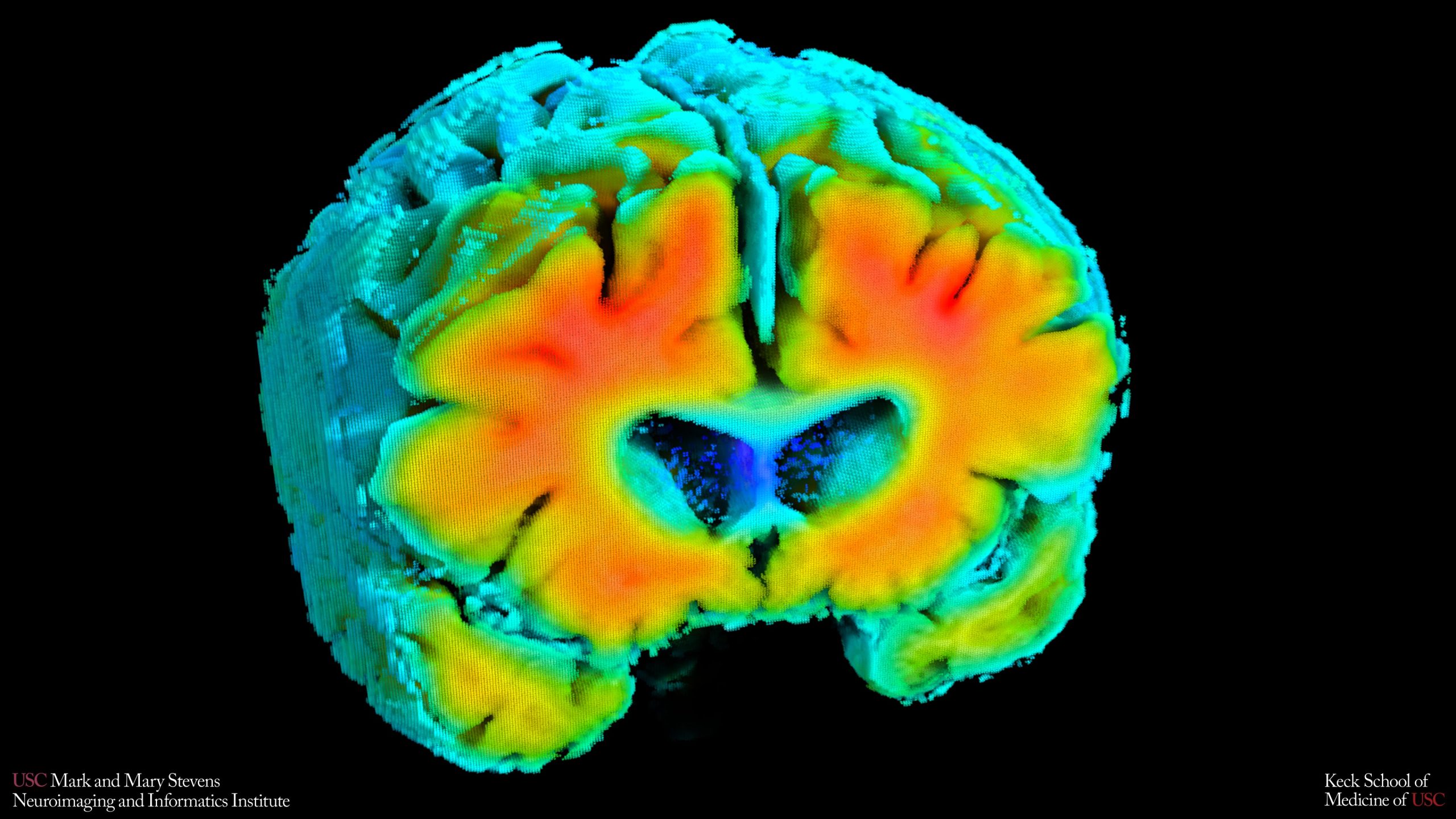
“These vascular measures are capturing something meaningful about brain health,” said Meredith N. Braskie, PhD, senior author of the study and assistant professor of neurology at the Keck School of Medicine. “They appear to align with what we see on MRI and PET scans that are commonly used to study Alzheimer’s disease, providing important information about how vascular health and standard brain measures of Alzheimer’s disease risk may be related.”
The analysis also showed that people diagnosed with mild cognitive impairment or dementia had weaker vascular function compared with cognitively healthy adults. This pattern supports the view that reduced cerebrovascular performance is part of the broader Alzheimer’s disease spectrum.
“These findings add to growing evidence that Alzheimer’s involves meaningful vascular contributions in addition to classic neurodegenerative changes,” said Arthur W. Toga, PhD, director of the Stevens INI. “Understanding how blood flow and oxygen regulation interact with amyloid and brain structure opens new doors for early detection and potentially prevention.”
Implications for Screening and Future Research
Compared with MRI and PET scans, the approaches used in this study are less costly and easier to administer. They do not involve injections, radiation exposure, or complex tasks for patients to complete. That makes them promising tools for large screening efforts and for individuals who may not be able to undergo more intensive imaging procedures.
The authors caution that the findings represent a single point in time and cannot establish cause and effect. Ongoing long-term studies are designed to determine whether changes in these vascular measures can forecast future cognitive decline or reveal how patients respond to treatment.
“If we can track these signals over time, we may be able to identify people at higher risk earlier and test whether improving vascular health can slow or reduce Alzheimer’s-related brain changes,” Tsiknia said.
Reference: “Cerebrovascular regulation dynamics and Alzheimer’s neuroimaging phenotypes” by Amaryllis A. Tsiknia, Jamie A. Terner, Zoe E. Tsokolas, Dae C. Shin, Elizabeth B. Joe, Peter S. Conti, Rebecca J. Lepping, Brendan J. Kelley, Rong Zhang, Sandra A. Billinger, Helena C. Chui, Vasilis Z. Marmarelis and Meredith N. Braskie, 13 February 2026, Alzheimer’s & Dementia.
DOI: 10.1002/alz.71146
This work was supported by the Office of The Director, National Institutes of Health, under Award Number S10OD032285, and by the National Institute on Aging [R01AG058162].
Never miss a breakthrough: Join the SciTechDaily newsletter.
Follow us on Google and Google News.