
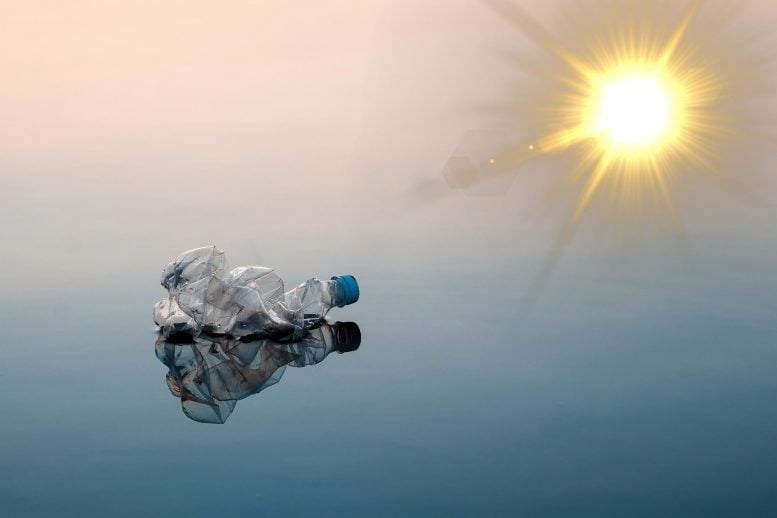
Polystyrene persists in the environment for millennia, according to some international governmental agencies. This estimate is based on the amount of time required for microbes to break down the plastic. But now researchers have challenged this common assumption with the finding that sunlight can break down polystyrene over a much shorter time scale, from decades to centuries. They report their results in Environmental Science & Technology Letters.
Used in many consumer and industrial products, such as food containers, protective packaging, and building materials, polystyrene widely contaminates the environment. Common microbes cannot degrade the polymer because of its aromatic backbone, leading scientists to estimate that it persists for tens of thousands of years. Collin Ward and colleagues at Woods Hole Oceanographic Institution wondered whether sunlight absorbed by polystyrene could transform it into carbon dioxide and dissolved organic carbon in a much shorter time.
To find out, the researchers placed five commercially available polystyrene samples in water and then exposed them to simulated sunlight that was three times brighter than sunlight at the equator. The researchers found that the simulated sunlight partially oxidized all five samples to dissolved organic carbon. They calculated that, for latitudes 0° to 50° N (extending from the equator to about the southern border of Canada), this process would take decades. Complete oxidation of polystyrene to carbon dioxide by sunlight would require centuries, they estimate. The polystyrene samples degraded at different rates depending on the additives they contained, which in the future could be manipulated to control the lifetimes of the plastics, the researchers say.
For more on this study, see Scientists Thought It Took Thousands of Years for Plastic to Decompose – It May Only Be Decades.
Reference: “Sunlight Converts Polystyrene to Carbon Dioxide and Dissolved Organic Carbon” by Collin P. Ward, Cassia J. Armstrong, Anna N. Walsh, Julia H. Jackson and Christopher M. Reddy, 10 October 2019, Environmental Science and Technology Letters.
DOI: 10.1021/acs.estlett.9b00532
The authors acknowledge funding from the Frank and Lisina Hoch Endowed Fund, the Andrew W. Mellon Foundation, the Stanley Watson Chair in Oceanography and the National Science Foundation Graduate Research Fellowship.
The American Chemical Society, the world’s largest scientific society, is a not-for-profit organization chartered by the U.S. Congress. ACS is a global leader in providing access to chemistry-related information and research through its multiple databases, peer-reviewed journals and scientific conferences. ACS does not conduct research, but publishes and publicizes peer-reviewed scientific studies. Its main offices are in Washington, D.C., and Columbus, Ohio.
Never miss a breakthrough: Join the SciTechDaily newsletter.
Follow us on Google and Google News.
3 Comments
Polystyrene, a Common Plastic, Degrades Much Faster Than Expected in Sunglight? (Sunlight)
Looks like these articles are not being proof read?
plastic bottles shown in photograph are of a material known as P.E.T. (Polyethylene_terephthalate) IUPAC name. Poly(ethyl benzene-1,4-dicarboxylate) not Polystyrene AKA Styrofoam.
“sunlight can break down polystyrene over a much shorter time scale, from decades to centuries” should be from centuries to decades. so degrading to CO2 seems feasable for P.E.T. but for styrene seems seems less likely? I did not read the rest of the article there might be more? I lost interest, Fake News?
You messed up the spelling of Sunlight in the title. 🙂
Yikes! It has now been fixed. Thanks!