
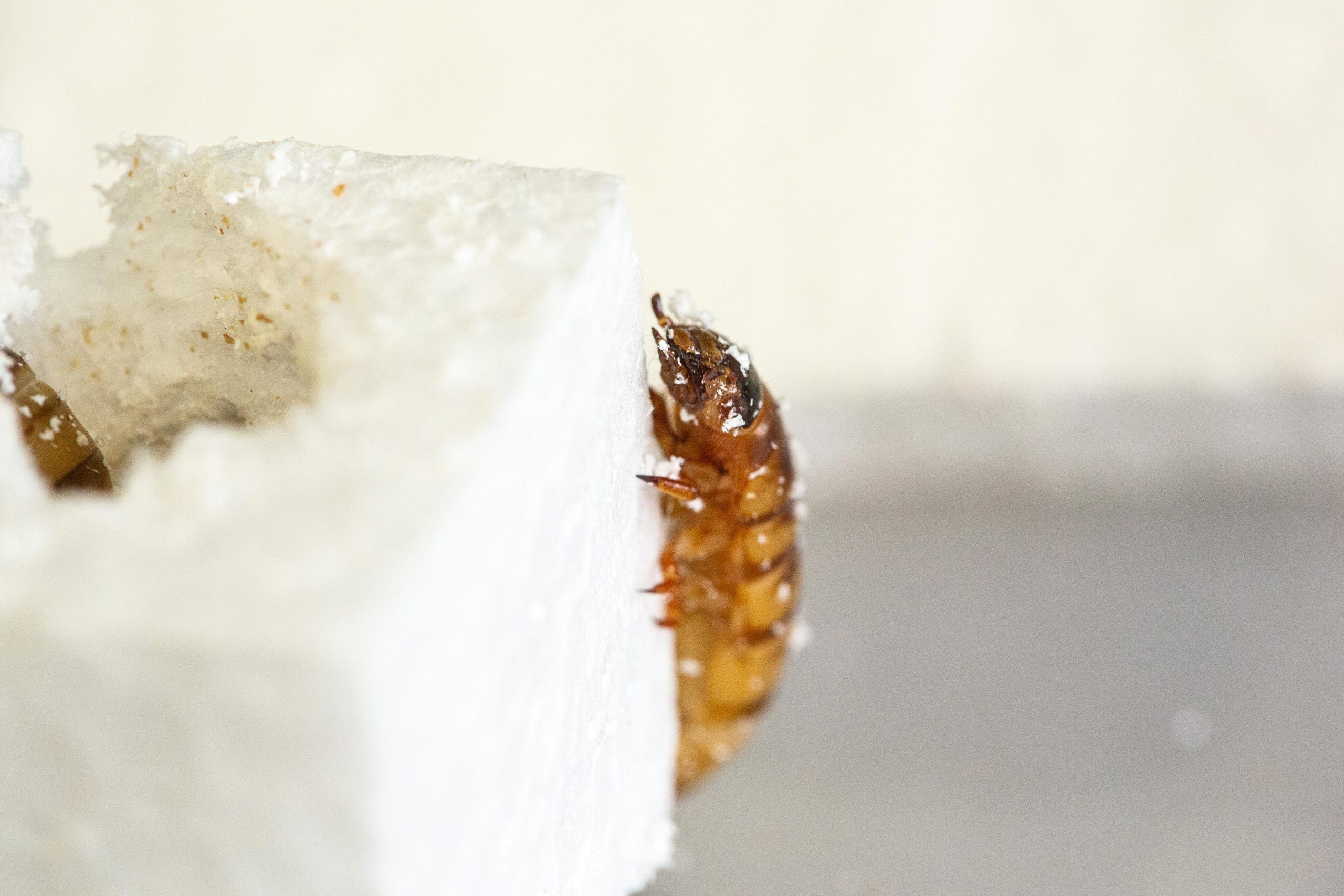
Superworms can break down polystyrene, thanks to gut bacteria, offering a promising approach to recycling challenging plastics through enzyme-based biodegradation.
According to the American Chemistry Council, in 2018 in the United States, 27.0 million tons of plastic ended up in landfills compared to just 3.1 million tons that were recycled. Worldwide the numbers are similarly bad, with just 9% of plastic being recycled according to a recent Organization for Economic Co-operation and Development (OECD) report.
The statistics are even worse for certain types of plastic. For example, out of 80,000 tons of styrofoam (polystyrene) containers generated in the United States, a negligible amount (less than 5,000 tons) was recycled.
One of the big problems is that most plastic isn’t easily recyclable and recycled plastic can be significantly lower in value due to a loss of quality.
Now, researchers at the University of Queensland have found a species of worm with an appetite for polystyrene could be the key to plastic recycling on a mass scale.
Superworms’ Unique Ability to Digest Polystyrene
Scientists discovered the common Zophobas morio ‘superworm’ can eat through polystyrene, thanks to a bacterial enzyme in their gut.
Dr. Chris Rinke and his team from UQ’s School of Chemistry and Molecular Biosciences fed superworms different diets over a three-week period, with some given polystyrene foam, some bran and others put on a fasting diet.
“We found the superworms fed a diet of just polystyrene not only survived, but even had marginal weight gains,” Dr. Rinke said. “This suggests the worms can derive energy from the polystyrene, most likely with the help of their gut microbes.”
Metagenomics and Enzyme Discovery
The researchers used a technique called metagenomics to find several encoded enzymes with the ability to degrade polystyrene and styrene. The long-term goal is to engineer enzymes to degrade plastic waste in recycling plants through mechanical shredding, followed by enzymatic biodegradation.
“Superworms are like mini recycling plants, shredding the polystyrene with their mouths and then feeding it to the bacteria in their gut,” Dr. Rinke said.
“The breakdown products from this reaction can then be used by other microbes to create high-value compounds such as bioplastics.”
It’s hoped this bio-upcycling will incentivize plastic waste recycling and reduce landfill.
Co-author of the research, PhD candidate Jiarui Sun, said they aim to grow the gut bacteria in the lab and further test its ability to degrade polystyrene. “We can then look into how we can upscale this process to a level required for an entire recycling plant,” Ms. Sun said.
Dr. Rinke said there are many opportunities for the biodegradation of plastic waste.
“Our team is very excited to push the science to make it happen,” he said.
This research has been published in Microbial Genomics.
Reference: “Insights into plastic biodegradation: community composition and functional capabilities of the superworm (Zophobas morio) microbiome in styrofoam feeding trials” by Jiarui Sun, Apoorva Prabhu, Samuel T. N. Aroney and Christian Rinke, 9 June 2022, Microbial Genomics.
DOI: 10.1099/mgen.0.000842
Never miss a breakthrough: Join the SciTechDaily newsletter.
Follow us on Google and Google News.
10 Comments
Its not the worms. Its the bacteria in their guts. If said bacteria starts eating plastic everywhere, then no more plastic. Better find something else to wrap your food in.
Yes, there is an old saying, “Be careful what you wish for. You may get it.”
So we found a bug/worm that can eat plastics and then use its guts to get rid of it.
Now what are they planning to do?
Breed more of these bloody worms and then what?
What are the worms leaving in place of the plastic? A bigger problem?
When we have gotten to the point and all the styrofoam and plastics have either been eaten and something else has become deposited in its place or mankind finally decided to STOP with all the madness and quit plastics for good, what will these worms, an entire recycling plants worth of worms that is.
Well…. what will they eat next?
Will we just breed then murder all the worms when their job is done?
I’m not against ingeniously thought up ideas but the ramifications in its wake could be much worse.
Wow the world is really depressing!
Sorry, I was incredibly high when I wrote this.
If these worms get loose in Nature, will our plastic infrastructure collapse?
Obviously this is a ploy by the eco-packaging lobby. Create a solution that appears earth-friendly, then little by little our strategic plastic reserves are depleted, forcing us to turn to biodegradables for our product packaging. Clever.
These ‘worms’ look like insect larva to me. This is a science site; can’t the writer identify these animals more precisely?
“Superworms are like mini recycling plants, shredding the polystyrene with their mouths and then feeding it to the bacteria in their gut,” Dr. Rinke said.
“The long-term goal is to engineer enzymes to degrade plastic waste in recycling plants through mechanical shredding, followed by enzymatic biodegradation.”
Ffs, this comment section is what’s depressing.
You cannot force nature to bear the issue. Please eat the plastic yourself.
Zophobas morio is the species name of the larvae which is often referred to as a “superworm”. It wasn’t the authors creative license that led him to call it as such.