
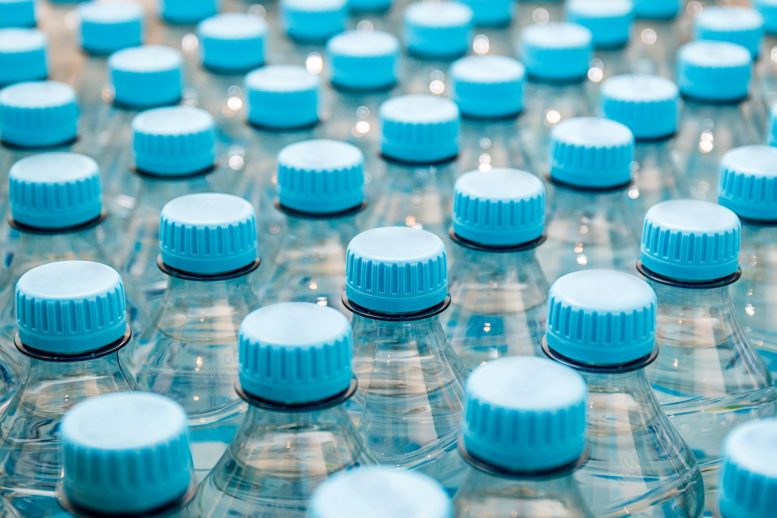
Plastics are one of the world’s largest polluters, taking hundreds of years to degrade in nature. A research team, led by YSE professor Yuan Yao and Liangbing Hu from the University of Maryland, has created a high-quality bioplastic from wood byproducts that they hope can solve one of the world’s most pressing environmental issues.
Efforts to shift from petrochemical plastics to renewable and biodegradable plastics have proven tricky — the production process can require toxic chemicals and is expensive, and the mechanical strength and water stability are often insufficient. But researchers have made a breakthrough, using wood byproducts, that shows promise for producing more durable and sustainable bioplastics.
A study published in Nature Sustainability, co-authored by Yuan Yao, assistant professor of industrial ecology and sustainable systems at Yale School of the Environment (YSE), outlines the process of deconstructing the porous matrix of natural wood into a slurry. The researchers say the resulting material shows a high mechanical strength, stability when holding liquids, and UV-light resistance. It can also be recycled or safely biodegraded in the natural environment, and has a lower life-cycle environmental impact when compared with petroleum-based plastics and other biodegradable plastics.
“There are many people who have tried to develop these kinds of polymers in plastic, but the mechanical strands are not good enough to replace the plastics we currently use, which are made mostly from fossil fuels,” says Yao. “We’ve developed a straightforward and simple manufacturing process that generates biomass-based plastics from wood, but also plastic that delivers good mechanical properties as well.”
Simple Manufacturing Using Wood Waste and Green Solvents
To create the slurry mixture, the researchers used a wood powder — a processing residue usually discarded as waste in lumber mills — and deconstructed the loose, porous structure of the powder with a biodegradable and recyclable deep eutectic solvent (DES). The resulting mixture, which features nanoscale entanglement and hydrogen bonding between the regenerated lignin and cellulose micro/nanofibrils, has a high solid content and high viscosity, which can be casted and rolled without breaking.
“We’ve developed a straightforward and simple manufacturing process that generates biomass-based plastics from wood, but also plastic that delivers good mechanical properties as well.” Yuan Yao, assistant professor of industrial ecology and sustainable systems
Biodegradable, Recyclable, and Low Impact
Yao then led a comprehensive life cycle assessment to test the environmental impacts of the bioplastic against commons plastics. Sheets of the bioplastic were buried in soil, fracturing after two weeks and completely degrading after three months; additionally, researchers say the bioplastic can be broken back down into the slurry by mechanical stirring, which also allows for the DES to be recovered and reused.
“That, to me, is what really makes this plastic good: It can all be recycled or biodegraded,” says Yao. “We’ve minimized all of the materials and the waste going into nature.”
The bioplastic has numerous applications, says Liangbing Hu, a professor at the Center for Materials Innovation at the University of Maryland and co-author of the paper. It can be molded into a film that can be used in plastic bags and packaging — one of the major uses of plastic and causes of waste production. Hu also says that because the bioplastic can be molded into different shapes, it has potential for use in automobile manufacturing, as well.
Sustainable Sourcing Concerns for Scale-Up
One area the research team continues to investigate is the potential impact on forests if the manufacturing of this bioplastic is scaled up. While the process currently uses wood byproducts in manufacturing, the researchers say they are keenly aware that large-scale production could require usage of massive amounts of wood, which could have far-reaching implications on forests, land management, ecosystems and climate change, to name a few.
Yao says the research team has already begun working with a forest ecologist to create forest simulation models, linking the growth cycle of forests with the manufacturing process. She also sees an opportunity to collaborate with people who work in forest-related fields at YSE — an uncommon convenience.
“It’s not often an engineer can walk down the hall and talk to a forester,” says Yao.
Yao, an emerging scholar in the field of industrial ecology, joined the YSE faculty last year. Her research examines the environmental and economic impacts of emerging technologies and industrial processes., integrating interdisciplinary approaches from the fields of industrial ecology, sustainable engineering, and systems modeling to develop techniques that promote more sustainable engineering approaches and policies.
Reference: “A strong, biodegradable and recyclable lignocellulosic bioplastic” by Qinqin Xia, Chaoji Chen, Yonggang Yao, Jianguo Li, Shuaiming He, Yubing Zhou, Teng Li, Xuejun Pan, Yuan Yao and Liangbing Hu, 25 March 2021, Nature Sustainability.
DOI: 10.1038/s41893-021-00702-w
Never miss a breakthrough: Join the SciTechDaily newsletter.
Follow us on Google and Google News.
6 Comments
… sounds good…
The question everyone wants to know… “Is it cheap?”
If it comes from lumber “waste” I would guess quantity isn’t a problem, but the other product in the mixing doesn’t sound too cheap, deep eutectic solvent(DES)…
Meanwhile, before we get a good alternative to non degradable plastic, governments need to start taxing plastic use, big companies wont make a change unless they are required to do. I bet we could reduce plastic use without any major change in the system in 50%, taxing single use plastics and packaging alone would achieve a significant reduction. Synthetic fibers are also a major source of pollution https://www.oceancleanwash.org/ tax their use as well.
If you are reading this, checkout https://theoceancleanup.com/
This initiative should be getting more international support, they have demonstrated that it’s possible to eliminate a good part of plastics in oceans and rivers and prevent further pollution.
Why do we need to replace plastic? Just stop using it and go back to a reusable,recyclable,returnable substance we already have glass! Why waste time and money on new things when we have something that worked in the past and will work again
The easiest and cheapest option is to stop dumping garbage/plastic into the ocean.
Your welcome.
I think this is a good development. But the question remains; is it sustainable using wood? I guess they would find out since they are already working with foresters to develop models in accessing the sustainability of using wood as a viable alternative.
North America contributes lesa than 5% of the plastic found in the ocean. Approximately 50% is from china and 30% is from india. We cant solve evry problem with taxes