
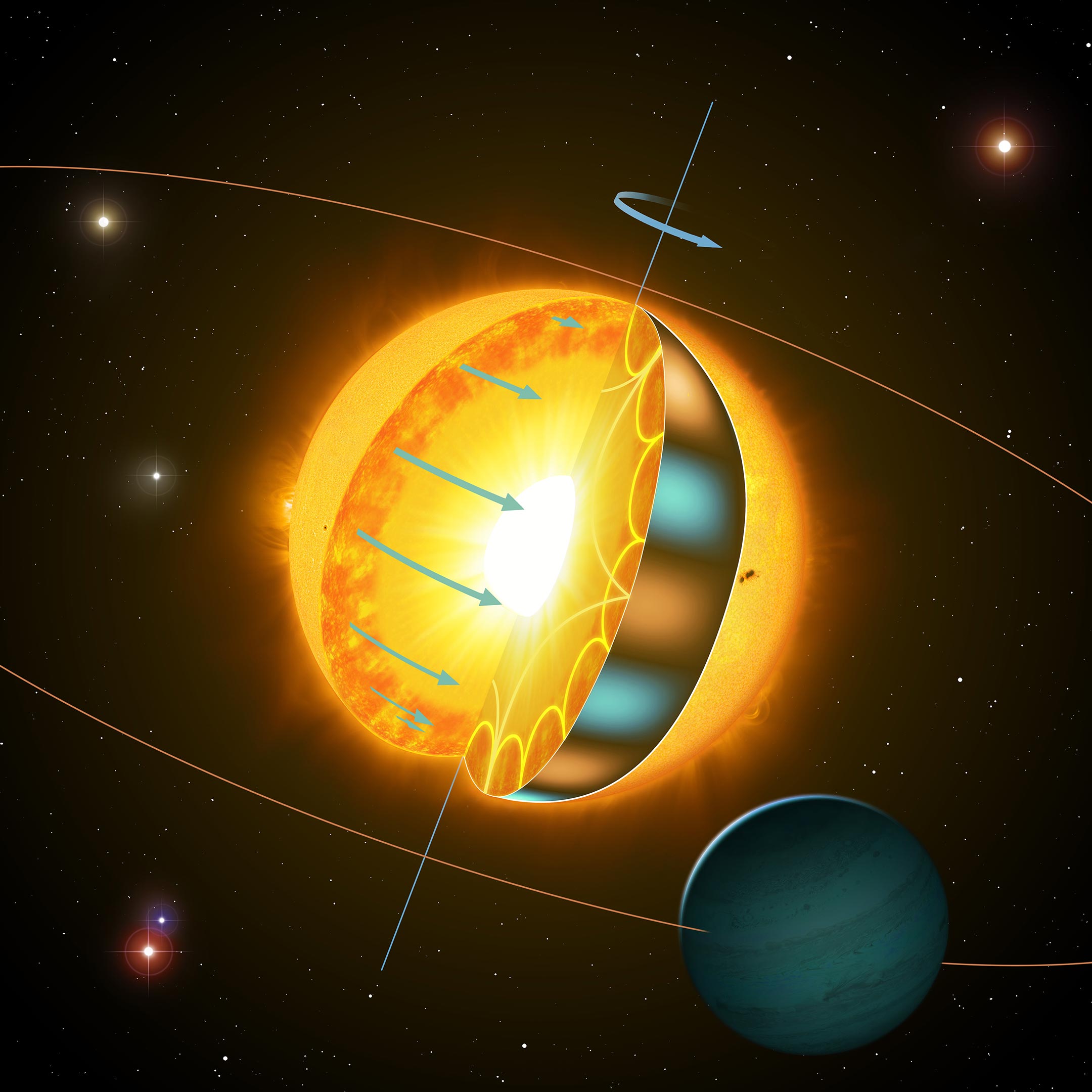
Using asteroseismology, researchers analyzed stellar oscillations caused by internal sound waves to more accurately measure spin rates across both young and old stars. The findings suggest that changes in a star’s magnetic field may alter its rotational deceleration over time. This could help refine models for our own Sun’s future evolution and space weather activity.
Stars spin faster than expected as they age according to a new study led by scientists at the University of Birmingham which uses asteroseismology to shed new light on this emerging theory.
All stars, like the Sun, are born spinning. As they grow older, their spin slows down due to magnetic winds in a process called ‘magnetic braking’. Research published in 2016 by scientists at Carnegie Observatories delivered the first hints that stars at a similar stage of life as the Sun were spinning faster than magnetic braking theories predicted. The results from this study were based on a method in which scientists pinpoint dark spots on the surface of stars and track them as they move with the stars’ spin. While the method has proven robust for measuring spin in younger stars, however, older stars have fewer star spots, which has made the effects of this “weakened” magnetic braking on these stars hard to confirm.
In a new study, published in the journal Nature Astronomy, researchers at the University of Birmingham used a different approach to confirm that older stars do, in fact, appear to rotate faster than expected. The team used asteroseismology to calculate how the star is rotating. This relatively new field of study enables scientists to measure the oscillations caused by sound waves trapped inside the star. By measuring the different characteristics of these waves, they can reveal different characteristics of stars, such as their size or age.
In this study, the team measured the modes, or the frequencies, of the sound waves produced by the star’s oscillation. As the star spins, these modes split into different frequencies. This can be imagined, the authors say, as the sound of two ambulances stood still on a roundabout compared to when they were driving in circles. By measuring these frequencies, it is possible to calculate the rate of spin in a way that is possible for both young and old stars.
Asteroseismic Evidence of Accelerated Rotatio
Lead author on the paper, Dr. Oliver Hall, said: “Although we’ve suspected for some time that older stars rotate faster than magnetic braking theories predict, these new asteroseismic data are the most convincing yet to demonstrate that this ‘weakened magnetic braking’ is actually the case. Models based on young stars suggest that the change in a star’s spin is consistent throughout their lifetime, which is different to what we see in these new data.”
One aspect the researchers believe could be key to the change in momentum loss, is changes to the star’s magnetic field. Understanding how the magnetic field interacts with rotation will be an important area of future study, and is being worked on by authors on the paper.
Implications for Our Sun’s Future
The results could also shed light on our own star’s activity over the next several billion years, explains co-author Dr Guy Davies: “These new findings demonstrate that we still have a lot to learn about the future of our own Sun as well as other stars. This work helps place in perspective whether or not we can expect reduced solar activity and harmful space weather in the future. To answer these questions we need better models of solar rotation, and this work takes an important step towards improving the models and supplying the data needed to test them.”
Reference: “Weakened magnetic braking supported by asteroseismic rotation rates of Kepler dwarfs” by Oliver J. Hall, Guy R. Davies, Jennifer van Saders, Martin B. Nielsen, Mikkel N. Lund, William J. Chaplin, Rafael A. García, Louis Amard, Angela A. Breimann, Saniya Khan, Victor See and Jamie Tayar, 22 April 2021, Nature Astronomy.
DOI: 10.1038/s41550-021-01335-x
Other contributors to the study include the European Space Agency (ESA), Aarhus University, University of Hawai’i, Universit´e Paris-Saclay, and the University of Exeter.
Never miss a breakthrough: Join the SciTechDaily newsletter.
Follow us on Google and Google News.
5 Comments
… an observation deserves decent explanation…
All rotating bodies tend to rotate faster and faster because the decrease in potential energy density caused by universal expansion causes the atomic rays of the atoms to contract. If the atomic rays decrease then the celestial bodies also decrease in radius. The conservation of the angular momentum causes the angular velocity to increase in the inverse proportion of the square of the contraction of the celestial bodies.
http://www.sciepub.com/IJP/abstract/13173
Since observations and quantum physics agree on the non-contraction of atoms the idea has no bearing on the rotation rate of old stars.
Your self promoted pseudoscience [ https://predatoryjournals.com/publishers/#S ] links do not consist of evidence testing the purported idea.
All rotating bodies tend to rotate faster and faster because the decrease in density of potential energy caused by universal expansion causes the contraction of the atomic radius of the atoms. If the atomic radius decrease then the celestial bodies also decrease in radius. The conservation of the angular momentum causes the angular velocity to increase in the inverse proportion of the square of the contraction of the radius of celestial bodies.
http://www.sciepub.com/IJP/abstract/13173
All rotating bodies tend to rotate faster and faster because the decrease in density of potential energy caused by universal expansion causes the atomic radius of the atoms to contract. If the atomic radius decrease then the celestial bodies also decrease in radius. The conservation of the angular momentum causes the angular velocity to increase in the inverse proportion of the square of the contraction of the celestial bodies.The contraction of the radius of celestial bodies is inversely proportional to the expansion of the universe.
http://www.sciepub.com/IJP/abstract/13173