
Close Menu
    Facebook X (Twitter) Instagram
    SciTechDaily
    • Biology
    • Chemistry
    • Earth
    • Health
    • Physics
    • Science
    • Space
    • Technology
    Facebook X (Twitter) Pinterest YouTube RSS
    SciTechDaily
    Home»Biology»New Species of Galapagos Giant Tortoise Identified
    Biology

    New Species of Galapagos Giant Tortoise Identified

    By Bill Hathaway, Yale UniversityOctober 23, 2015No Comments2 Mins Read
    Facebook Twitter Pinterest Telegram LinkedIn WhatsApp Email Reddit
    Share
    Facebook Twitter LinkedIn Pinterest Telegram Email Reddit
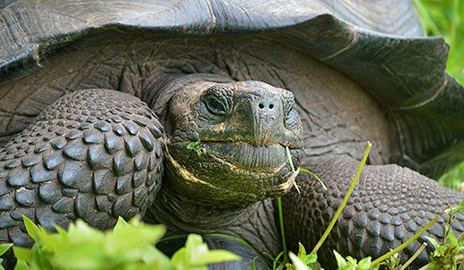
    New Galapagos Giant Tortoise Species
    Eastern Santa Cruz tortoise. (Photo credit: Washington Tapia)

    A team of researchers from Yale University have discovered a new species of giant tortoise in the Galapagos.

    A few hundred giant tortoises living on one side of Santa Cruz Island in the Galapagos actually are a separate species from a second, larger population living less than 10 kilometers (6 miles) away, a new Yale-led genetic analysis has revealed.

    The recognition of the Eastern Santa Cruz tortoise as a distinct species provides new insight into the history of these evolutionary icons that live on the island chain that inspired Charles Darwin.

    While the larger western population on the island numbers about 2,000 and lives mostly in a protected national park, the smaller number of Eastern Santa Cruz tortoises may need more protection, said Adalgisa “Gisella” Caccone, senior research scientist in the Department of Ecology and Evolutionary Biology and senior author of the research published in the journal PLOS ONE.

    “Naming a new species elevates its status and enables more resources to be devoted to protecting its range,” Caccone said.

    Researchers had noted differences in the shells, or carapaces, of the two populations of giant tortoises but had assumed these were simply variations within the same species. However, a close genetic analysis revealed they were in fact as genetically distinct as species living on different islands.

    “The story tells us something about patterns of divergence in the giant tortoises in the Galapagos and how colonization of the archipelago did not follow a simple linear model,” Caccone said.

    The study was conducted by an international group, which included researchers from the University of Crete, British Columbia, and researchers from several U.S.-based universities and foundations.

    Reference: “Description of a New Galapagos Giant Tortoise Species (Chelonoidis; Testudines: Testudinidae) from Cerro Fatal on Santa Cruz Island” by Nikos Poulakakis, Danielle L. Edwards, Ylenia Chiari, Ryan C. Garrick, Michael A. Russello, Edgar Benavides, Gregory J. Watkins-Colwell, Scott Glaberman, Washington Tapia, James P. Gibbs, Linda J. Cayot and Adalgisa Caccone, 21 October 2015, PLOS One.
    DOI: 10.1371/journal.pone.0138779

    Never miss a breakthrough: Join the SciTechDaily newsletter.
    Follow us on Google and Google News.

    Galapagos Islands Tortoise Wildlife Yale University
    Share. Facebook Twitter Pinterest LinkedIn Email Reddit

    Related Articles

    Yale Researchers Discover a Lonely Giant Tortoise – Whose Species Was Last Seen Over 100 Years Ago

    Slow but Deadly: Watch This Tortoise Hunt a Baby Bird

    3D Models Reveal How Tortoises Get Back Onto Their Feet

    Lesula, A New Species of Monkey

    Researchers Study Regulatory Gene’s Role in Sperm Quality Control

    Trip to Rainforest Yields Organisms Capable of Degrading Polyurethane

    Bonobo Great Apes Are Domesticating Themselves

    Altered Microbes that Cause Obesity & Chronic Liver Disease May be Infectious

    Ecuador Rainforest Fungus Survives on Polyurethane without Oxygen

    Leave A Reply Cancel Reply

    • Facebook
    • Twitter
    • Pinterest
    • YouTube

    Don't Miss a Discovery

    Subscribe for the Latest in Science & Tech!

    Trending News

    Breakthrough Bowel Cancer Trial Leaves Patients Cancer-Free for Nearly 3 Years

    Natural Compound Shows Powerful Potential Against Rheumatoid Arthritis

    100,000-Year-Old Neanderthal Fossils in Poland Reveal Unexpected Genetic Connections

    Simple “Gut Reset” May Prevent Weight Gain After Ozempic or Wegovy

    2.8 Days to Disaster: Scientists Warn Low Earth Orbit Could Suddenly Collapse

    Common Food Compound Shows Surprising Power Against Superbugs

    5 Simple Ways To Remember More and Forget Less

    The Atomic Gap That Could Cost the Semiconductor Industry Billions

    Follow SciTechDaily
    • Facebook
    • Twitter
    • YouTube
    • Pinterest
    • Newsletter
    • RSS
    SciTech News
    • Biology News
    • Chemistry News
    • Earth News
    • Health News
    • Physics News
    • Science News
    • Space News
    • Technology News
    Recent Posts
    • Scientists Print Artificial Neurons That Can Talk to the Brain
    • Bowel and Ovarian Cancers Are Dramatically Rising in Young Adults and Scientists Aren’t Sure Why
    • Alzheimer’s May Begin Decades Earlier Than You Think, New Mayo Clinic Study Finds
    • The Hidden Risk of Taking Breaks From Weight-Loss Drugs Like Ozempic
    • Total Solar Eclipse Made Cities Go Eerily Quiet Beneath the Surface
    Copyright © 1998 - 2026 SciTechDaily. All Rights Reserved.
    • Science News
    • About
    • Contact
    • Editorial Board
    • Privacy Policy
    • Terms of Use

    Type above and press Enter to search. Press Esc to cancel.