
Close Menu
    Facebook X (Twitter) Instagram
    SciTechDaily
    • Biology
    • Chemistry
    • Earth
    • Health
    • Physics
    • Science
    • Space
    • Technology
    Facebook X (Twitter) Pinterest YouTube RSS
    SciTechDaily
    Home»Space»Dodging Debris to Keep Satellites Safe
    Space

    Dodging Debris to Keep Satellites Safe

    By European Space Agency (ESA)April 22, 20213 Comments3 Mins Read
    Facebook Twitter Pinterest Telegram LinkedIn WhatsApp Email Reddit
    Share
    Facebook Twitter LinkedIn Pinterest Telegram Email Reddit
    Space Debris Danger
    Despite progress in technology, and in understanding the space environment, the need for significantly increasing the pace in applying proposed measures to reduce debris creation has been identified at Europe’s largest-ever space debris conference. Credit: ESA, CC BY-SA 3.0 IGO

    ESA safeguards satellites from space debris collisions through meticulous monitoring and evasive maneuvers, but increasing debris calls for automated solutions.

    Our planet is surrounded by spacecraft helping us study our changing climate, save lives following disasters, deliver global communication and navigation services and help us answer important scientific questions.

    But these satellites are at risk. Accidental collisions between objects in space can produce huge clouds of fast-moving debris that can spread and damage additional satellites with cascading effect.

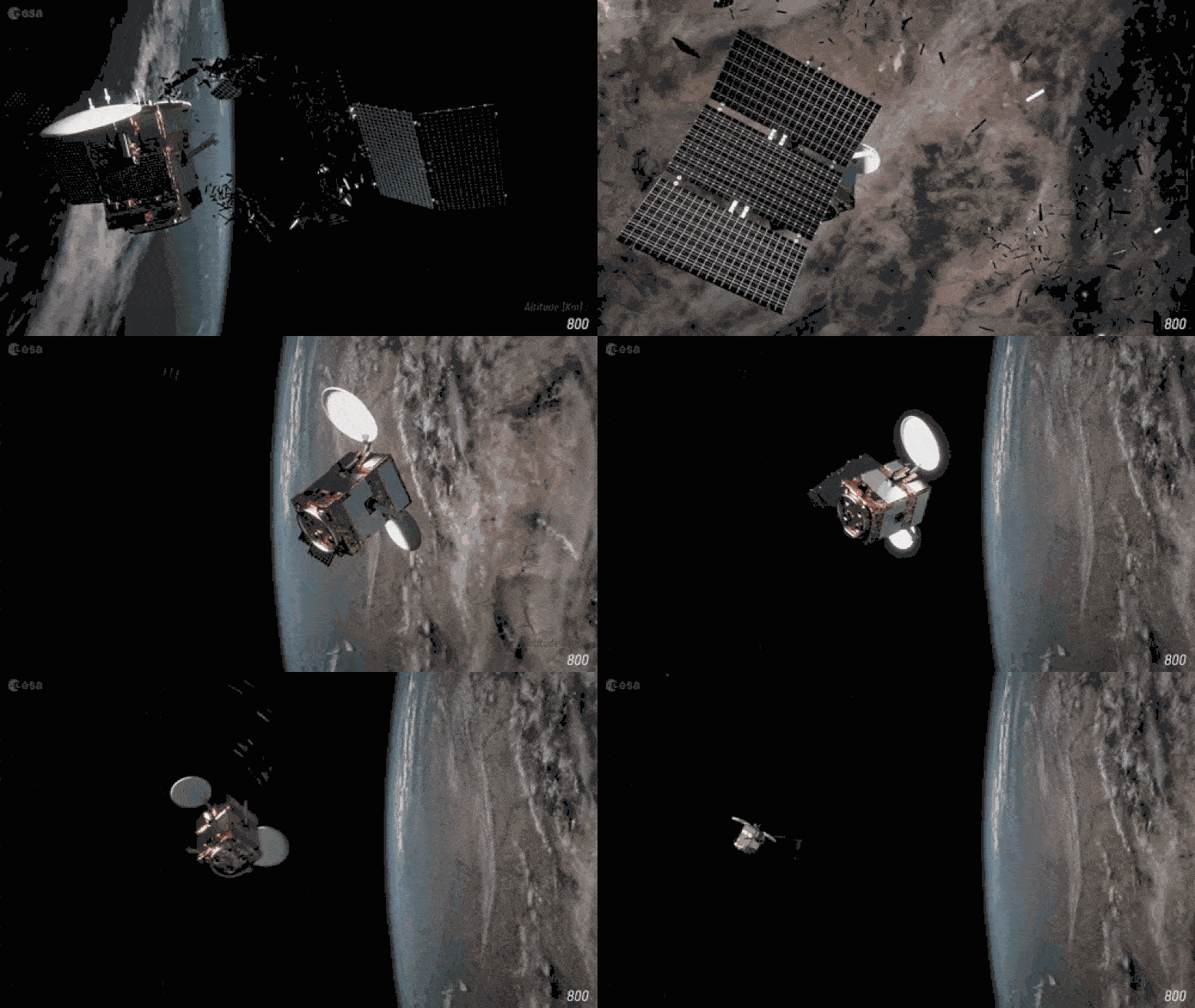
    In this animation, find out how teams at ESA’s European Space Operations Centre in Darmstadt, Germany, take action to keep satellites safe after receiving an alert warning of a possible collision between an active satellite and a piece of space debris.

    When the alert is raised, ESA experts determine the risk of a collision and plan a collision avoidance maneuver that can be used to get the satellite out of harm’s way if necessary.

    Additional observations of the piece of space debris help the team better understand its path and the risk of collision. If that risk remains too high (typically 1 in 10 000), the planned maneuver is carried out to temporarily change the orbit of the satellite until the threat has passed.

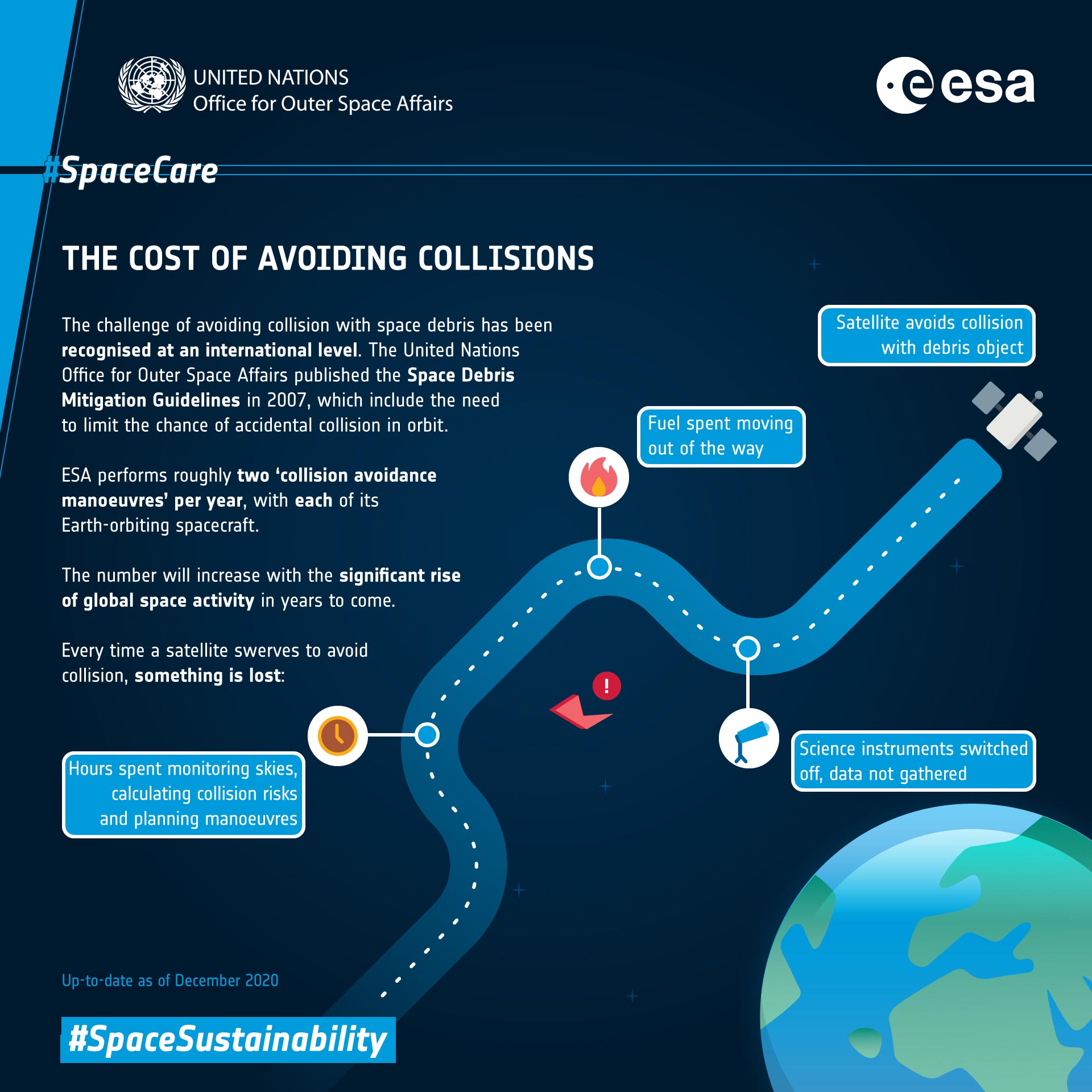
    Each maneuver comes at a price. They take skill and time to plan, cost precious fuel – shortening the lifetime of the mission – and often require instruments to be temporarily shut off, preventing them from collecting important data.
    Cost of Avoiding Collision
    Space might seem an empty, vast expanse, but satellites in Earth’s orbit face the constant risk of collision – with other satellites, dead or alive, or with fragments of debris. It is now routine for operators of spacecraft in busy highways to divert their mission out of harm’s way. In fact at ESA, each mission flown performs on average two ‘collision avoidance maneuvers’ per year. These maneuvers are costly. Hours are spent on the ground monitoring the skies, calculating the risk, and planning maneuvers, not to mention the extra fuel spent and missed science and data collected while instruments are turned off. Credit: ESA / UNOOSA

    While most alerts do not end up requiring evasive action, the number of alerts is rapidly increasing. Hundreds are already issued every week. Several companies have begun to launch large constellations into low-Earth orbit to provide global internet access. They have great benefits, but could be a source of huge disruption if we do not change our behavior.

    In just a few years, our current methods for avoiding collisions in space will no longer be enough. To safeguard humankind’s continued access to space for future generations, ESA is developing technologies for an automated collision avoidance system.

    Find out more about ESA’s Space Debris and Clean Space Offices, both part of the Space Safety Programme, and the Agency’s conference on space debris — the world’s largest on the topic — taking place in April 2021.

    Never miss a breakthrough: Join the SciTechDaily newsletter.
    Follow us on Google and Google News.

    European Space Agency Space Debris
    Share. Facebook Twitter Pinterest LinkedIn Email Reddit

    Related Articles

    ESA’s Aeolus: A Historic End to a Trailblazing Mission

    Aeolus’ Fiery Demise: The Blaze of Glory That Lights the Path to Space Safety

    Swarm Spacecraft Dodges Collision With Space Junk During Climb To Escape Sun’s Wrath

    Protecting Modern Life: New Laser Station Lights the Way To Space Debris Reduction

    ESA’s Solar Orbiter Spacecraft Is Skimming Earth for a Gravity Assist – And It’s One of the Riskiest Planetary Flybys Ever

    Drive to Destruction: Simulating Burn-Up During Atmospheric Reentry

    Space Debris: It’s Time to Act

    Space Debris Danger to Satellites: Over 129 Million Objects in Orbit Around the Earth [Video]

    Space Debris Threatens Our Continued Use of Near-Earth Space for the Benefit of Humankind

    3 Comments

    1. GHOSTRIDER on April 22, 2021 1:57 pm

      The satilite should monitor itself and make it’s own course correction how hard can that be I think it would be way easyer then your way some simple gear a radar system and a gidience system would do it uses are just to cheap with your money make it the best it can be then you can spend your time relaxing instead of watching for debris in the sky

      Reply
    2. jake3_14 on April 22, 2021 4:12 pm

      Our satellite technologies are far from perfect. A Kessler syndrome/cascade is inevitable.

      Reply
    3. Ken on April 24, 2021 4:31 am

      Is this another “horses already out of the barn” situation? Human beings tend to focus on immediate goals, while letting the negative results of attaining those goals proliferate to the crisis point. Then we find ourselves having to devise complicated procedures to deal with escalating problems that should have been dealt with from the ground up, but instead now threaten what we gained from the venture in the first place. Will we never learn?

      Reply
    Leave A Reply Cancel Reply

    • Facebook
    • Twitter
    • Pinterest
    • YouTube

    Don't Miss a Discovery

    Subscribe for the Latest in Science & Tech!

    Trending News

    Scientists Uncover Potential Brain Risks of Popular Fish Oil Supplements

    Scientists Discover a Surprising Way To Make Bread Healthier and More Nutritious

    After 60 Years, Scientists Uncover Unexpected Brain Effects of Popular Diabetes Drug Metformin

    New Research Uncovers Hidden Side Effects of Popular Weight-Loss Drugs

    Scientists Rethink Extreme Warming After Surprising Ocean Discovery

    Landmark Study Links Never Marrying to Significantly Higher Cancer Risk

    Researchers Discover Unknown Beetle Species Just Steps From Their Lab

    Largest-Ever Study Finds Medicinal Cannabis Ineffective for Anxiety, Depression, PTSD

    Follow SciTechDaily
    • Facebook
    • Twitter
    • YouTube
    • Pinterest
    • Newsletter
    • RSS
    SciTech News
    • Biology News
    • Chemistry News
    • Earth News
    • Health News
    • Physics News
    • Science News
    • Space News
    • Technology News
    Recent Posts
    • Scientists Discover Caffeine Can Repair Key Memory Circuits After Sleep Loss
    • Strange 65-Foot Dinosaur Discovered in Argentina
    • Researchers Uncover Source of Strange Deformation in Earth’s Largest Continental Rift
    • Scientists Solve Mystery of Where the Colorado River Vanished Millions of Years Ago
    • Not Just Alzheimer’s: Scientists Uncover Clues to a Second, Overlooked Disorder
    Copyright © 1998 - 2026 SciTechDaily. All Rights Reserved.
    • Science News
    • About
    • Contact
    • Editorial Board
    • Privacy Policy
    • Terms of Use

    Type above and press Enter to search. Press Esc to cancel.