
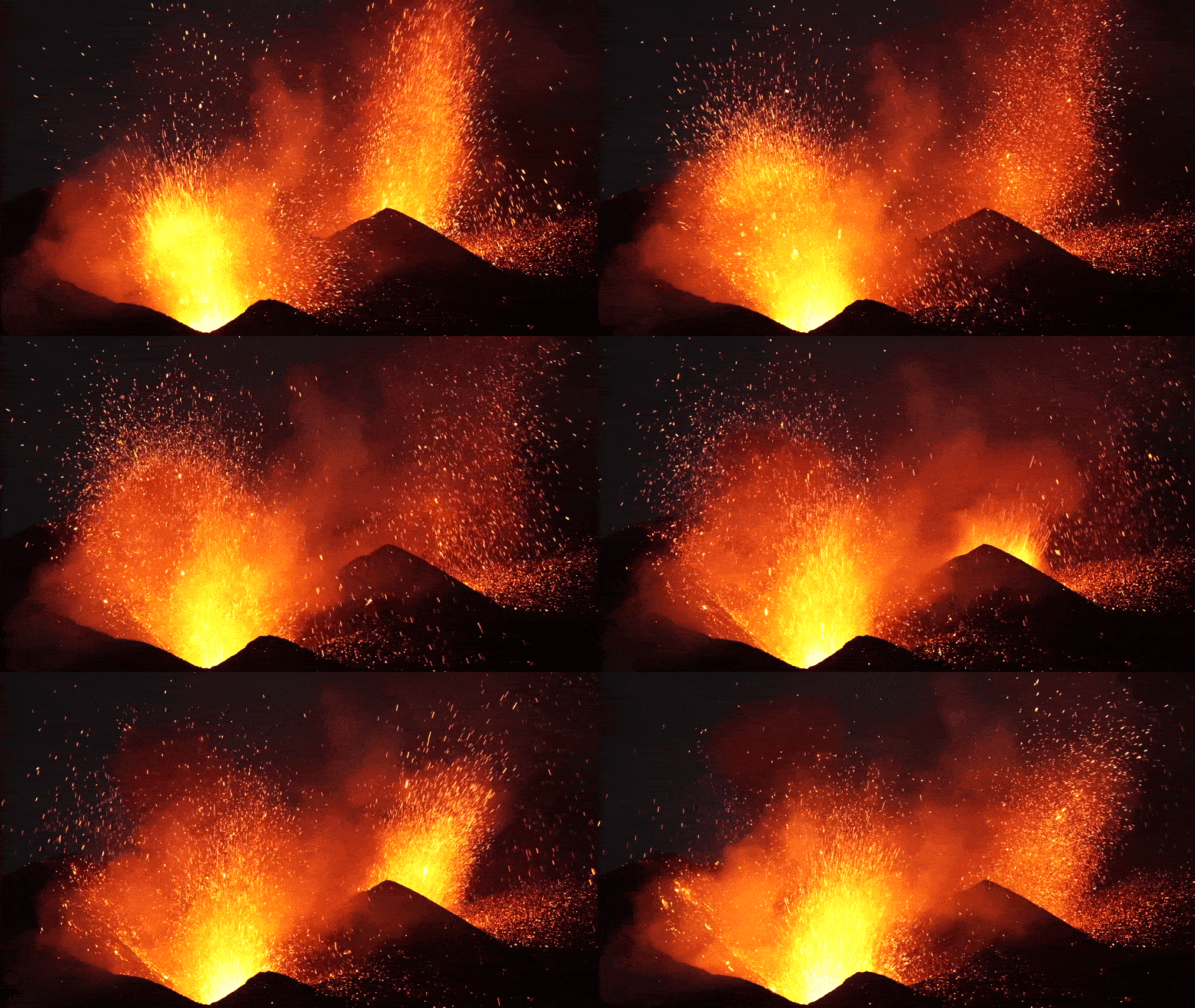
Researchers simulated metal-rich lava flows to predict what volcanism might look like on metallic bodies like asteroid 16 Psyche.
What would a volcano — and its lava flows — look like on a planetary body made primarily of metal? A pilot study from North Carolina State University offers insights into ferrovolcanism that could help scientists interpret landscape features on other worlds.
Volcanoes form when magma, which consists of the partially molten solids beneath a planet’s surface, erupts. On Earth, that magma is mostly molten rock, composed largely of silica. But not every planetary body is made of rock — some can be primarily icy or even metallic.
“Cryovolcanism is volcanic activity on icy worlds, and we’ve seen it happen on Saturn’s moon Enceladus,” says Arianna Soldati, assistant professor of marine, earth, and atmospheric sciences at NC State and lead author of a paper describing the work. “But ferrovolcanism, volcanic activity on metallic worlds, hasn’t been observed yet.”
16 Psyche: A Metallic Asteroid
Enter 16 Psyche, a 140-mile (225-kilometer) diameter asteroid situated in the asteroid belt between Mars and Jupiter. Its surface, according to infrared and radar observations, is mainly iron and nickel. 16 Psyche is the subject of an upcoming NASA mission, and the asteroid inspired Soldati to think about what volcanic activity might look like on a metallic world.
“When we look at images of worlds unlike ours, we still use what happens on Earth — like evidence of volcanic eruptions — to interpret them,” Soldati says. “However, we don’t have widespread metallic volcanism on Earth, so we must imagine what those volcanic processes might look like on other worlds so that we can interpret images correctly.”
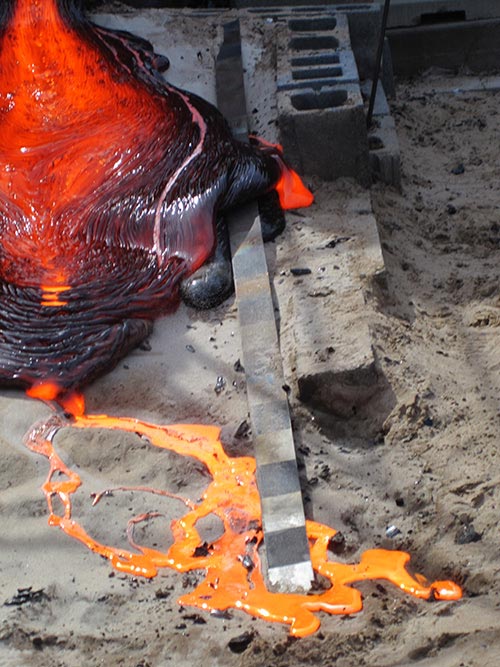
Soldati defines two possible types of ferrovolcanism: Type 1, or pure ferrovolcanism, occurring on entirely metallic bodies; and Type 2, spurious ferrovolcanism, occurring on hybrid rocky-metallic bodies.
In a pilot study, Soldati and colleagues from the Syracuse Lava Project produced Type 2 ferrovolcanism, in which metal separates from rock as the magma forms.
“The Lava Project’s furnace is configured for melting rock, so we were working with the metals (mainly iron) that naturally occur within them,” Soldati says. “When you melt rock under the extreme conditions of the furnace, some of the iron will separate out and sink to the bottom since it’s heavier. By completely emptying the furnace, we were able to see how that metal magma behaved compared to the rock one.”
Metal vs. Rock: Different Lava, Different Landscapes
The metallic lava flows traveled 10 times faster and spread more thinly than the rock flows, breaking into a myriad of braided channels. The metal also traveled largely beneath the rock flow, emerging from the leading edge of the rocky lava.
The smooth, thin, braided, widely spread layers of metallic lava would leave a very different impression on a planet’s surface than the often thick, rough, rocky flows we find on Earth, according to Soldati.
“Although this is a pilot project, there are still some things we can say,” Soldati says. “If there were volcanoes on 16 Psyche — or on another metallic body — they definitely wouldn’t look like the steep-sided Mt. Fuji, an iconic terrestrial volcano. Instead, they would probably have gentle slopes and broad cones. That’s how an iron volcano would be built — thin flows that expand over longer distances.”
Reference: “Imagining and constraining ferrovolcanic eruptions and landscapes through large-scale experiments” by A. Soldati, J. A. Farrell, R. Wysocki and J. A. Karson, 17 March 2021, Nature Communications.
DOI: 10.1038/s41467-021-21582-w
The work appears in Nature Communications. James Farrell, Bob Wysocki, and Jeff Karson of Syracuse University’s Syracuse Lava Project are coauthors of the work.
Never miss a breakthrough: Join the SciTechDaily newsletter.
Follow us on Google and Google News.