
Close Menu
    Facebook X (Twitter) Instagram
    SciTechDaily
    • Biology
    • Chemistry
    • Earth
    • Health
    • Physics
    • Science
    • Space
    • Technology
    Facebook X (Twitter) Pinterest YouTube RSS
    SciTechDaily
    Home»Health»Uncovering Why the COVID-19 Virus Is So Infectious and Efficiently Evades Immune Responses
    Health

    Uncovering Why the COVID-19 Virus Is So Infectious and Efficiently Evades Immune Responses

    By University of MinnesotaMay 11, 2020No Comments2 Mins Read
    Facebook Twitter Pinterest Telegram LinkedIn WhatsApp Email Reddit
    Share
    Facebook Twitter LinkedIn Pinterest Telegram Email Reddit
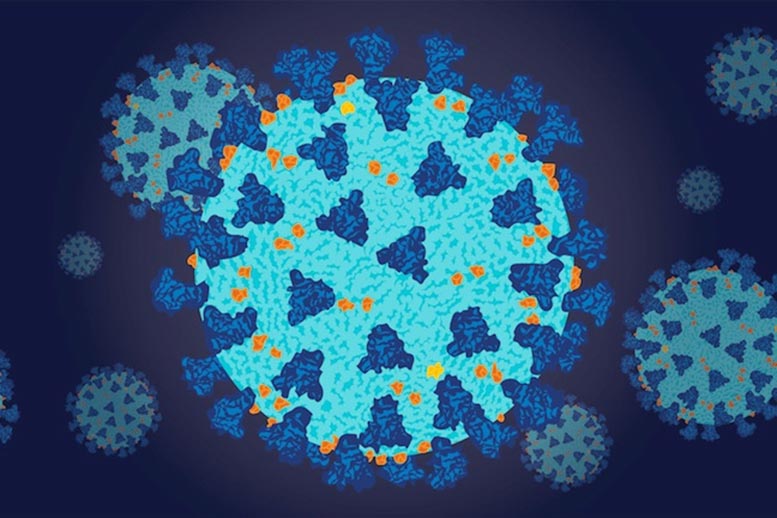
    SARS-CoV-2 Virus Illustration
    SARS-CoV-2 virus illustration. Credit: Megan Murrell / University of Minnesota

    SARS-CoV-2, the virus that causes COVID-19, is highly infectious. Curiously, in many patients, it triggers poor immune responses, which prolongs illness. This helps the virus spread widely, exacerbating the global pandemic. In a new study published in the Proceedings of the National Academy of Sciences, researchers at the University of Minnesota identified the biochemical mechanism that may explain how the virus infects people efficiently while evading their immune responses.

    This study, led by Fang Li, a professor in the College of Veterinary Medicine, examined the mechanism by which SARS-CoV-2 enters cells. Specifically, the team of scientists investigated how the virus “unlocks” human cells using a surface spike protein as the “key.” They made three important findings:

    • the tip of the viral key binds strongly to human cells;
    • the tip of the viral key is often hidden; and
    • when new virus particles are made, the viral key is already pre-activated by a human enzyme.

    “Typically when a virus develops mechanisms to evade immune responses, it loses its potency to infect people,” said Li. “However, SARS-CoV-2 maintains its infectivity using two mechanisms. First, during its limited exposure time, the tip of the viral key grabs a receptor protein on human cells quickly and firmly. Second, the pre-activation of the viral key allows the virus to more effectively infect human cells.”

    Li says that recognizing the evasiveness of SARS-CoV-2 is important for designing antibody drugs and vaccines. Antibody drugs would need to overpower the tip of the hidden viral key by latching onto it very quickly and tightly during its limited exposure time. Alternatively, drugs can target other parts of the viral key that are more exposed.

    Li recommends that successful antiviral strategies will need to consider both the potency of the virus and its evasiveness.

    Reference: “Cell entry mechanisms of SARS-CoV-2” by Jian Shang, Yushun Wan, Chuming Luo, Gang Ye, Qibin Geng, Ashley Auerbach and Fang Li, 6 May 2020, Proceedings of the National Academy of Sciences.
    DOI: 10.1073/pnas.2003138117

    The study is coauthored by postdoctoral researchers Jian Shang, Yushun Wan, and Chuming Luo, graduate students Gang Ye and Qibin Geng, and junior scientist Ashley Auerbach. The National Institutes of Health funded the study.

    Never miss a breakthrough: Join the SciTechDaily newsletter.
    Follow us on Google and Google News.

    COVID-19 Popular Public Health University of Minnesota Virology
    Share. Facebook Twitter Pinterest LinkedIn Email Reddit

    Related Articles

    New Drugs Outperform Paxlovid – A Game Changer for COVID and Future Pandemics

    “There Is Hope for This Horrible Pandemic” – Trial Drug Can Block Early Stages of COVID-19

    Stanford: How Humanity Has ‘Engineered a World Ripe for Pandemics’

    Mothers in China With COVID-19 Gave Birth as Doctors Observed – Here’s What They Found

    New Coronavirus That Causes COVID-19 Is Stable for Hours on Surfaces

    Rapid Spread of Coronavirus Outbreak Fueled by ‘Stealth Transmission’

    MIT COVID-19 Diagnostic Could Aid Efforts to Detect and Prevent the Spread of Coronavirus

    Scientific Estimates of Spread of Coronavirus Much Higher Than Official Reports

    “Snake Pneumonia” – Coronavirus Outbreak in China Traced to Snakes by Genetic Analysis

    Leave A Reply Cancel Reply

    • Facebook
    • Twitter
    • Pinterest
    • YouTube

    Don't Miss a Discovery

    Subscribe for the Latest in Science & Tech!

    Trending News

    Why Popular Diabetes Drugs Like Ozempic Don’t Work for Everyone: The “Genetic Glitch”

    Scientists Stunned After Finding Plant Thought Extinct for 60 Years

    Scientists Discover Tiny New Spider That Hunts Prey 6x Its Size

    Natural Component From Licorice Shows Promise for Treating Inflammatory Bowel Disease

    Scientists Warn: Popular Sweetener Linked to Dangerous Metabolic Effects

    Monster Storms on Jupiter Unleash Lightning Beyond Anything on Earth

    Scientists Create “Liquid Gears” That Spin Without Touching

    The Simple Habit That Could Help Prevent Cancer

    Follow SciTechDaily
    • Facebook
    • Twitter
    • YouTube
    • Pinterest
    • Newsletter
    • RSS
    SciTech News
    • Biology News
    • Chemistry News
    • Earth News
    • Health News
    • Physics News
    • Science News
    • Space News
    • Technology News
    Recent Posts
    • Your Blood Test Might Already Show Alzheimer’s Risk
    • Common Pregnancy Medications Linked to Higher Autism Risk in Massive U.S. Study
    • Scientists Teach AI To Think Like a Professional Chemist
    • Scientists Were Wrong About This Strange “Rule-Breaking” Particle
    • Webb Space Telescope Uncovers Unexpected Ice Clouds on a Jupiter-Like World
    Copyright © 1998 - 2026 SciTechDaily. All Rights Reserved.
    • Science News
    • About
    • Contact
    • Editorial Board
    • Privacy Policy
    • Terms of Use

    Type above and press Enter to search. Press Esc to cancel.