
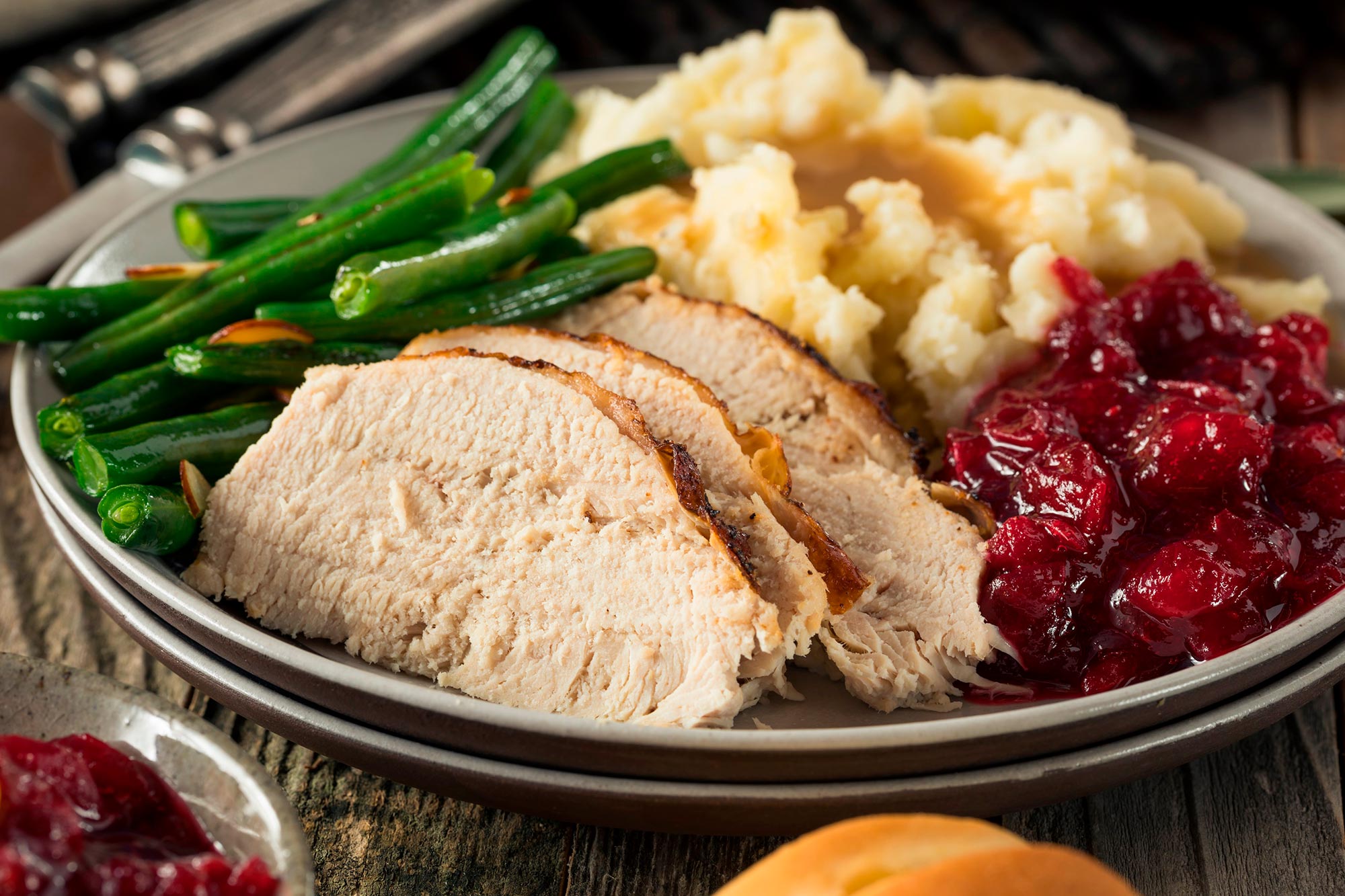
According to data in mice, extra tryptophan could reduce the risk of future colitis flares.
Thanksgiving is often a time for thinking about your belly. For those with an inflammatory bowel disease like ulcerative colitis, feasting can be associated with stress, even when food isn’t a trigger for the painful symptoms. New research in mice suggests that certain foods – especially those high in tryptophan, like turkey, pork, nuts, and seeds – could reduce the risk of a colitis flare. The findings point to a noninvasive method of improving long-term colitis management, if the results are validated in people.
Research Findings and Implications
“Although there are some treatments for ulcerative colitis, not everyone responds to them,” says senior author Sangwon Kim, Ph.D., an assistant professor of immunology at Thomas Jefferson University. “This disease has a huge impact on quality of life, and can lead to surgery to remove the colon or cancer.” The research was published on November 14 in the scientific journal Nature Communications.
Since ulcerative colitis is caused by inflammation of the inner lining of the colon and rectum, Dr. Kim and his colleagues looked for ways to cool down the inflamed tissue. They focused on a group of immune cells called T-regulatory (T-reg) cells, which can help break the cycle of inflammation. If they could get more T-reg cells to the colon, perhaps they could reduce the inflammation that causes colitis.
Dr. Kim’s team thought about how to attract the T-reg cells, and found a specific receptors on the surface of T-reg cells that acts like a magnet for the colon. The more of this receptor, called CPR15, the T-reg cells have, the more strongly they’re attracted to the colon. So they searched for molecules that could make T-reg cells produce more GPR15 to turn up the power of the magnet. They found tryptophan – or one of the molecules that tryptophan breaks down into in the body – could increase these receptors called GPR15.
Dietary Tryptophan and Its Effects
To test whether these molecules could control colitis, the researchers supplemented tryptophan in the diet of mice over a period of two weeks. They saw a doubling in the amount of inflammation-suppressing T-reg cells in the colon tissue compared to mice that weren’t fed extra tryptophan. Dr. Kim’s team also saw a reduction in colitis symptoms. What’s more, the effects seemed to last for at least a week after tryptophan was removed from the diet. “In human time that might translate to about a month of benefit,” explained Dr. Kim who is also a researcher at the Sidney Kimmel Cancer Center – Jefferson Health.
However, when tryptophan was given to mice during a colitis flare, it provided little benefit, suggesting this dietary change might only be effective at preventing future flares rather than treating them.
Additional Discoveries and Future Research
In a chance finding, while looking for molecules that could increase GPR15, the researchers also stumbled across a molecule that helps explain why smoking seems to be protective against colitis. Researchers have long observed that people who smoke cigarettes have a lower incidence of ulcerative colitis than the general public. Dr. Kim’s team found a molecule that is prevalent in smoke – from cigarettes and barbeque alike – that can also increase GPR15 levels on T-reg cells “Although both might help protect against colitis, tryptophan is obviously the much safer and healthier option,” says Dr. Kim.
In the future, the researchers plan to test whether these results can be translated to people with colitis. Tryptophan supplement is considered safe, as long as the dose doesn’t exceed 100 milligrams per day. Using the mouse data as a guide, Dr. Kim expects that 100 milligrams could be enough to see an effect in humans, and is planning further testing in clinical trials.
Reference: “Dietary L-Tryptophan consumption determines the number of colonic regulatory T cells and susceptibility to colitis via GPR15” by Nguyen T. Van, Karen Zhang, Rachel M. Wigmore, Anne I. Kennedy, Carolina R. DaSilva, Jialing Huang, Manju Ambelil, Jose H. Villagomez, Gerald J. O’Connor, Randy S. Longman, Miao Cao, Adam E. Snook, Michael Platten, Gerard Kasenty, Luis J. Sigal, George C. Prendergast and Sangwon V. Kim, 14 November 2023, Nature Communications.
DOI: 10.1038/s41467-023-43211-4
This work was supported by NIAID grant R01AI141787 (S.V.K), NIAID grant R21AI142318 (S.V.K.), Career Development Award from Crohn’s and Colitis Foundation of America (#329388) (S.V.K.), SKCC pilot fund for the iGONAD method of mouse genetic modification (L.J.S.), and National Institute of Health grant 5P30CA056036-22 (TJU SKCC core grant). Dr. Kim holds a patent related to this work. The authors declare no other conflicts of interest.
Never miss a breakthrough: Join the SciTechDaily newsletter.
Follow us on Google and Google News.