
Close Menu
    Facebook X (Twitter) Instagram
    SciTechDaily
    • Biology
    • Chemistry
    • Earth
    • Health
    • Physics
    • Science
    • Space
    • Technology
    Facebook X (Twitter) Pinterest YouTube RSS
    SciTechDaily
    Home»Biology»Researchers Decipher the Structure of the MHC-I Peptide-Loading Complex
    Biology

    Researchers Decipher the Structure of the MHC-I Peptide-Loading Complex

    By Max Planck InstituteNovember 13, 2017No Comments3 Mins Read
    Facebook Twitter Pinterest Telegram LinkedIn WhatsApp Email Reddit
    Share
    Facebook Twitter LinkedIn Pinterest Telegram Email Reddit
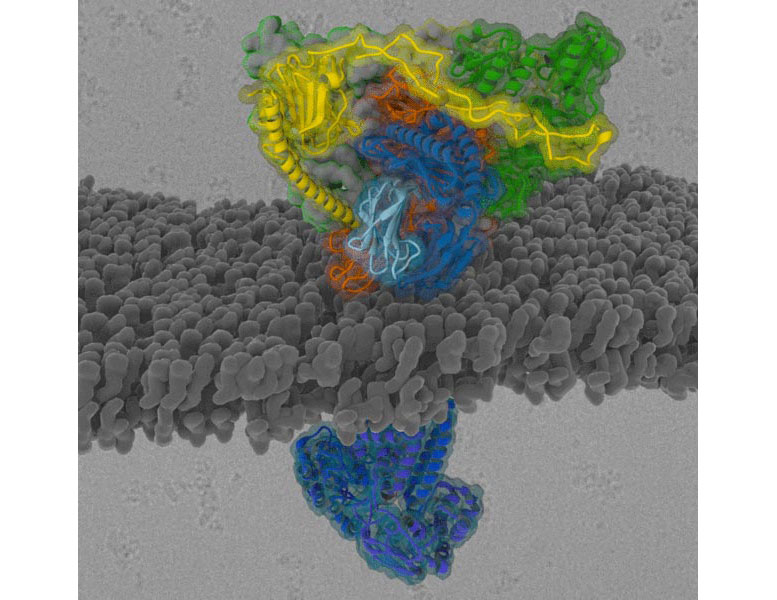
    Structure of the Human MHC-I Peptide-Loading Complex
    Structure of the MHC-I peptide-loading complex in the membrane of the endoplasmic reticulum. © S. Trowitzsch, A. Möller, R. Tampé

    Researchers at the Max Planck Institute of Biophysics, Goethe University in Frankfurt and Martin Luther University in Halle-Wittenberg are deciphering the structure of the MHC-I peptide-loading complex.

    Nowadays, social media help us to keep abreast of current events. As we are unable to process the entire flood of information at once, neural networks extract only the information we need to know. The cells in our body act in a similar manner: In the fight against parasites, viruses, and even cancer, a molecular machine called the MHC-I peptide-loading complex selects protein fragments important for the immune system.

    In cells, status updates in the form of small protein fragments carry information from the cell’s interior. These peptides are presented on the cell’s surface by MHC-I proteins, short for major histocompatibility complex class I proteins, so that they can be detected by the immune system. MHC-I molecules rapidly deliver information about cancer cells or virus-infected cells to the immune system. This enables the immune system to recognize degenerate or infected cells and eliminate them. However, a faulty message can lead to autoimmune diseases or chronic inflammation.

    “In order to investigate the structure of this extremely fragile complex, we first developed a molecular bait. Using this tool, we were able to isolate the MHC-I peptide-loading complex from the endoplasmic reticulum,” explains Simon Trowitzsch of the Biocenter at Goethe University in Frankfurt. “Thanks to groundbreaking improvements in cryo-electron microscopy, which recently garnered the Nobel Prize, we were able to observe the MHC-I peptide complex directly and elucidate its structure,” adds Arne Möller of the Max Planck Institute of Biophysics.

    In order for the cell to provide information to the immune system, membrane transport proteins, folding enzymes, and MHC-I molecules must work together precisely within a complex. The results of the study show how the MHC-I peptide-loading complex filters out only those protein fragments that are recognized by immune cells. “These findings are significant because viruses and cancer cells interfere with information transfer and are able to outsmart the immune system. We now better understand how cells select antigens to detect cancer or infections. This could help to improve immunotherapies,” says Robert Tampé of the Institute of Biochemistry at Goethe University.

    Reference: “Structure of the human MHC-I peptide-loading complex” by Andreas Blees, Dovile Januliene, Tommy Hofmann, Nicole Koller, Carla Schmidt, Simon Trowitzsch, Arne Moeller and Robert Tampé, 1 November 2017, Nature.
    DOI: 10.1038/nature24627

    Never miss a breakthrough: Join the SciTechDaily newsletter.
    Follow us on Google and Google News.

    Biophysics Cell Biology Immunobiology Max Planck Institute
    Share. Facebook Twitter Pinterest LinkedIn Email Reddit

    Related Articles

    Can We Program Life? Rewriting the Rulebook on How Cells Self-Organize

    Scientists Discover a New Class of “Molecular Motors”

    New Technique Allows Scientists to Switch ATP Synthase On and Off Using UV Light

    Researchers Generate Immune Responses From Stem Cell Grown Thymus Tissue

    Scientists Synthesize the First Biologically Effective Perfume

    Ajuba Regulates Stem Cell Activity in the Heart

    β-Catenin Regulates Telomerase in Stem Cells and Cancer Cells

    DNA Jumps Directly From the Cell’s Chloroplasts Into Its Nucleus

    Researchers Track Development of T-cells in Living Zebrafish Embryos

    Leave A Reply Cancel Reply

    • Facebook
    • Twitter
    • Pinterest
    • YouTube

    Don't Miss a Discovery

    Subscribe for the Latest in Science & Tech!

    Trending News

    Even Occasional Binge Drinking May Triple Liver Damage Risk

    Liftoff! NASA’s Artemis II Launch Sends Astronauts Around the Moon for First Time in 50 Years

    Scientists Discover New Way To Eliminate “Zombie Cells” Driving Aging

    This New Quantum Theory Could Change Everything We Know About the Big Bang

    This One Vitamin May Help Protect Your Brain From Dementia Years Later

    Stopping Weight-Loss Drugs Like Ozempic Can Quickly Erase Heart Benefits

    A 500-Million-Year-Old Surprise Is Forcing Scientists to Rethink Spider Evolution

    Coffee and Blood Pressure: What You Need To Know Before Your Next Cup

    Follow SciTechDaily
    • Facebook
    • Twitter
    • YouTube
    • Pinterest
    • Newsletter
    • RSS
    SciTech News
    • Biology News
    • Chemistry News
    • Earth News
    • Health News
    • Physics News
    • Science News
    • Space News
    • Technology News
    Recent Posts
    • Childhood Junk Food May Rewire the Brain for Life
    • NIH Scientists Discover Powerful New Opioid That Relieves Pain Without Dangerous Side Effects
    • Breakthrough Study Reveals Why Damaged Nerves Struggle To Heal
    • 20-Year Study Reveals Cholera’s Surprising Weakness
    • $220 Billion Problem: Scientists Uncover the Secret Weapon Bacteria Use To Take Over Crops
    Copyright © 1998 - 2026 SciTechDaily. All Rights Reserved.
    • Science News
    • About
    • Contact
    • Editorial Board
    • Privacy Policy
    • Terms of Use

    Type above and press Enter to search. Press Esc to cancel.