
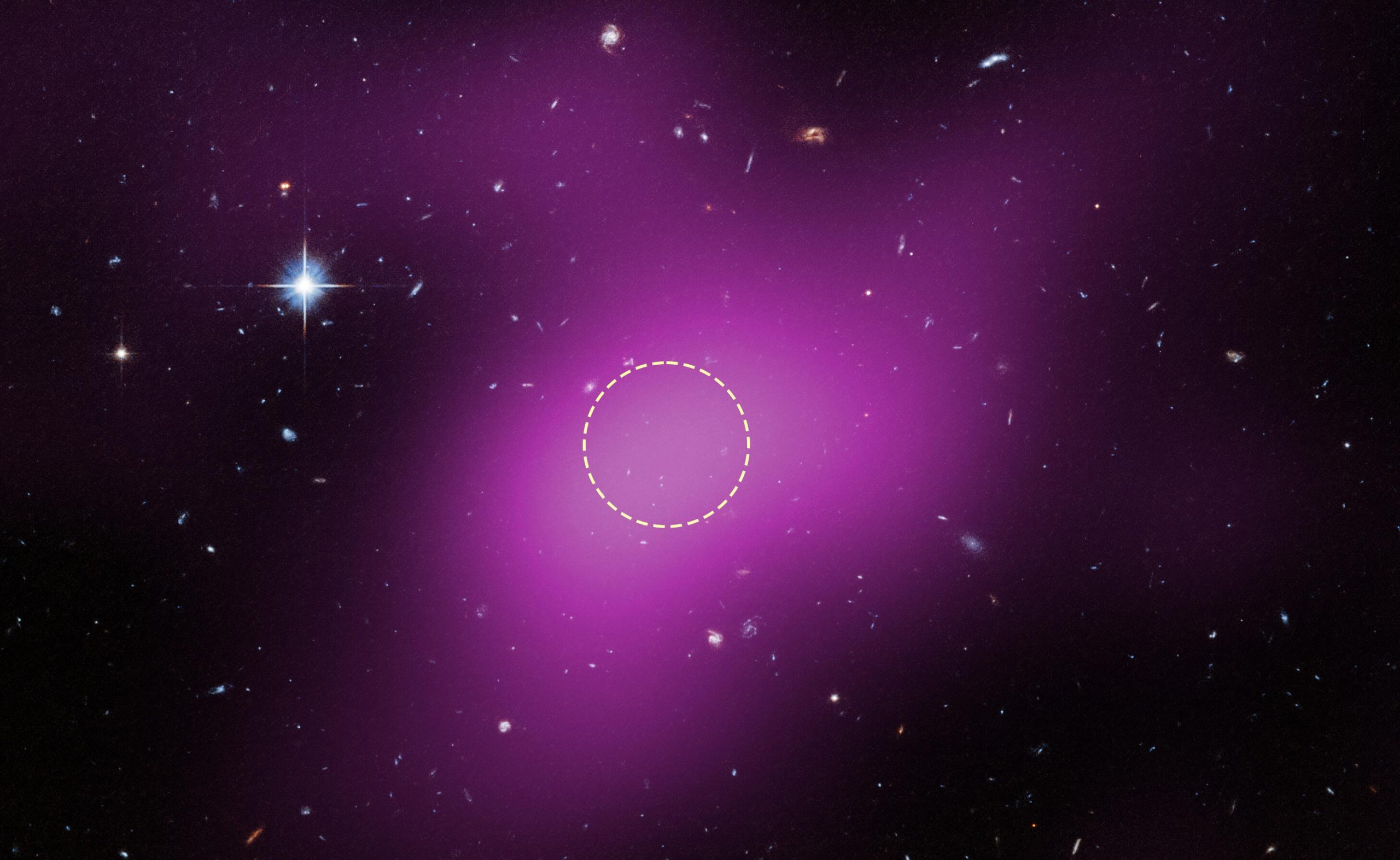
Scientists have identified a strange cosmic relic called Cloud-9 — a starless, gas-filled object dominated by dark matter.
Detected with Hubble, it appears to be a failed galaxy that never formed stars, preserving a snapshot of the early Universe.
A Starless Relic Revealed by Hubble
Astronomers using the Hubble Space Telescope have identified a previously unseen kind of cosmic object. It is a cloud filled with gas and dominated by dark matter, yet it contains no stars at all. Researchers describe it as a relic left over from the earliest stages of galaxy formation. Known as “Cloud-9,” it represents the first confirmed discovery of this type of object anywhere in the Universe.
“This is a tale of a failed galaxy,” said the program’s principal investigator, Alejandro Benitez-Llambay of the Milano-Bicocca University in Milan, Italy. “In science, we usually learn more from the failures than from the successes. In this case, seeing no stars is what proves the theory right. It tells us that we have found in the local Universe a primordial building block of a galaxy that hasn’t formed.”
A Rare View Into the Dark Universe
“This cloud is a window into the dark Universe,” explained team member Andrew Fox of AURA/STScI for the European Space Agency. “We know from theory that most of the mass in the Universe is expected to be dark matter, but it’s difficult to detect this dark material because it doesn’t emit light. Cloud-9 gives us a rare look at a dark-matter-dominated cloud.”
Cloud-9 belongs to a class of objects known as Reionization-Limited H I Clouds, or “RELHICs.” The term “H I” refers to neutral hydrogen, while “RELHIC” describes a hydrogen cloud formed in the early Universe that never went on to create stars. For many years, scientists had predicted the existence of such objects but lacked direct evidence. Hubble’s observations finally confirmed that this cloud truly contains no stars.
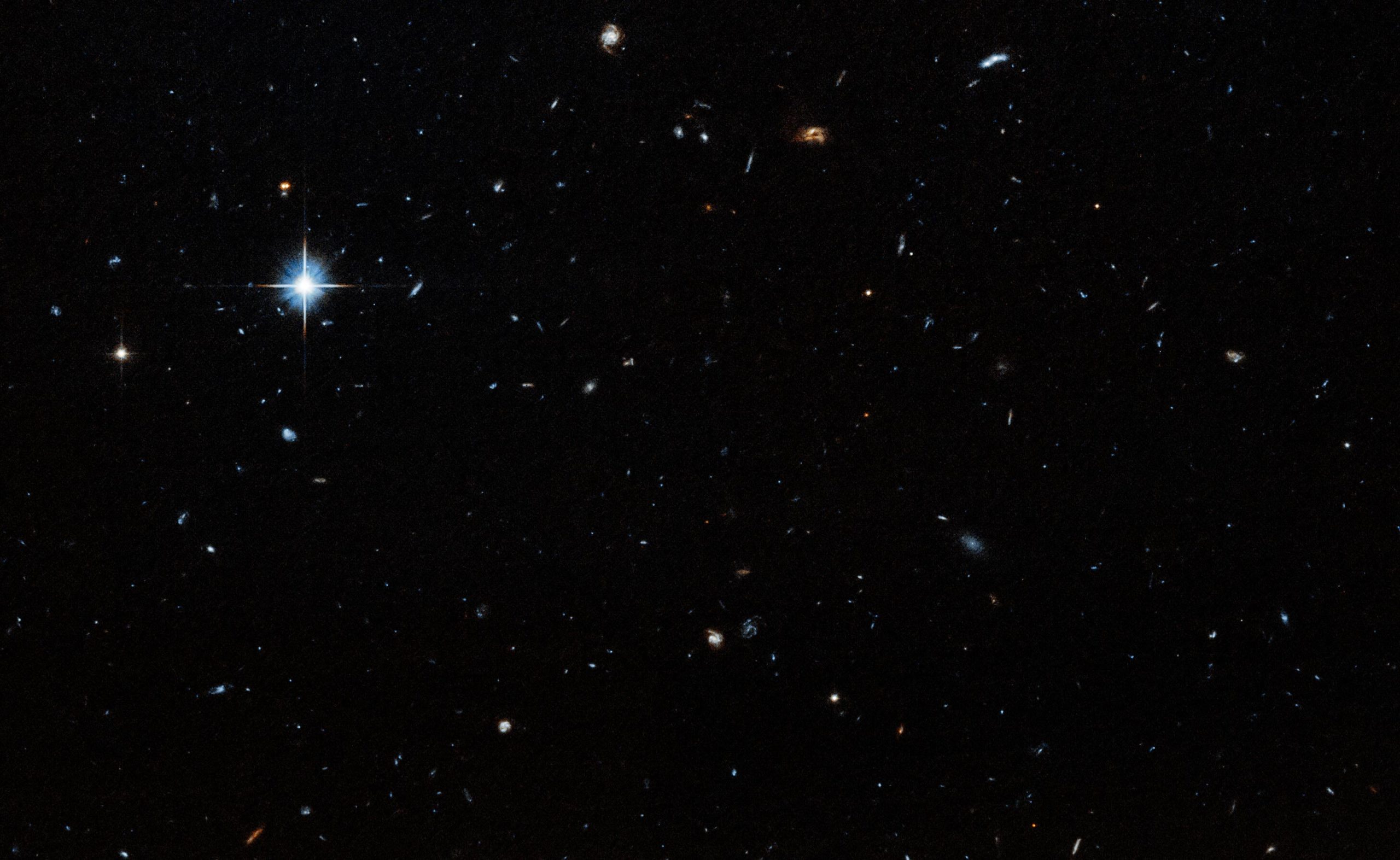
This image shows the blank field of the surrounding region of Cloud-9, which is 2000 light-years from Earth. Credit: NASA, ESA. G. Anand (STScI), and A. Benitez-Llambay (Univ. of Milan-Bicocca); Image processing: J. DePasquale (STScI)
Confirming a Long-Predicted Phantom Object
“Before we used Hubble, you could argue that this is a faint dwarf galaxy that we could not see with ground-based telescopes. They just didn’t go deep enough in sensitivity to uncover stars,” explained lead author Gagandeep Anand of the Space Telescope Science Institute (STScI), Baltimore, USA. “But with Hubble’s Advanced Camera for Surveys, we’re able to nail down that there’s nothing there.”
The discovery itself came as a surprise to the research team. “Among our galactic neighbors, there might be a few abandoned houses out there,” said STScI’s Rachael Beaton, who is also on the research team.
RELHICs are thought to be clouds of dark matter that never collected enough gas to trigger star formation. Because of this, they preserve conditions from the Universe’s earliest eras. Cloud-9 suggests that many more small, dark matter-dominated structures may exist, representing other failed galaxies. These objects are difficult to study because traditional astronomy focuses on bright stars and glowing galaxies, leaving the dark components largely hidden.
Measuring the Mass of a Dark Matter Cloud
Astronomers have studied hydrogen clouds near the Milky Way for decades, but those clouds are typically large, irregular, and very different in appearance. Cloud-9 stands out because it is smaller, more compact, and nearly spherical, giving it a distinct structure compared with other known clouds.
The central region of Cloud-9 is made of neutral hydrogen and spans roughly 4900 light-years across. The gas alone has a mass about 1 million times that of the Sun. However, observations suggest the gas pressure is balanced by the gravity of the surrounding dark matter. If that balance is correct, the total mass of Cloud-9 must be dominated by dark matter, amounting to roughly 5 billion solar masses.
Why Starless Objects Matter
Cloud-9 highlights how much of the Universe exists beyond stars. Focusing only on visible light does not tell the full story. By studying gas and dark matter together, astronomers can gain insight into systems that would otherwise remain invisible.
Detecting these failed galaxies is especially difficult because nearby bright objects can overwhelm their faint signals. They are also easily affected by environmental processes such as ram-pressure stripping, which can remove gas as the cloud travels through intergalactic space. These challenges help explain why such objects appear to be rare.
How Cloud-9 Was Found
Cloud-9 was first identified three years ago during a radio survey conducted with the Five-hundred-meter Aperture Spherical Telescope (FAST) in Guizhou, China. The detection was later confirmed by observations from the Green Bank Telescope and the Very Large Array in the United States. The name “Cloud-9” has no special meaning in Chinese culture and was assigned simply because it was the ninth gas cloud detected near the edges of the nearby spiral galaxy Messier 94 (M94).
The cloud lies close to M94 and appears to be physically linked to the galaxy. High-resolution radio observations reveal subtle distortions in the gas, which may indicate an interaction between Cloud-9 and its larger neighbor.
A Galaxy That Never Formed, or One That Might Someday
Cloud-9 could eventually become a galaxy if it gains enough mass over time. If it were significantly larger, gravity would have caused it to collapse and form stars long ago. If it were much smaller, its gas would likely have dispersed and become ionized, leaving little behind. Instead, it exists in a narrow middle range where it can persist as a RELHIC.
This discovery deepens scientists’ understanding of how galaxies form, how the early Universe evolved, and how dark matter behaves. The complete absence of stars allows researchers to study the properties of dark matter clouds without interference from starlight. As future surveys improve, astronomers expect to find more of these rare relics, offering new clues about the Universe’s hidden structure and the physics governing dark matter.
This result has been published in The Astrophysical Journal Letters.
Reference: “The First RELHIC? Cloud-9 is a Starless Gas Cloud*” by Gagandeep S. Anand, Alejandro Benítez-Llambay, Rachael Beaton, Andrew J. Fox, Julio F. Navarro and Elena D’Onghia, 10 November 2025, The Astrophysical Journal Letters.
DOI: 10.3847/2041-8213/ae1584
The Hubble Space Telescope is a project of international cooperation between ESA and NASA.
Never miss a breakthrough: Join the SciTechDaily newsletter.
Follow us on Google and Google News.
5 Comments
That’s like calling red blood cells ‘failed cells’ just because they don’t have mitochondria.
Humanity knows far too little to be describing such massive universal properties as a “failed” anything.
Error at the beginning of this summary: It is ~15 million light years away, not 2000. Lies near M94. Consult the original paper given in the link.
This is not “the first confirmed discovery of this type of object anywhere in the Universe”. Some others are J0613+52 and VIRGOH1 21.
The article states Cloud-9 is 4,900ly wide but only 2,000ly away. At that scale, it would be sitting well within the Milky Way, physically engulfing everything from Deneb and the Ring Nebula all the way out to the Eagle Nebula and the Crab Nebula. It creates quite a spatial contradiction.
“The Black Cloud” by Fred Hoyle.