
A long-term study found that brain health can improve throughout life with consistent daily habits, cognitive training, and personalized support, regardless of age.
What if the brain doesn’t have to follow the familiar path of gradual decline with age? A major new study published in Scientific Reports is challenging long-held assumptions about aging, revealing that the human brain may remain capable of measurable growth and improvement well into later life.
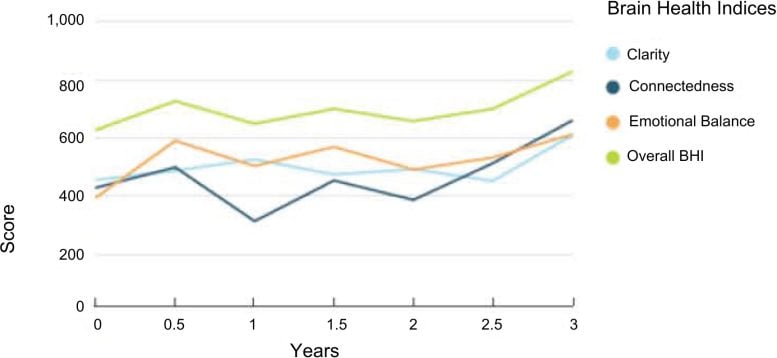
Researchers at the Center for BrainHealth at The University of Texas at Dallas tracked nearly 4,000 adults between the ages of 19 and 94 over a three-year period. Using the BrainHealth Index (BHI) — a multidimensional tool designed to assess overall brain fitness — the team found that targeted, brain-healthy habits were linked to gains in cognitive performance across the lifespan.
Unlike conventional assessments focused mainly on detecting disease or impairment, the BHI measures growth potential in three key areas: clarity (thinking skills), connectedness (social purpose), and emotional balance (mental resilience).
Key findings
- No Limit to Improvement: Participants across all performance levels showed measurable gains in brain health. Even individuals with the highest initial scores continued improving over more than 1,000 days, suggesting brain optimization may not have a clear upper limit.
- Biggest Gains Among Low Starters: People who began the study with the lowest baseline scores experienced the fastest and most significant improvement, indicating that poor brain health can be improved over time.
- Small Daily Habits Matter: The strongest results were linked to consistency. Participants who spent 5 to 15 minutes per day on microtraining exercises and incorporated brain-healthy habits into daily life achieved the highest scores.
- Benefits Across All Ages: Younger adults improved at rates similar to participants in their 70s and 80s, challenging the idea that proactive brain care only benefits older adults.
Study Challenges Myths About Cognitive Decline
“For too long, we’ve operated under the outdated notion that we need to wait until something bad happens to our brain before we do anything for it,” said Sandra Bond Chapman, PhD, chief director of the Center for BrainHealth and distinguished professor at UT Dallas.
“This study reminds us that our brain is not defined by age; it is defined by possibility. Humans have already expanded how long we live. Now, we are expanding how long the brain can continue to improve, disrupting the trajectory of decline that often begins in our early 30s. Because the true promise of longer life is a brain that allows us to thrive year by year.”
Researchers also identified what they described as a rebound effect. Participants used cognitive strategies to recover, maintain, or even improve brain health during stressful life events, including illness, job loss, and caregiving responsibilities. The findings suggest that brain health is adaptable and can be strengthened using proven techniques.
Personalized Brain Training Shows Lasting Benefits
The research was conducted through The BrainHealth Project, a long-term initiative focused on improving brain health throughout life. Available online and through a mobile app, the program combines brain strategy training, lifestyle guidance, personalized coaching, and ongoing progress tracking through the BrainHealth Index.
“Every brain is as unique as a fingerprint and has potential for growth,” said Lori Cook, PhD, director of clinical research at the Center for BrainHealth. “By moving away from one-size-fits-all solutions, we are empowering people with a personalized blueprint and the agency to continuously invest in their brain health and performance.”
Using a scalable digital platform, Center for BrainHealth has expanded its research beyond the lab into real-world settings across all 50 states and more than 60 countries. Researchers say this approach could help shift public health efforts toward proactive and cost-effective ways to improve brain performance on a global scale.
Reference: “Measuring and increasing the brain health span across adulthood: a public health imperative” by Lori G. Cook, Jeffrey S. Spence, Zhengsi Chang, Erin E. Venza, Aaron Tate, Ian H. Robertson, Mark D’Esposito, Geoffrey S. F. Ling, Jane G. Wigginton and Sandra Bond Chapman, 2 May 2026, Scientific Reports.
DOI: 10.1038/s41598-026-51403-3
Never miss a breakthrough: Join the SciTechDaily newsletter.
Follow us on Google and Google News.
6 Comments
I get smarter every day!
Read the entire paper. There are many limitations to the study that should caution interpretation.
THANK YOU for that post
We are share that post.
I also Brain Strong.
Thanks Blessings!
Building Better Brains!
I agree whole heart heartedly. I feel that keeping track track of my daily routine and constantly looking for new things, discoveres, reading and such keeps me alert and clear headed. No problems as yet.