
Close Menu
    Facebook X (Twitter) Instagram
    SciTechDaily
    • Biology
    • Chemistry
    • Earth
    • Health
    • Physics
    • Science
    • Space
    • Technology
    Facebook X (Twitter) Pinterest YouTube RSS
    SciTechDaily
    Home»Biology»Adult-Born Neurons Grow More Than Their Counterparts From Infancy – May Even Have Unique Functions
    Biology

    Adult-Born Neurons Grow More Than Their Counterparts From Infancy – May Even Have Unique Functions

    By Society for NeuroscienceJune 22, 2020No Comments2 Mins Read
    Facebook Twitter Pinterest Telegram LinkedIn WhatsApp Email Reddit
    Share
    Facebook Twitter LinkedIn Pinterest Telegram Email Reddit
    Adult-Born Neuron Reconstructions
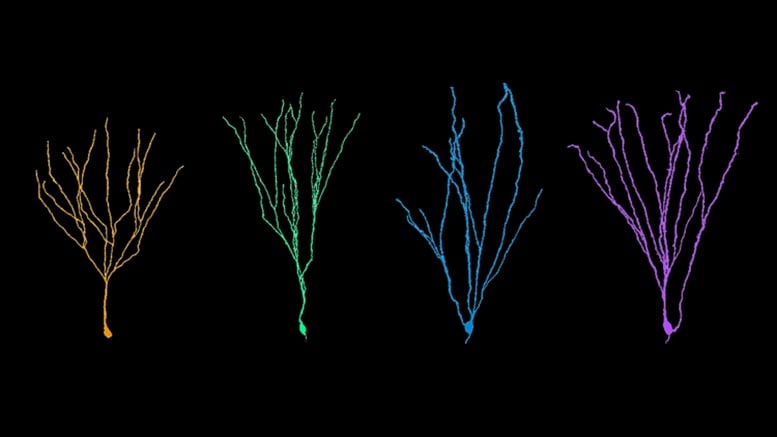
    Reconstructions of adult-born neurons. Left to right: age 2 weeks, 4 weeks, 6 weeks, and 24 weeks. Adult-born neurons continue to undergo significant morphological modifications beyond previously described developmental timelines. They remain distinct from their developmentally-born counterparts. Credit: Cole, Espinueva et al., JNeurosci 2020

    Neurons created via neurogenesis mature longer, grow larger, and may have unique functions.

    Adult-born neurons keep growing and contributing to brain flexibility long after neurogenesis declines, according to research in rats published in JNeurosci.

    The dentate gyrus, a brain region involved in distinguishing memories, creates new neurons during adulthood — that much is clear. What remains unclear is how long adult neurogenesis takes place and how many neurons it creates. However, humans may not need neurogenesis to persist for the entirety of adulthood, because the brain gets the same memory benefits from neurons that are still growing up.

    Cole, Espinueva et al. tracked neurogenesis by injecting rats’ dentate gyri with a retrovirus that incorporates itself into the DNA of dividing cells, making all the neurons born on injection day glow. Just like neurons born in infancy, adult-born neurons went through a standard six-week development period. But at the seven-week mark, growth markers like thicker dendrites reappeared, indicating an upcoming stage of growth.

    And the neurons did keep growing. Twenty-four weeks after their birth, the adult-born neurons were much bigger than infancy-born neurons, with more dendrites and potential synapses and larger synaptic terminals. This beefed-up anatomy suggests a different, perhaps more powerful function than neurons born during infancy. Since adult-born neurons slowly mature over a long period of time, they keep contributing toward plasticity.

    Reference: “Adult-Born Hippocampal Neurons Undergo Extended Development and Are Morphologically Distinct From Neonatally-Born Neurons” by John Darby Cole, Delane Espinueva, Désirée R. Seib, Alyssa M. Ash, Matthew B. Cooke, Shaina P. Cahill, Timothy O’Leary, Sharon S. Kwan and Jason S. Snyder, 22 June 2020, JNeurosci.
    DOI: 10.1523/JNEUROSCI.1665-19.2020

    Never miss a breakthrough: Join the SciTechDaily newsletter.
    Follow us on Google and Google News.

    Aging Brain Neuroscience Society for Neuroscience
    Share. Facebook Twitter Pinterest LinkedIn Email Reddit

    Related Articles

    Brain Circuit Found That Helps Explain Why Motivation to Learn Declines With Age

    Deep Inside the Brain: Neuroscientists Discover the Missing Piece of the Brain’s Multitasking Network

    Scientists Uncover Brain Mechanism That May Explain Why Sleep Helps You Learn

    Feeling Disconnected? Loneliness Alters Your Brain’s Social Network

    A Child’s Unique Brain Activity Reveals Their Memory Ability

    Unlocking the Neuroscience of How Experiencing Traumatic Stress Leads to Aggression

    Researchers Discover How Stress Restructures the Brain

    Functional Magnetic Resonance Imaging Shows How the Brain Repurposes Unused Regions

    Why Older People Are More Susceptible to Fraud

    Leave A Reply Cancel Reply

    • Facebook
    • Twitter
    • Pinterest
    • YouTube

    Don't Miss a Discovery

    Subscribe for the Latest in Science & Tech!

    Trending News

    Invisible Black Holes Could Be Triggering Supernovae

    Scientists Discover the First Contagious Cancer in a Freshwater Animal

    THC-CBD Treatment Dramatically Reduces Agitation in Dementia Trial

    Scientists Say Love Follows Mathematical Patterns

    “Zombie Cells” Reveal a Hidden Weakness That Could Help Fight Aging

    Alien Signals May Be Hiding in a Radio Band SETI Has Barely Explored

    Earth’s Hidden Thermostat Has Regulated Climate for 60 Million Years

    This 518-Million-Year-Old Creature Reveals How Spiders Got Their Bite

    Follow SciTechDaily
    • Facebook
    • Twitter
    • YouTube
    • Pinterest
    • Newsletter
    • RSS
    SciTech News
    • Biology News
    • Chemistry News
    • Earth News
    • Health News
    • Physics News
    • Science News
    • Space News
    • Technology News
    Recent Posts
    • Tiny Divers Challenge a Major Theory About Ocean Insects
    • More Than 1,500 Ships Could Carry a Marine Crisis Around the World
    • New Compound Could Help Aging Muscles Repair Themselves
    • Exercise Helps Hip Arthritis but the Relief May Be Hard to Notice
    • Rare Bourbon Virus Confirmed in New York for the First Time
    Copyright © 1998 - 2026 SciTechDaily. All Rights Reserved.
    • Science News
    • About
    • Contact
    • Editorial Board
    • Privacy Policy
    • Terms of Use

    Type above and press Enter to search. Press Esc to cancel.