
Neuroscientists at Synapsy have identified one of the mechanisms behind the antidepressant effect of lactate, a molecule produced by the body during exercise. Its key features – lactate, NADH, and neurogenesis – will pave the way for new treatment possibilities.
Depression is the leading cause of disability worldwide. Neuroscientists from Synapsy – the Swiss National Centre of Competence in Research into Mental Illness – based at Lausanne University Hospital (CHUV) and Lausanne University (UNIL) have recently demonstrated that lactate, a molecule produced by the body during exercise, has an antidepressant effect in mice. Lactate is best known for the pivotal role it plays in the nutrition of neurons inside the brain. Yet it can also counter the inhibition of the survival and proliferation of new neurons, a loss seen in patients suffering from depression and in stressed animal. Furthermore, the research team pinpointed NADH as a vital component in the mechanism: this is a molecule with antioxidant properties that is derived from the metabolism of lactate. The findings, published in the scientific journal Molecular Psychiatry, provide a better understanding of the physiological mechanisms that underpin physical activity, which should lead to an improvement in the way depression is treated in the future.
WHO recognizes depression – which affects nearly 264 million people – as the leading cause of disability worldwide. Treatments based on antidepressants and psychotherapy are available to help people suffering from the disorder. Yet, as Jean-Luc Martin, senior lecturer and researcher at CHUV’s Centre for Psychiatric Neurosciences (CNP) and UNIL, Synapsy member and co-director of the study together with Professor Pierre Magistretti, points out: “Around 30% of people with depression don’t respond to antidepressants.” At the same time, the antidepressant effects of physical activity have been known for many years, even though the scientific community has struggled to figure out the molecular mechanisms involved.
Exercise and Lactate: United Against Depression
During its previous investigations, the laboratory led by Dr Martin focused on lactate – a molecule produced during physical exercise – in an attempt to explain the benefits of sport. The researchers observed the antidepressant action of lactate when administered to mice at doses comparable to those found during physical activity. As the Vaud-based neuroscientist continues: “Lactate decreases anhedonia in particular, one of the main symptoms of depression, which involves losing interest or pleasure in all those activities which, prior to depression, were considered enjoyable.”
Giving Birth to New Neurons
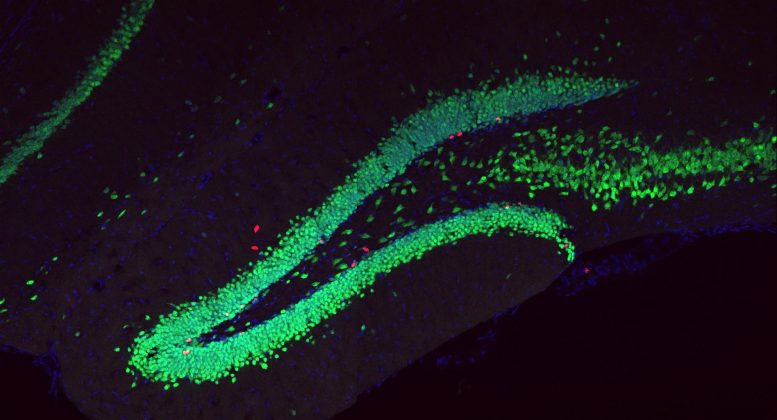
The CNP team was keen to delve deeper and understand how lactate acts on the brain to counter depression. They focused on adult neurogenesis in the hippocampus, a region of the brain that plays a role in memory and depression. “Adult neurogenesis is the term used for the production of new neurons in adulthood from brain stem cells,” points out Dr. Martin. “Its core purpose is to replace neurons, and it’s known to be impaired in depressive patients, when it contributes to the reduction in the volume of the hippocampus observed in some individuals.” With the help of his fellow researchers, Dr. Martin was able to show that lactate restores neurogenesis and lowers depressive behavior in mice. Conversely, without neurogenesis, lactate loses its antidepressant power, indicating that the two are intimately linked.
A Key Trio
But this does not tell us anything about the mechanism by which lactate regulates neurogenesis. Accordingly, the researchers studied its metabolism: in other words, all the cellular chemical reactions relating to it. Lactate is largely derived from the breakdown of glucose from food, and is then oxidized to pyruvate. Anthony Carrard, a biologist at CNP and the study’s lead investigator, explains: “We logically tested pyruvate on neurogenesis, without success. So, we said to ourselves that the answer had to be found in the conversion of lactate to pyruvate.”
During conversion of lactate to pyruvate, cells produce a molecule with antioxidant potential, known as NADH. As Dr. Carrard continues: “It’s NADH and its antioxidant properties that protect neurogenesis during a depressive episode – or at least during a modeling of some of these symptoms in animals.” In conclusion, the researcher adds: “This mechanism could explain the link between sport and depression, understanding that further experiments are still needed to demonstrate it. Importantly, it offers potential targets for devising future treatments. To do this, we’re first going to identify the proteins on which the NADH factor acts.”
Reference: “Role of adult hippocampal neurogenesis in the antidepressant actions of lactate” by Anthony Carrard, Frédéric Cassé, Charline Carron, Sophie Burlet-Godinot, Nicolas Toni, Pierre J. Magistretti and Jean-Luc Martin, 14 May 2021, Molecular Psychiatry.
DOI: 10.1038/s41380-021-01122-0
Never miss a breakthrough: Join the SciTechDaily newsletter.
Follow us on Google and Google News.