
ALMA Spots Earliest Environment Pollution in the Universe
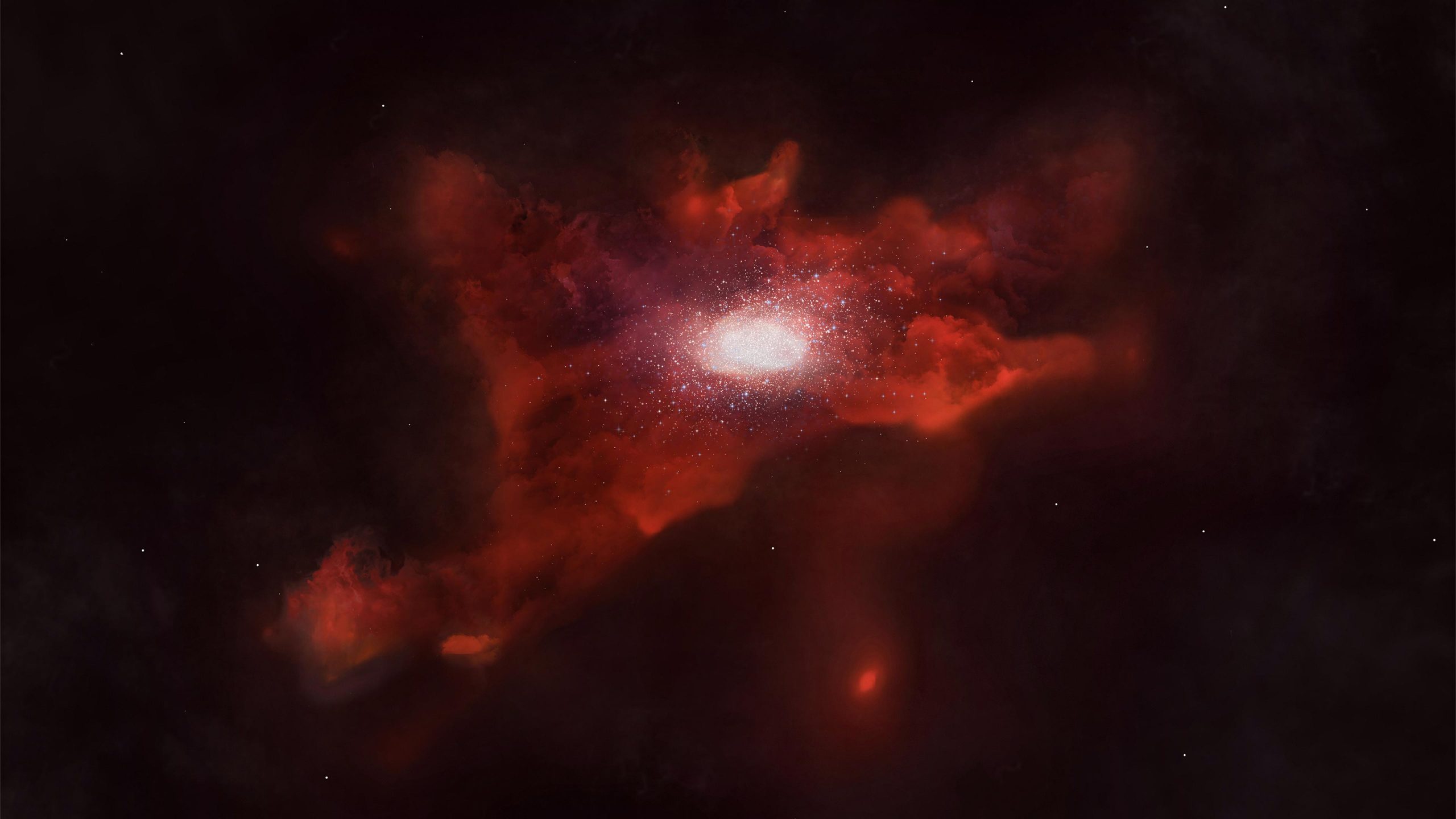
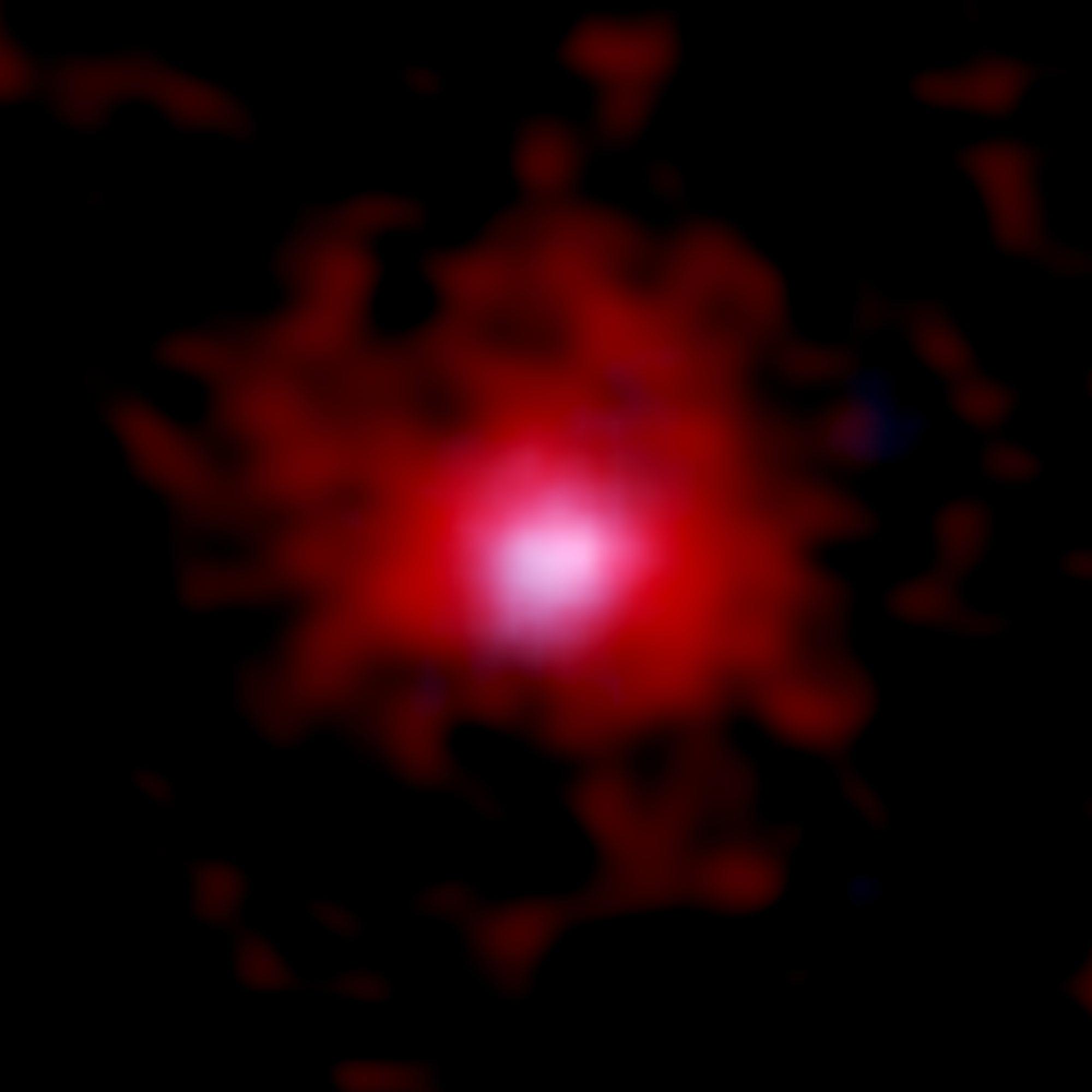
Researchers have discovered gigantic clouds of gaseous carbon spanning more than a radius of 30,000 light-years around young galaxies using the Atacama Large Millimeter/submillimeter Array (ALMA). This is the first confirmation that carbon atoms produced inside of stars in the early Universe have spread beyond galaxies. No theoretical studies have predicted such huge carbon cocoons around growing galaxies, which raises questions about our current understanding of cosmic evolution.
“We examined the ALMA Science Archive thoroughly and collected all the data that contain radio signals from carbon ions in galaxies in the early Universe, only one billion years after the Big Bang,” says Seiji Fujimoto, the lead author of the research paper who is an astronomer at the University of Copenhagen, and a former Ph.D. student at the University of Tokyo. “By combining all the data, we achieved unprecedented sensitivity. To obtain a dataset of the same quality with one observation would take 20 times longer than typical ALMA observations, which is almost impossible to achieve.”
Animation of the ALMA and NASA/ESA Hubble Space Telescope (HST) images of a young galaxy surrounded by a gaseous carbon cocoon. The red color shows the distribution of carbon gas imaged by combining the ALMA data for 18 galaxies. The stellar distribution photographed by HST is shown in blue. The gaseous carbon clouds are almost five times larger than the distribution of stars in the galaxies, as observed with the Hubble Space Telescope. Credit: ALMA (ESO/NAOJ/NRAO), NASA/ESA Hubble Space Telescope, Fujimoto et al.
Heavy elements such as carbon and oxygen did not exist in the Universe at the time of the Big Bang. They were formed later by nuclear fusion in stars. However, it is not yet understood how these elements spread throughout the Universe. Astronomers have found heavy elements inside baby galaxies but not beyond those galaxies, due to the limited sensitivity of their telescopes. This research team summed the faint signals stored in the data archive and pushed the limits.
“The gaseous carbon clouds are almost five times larger than the distribution of stars in the galaxies, as observed with the Hubble Space Telescope,” explains Masami Ouchi, a professor at the National Astronomical Observatory of Japan and the University of Tokyo. “We spotted diffuse but huge clouds floating in the coal-black Universe.”
Then, how were the carbon cocoons formed? “Supernova explosions at the final stage of stellar life expel heavy elements formed in the stars,” says Professor Rob Ivison, the Director for Science at the European Southern Observatory. “Energetic jets and radiation from supermassive black holes in the centers of the galaxies could also help transport carbon outside of the galaxies and finally throughout the Universe. We are witnessing this ongoing diffusion process, the earliest environmental pollution in the Universe.”
The research team notes that at present theoretical models are unable to explain such large carbon clouds around young galaxies, probably indicating that some new physical process must be incorporated into cosmological simulations. “Young galaxies seem to eject an amount of carbon-rich gas far exceeding our expectation,” says Andrea Ferrara, a professor at Scuola Normale Superiore di Pisa.
The team is now using ALMA and other telescopes around the world to further explore the implications of the discovery for galactic outflows and carbon-rich halos around galaxies.
Paper and the Research Team
These observation results are published by S. Fujimoto et al. “First Identification of 10 kpc [CII] Halo around Star-Forming Galaxies at z=5-7” in the Astrophysical Journal on December 16, 2019.
The research team members are:
Seiji Fujimoto (The University of Tokyo/National Astronomical Observatory of Japan/Waseda, University, current affiliation is University of Copenhagen), Masami Ouchi (National Astronomical Observatory of Japan/The University of Tokyo) , Andrea Ferrara (Scuola Normale Superiore di Pisa), Andrea Pallottini (Scuola Normale Superiore di Pisa), Rob. J. Ivison (European Southern Observatory), Christopher Behrens (Scuola Normale Superiore di Pisa), Simona Gallerani (Scuola Normale Superiore di Pisa), Shohei Arata (Osaka University), Hidenobu Yajima (University of Tsukuba), and Kentaro Nagamine (Osaka University/The University of Tokyo/University of Nevada)
References: “First Identification of 10 kpc [C ii] 158 μm Halos around Star-forming Galaxies at z = 5–7” by Seiji Fujimoto, Masami Ouchi, Andrea Ferrara, Andrea Pallottini, R. J. Ivison, Christoph Behrens, Simona Gallerani, Shohei Arata, Hidenobu Yajima and Kentaro Nagamine, 16 December 2019, The Astrophysical Journal.
DOI: 10.3847/1538-4357/ab480f
This research was supported by World Premier International Research Center Initiative (WPI Initiative), MEXT, Japan, JSPS KAKENHI (No. 15H02064, 16J02344, 17H01110, 17H01111, 17H01114), NAOJ ALMA Scientific Research Grant Number 2017-06B, Munich Institute for Astro- and Particle Physics (MIAPP) of the DFG cluster of excellence ”Origin and Structure of the Universe,” 2018 Graduate Research Abroad in Science Program Grant (GRASP2018), the Hayakawa Satio Fund awarded by the Astronomical Society of Japan, and the ERC Advanced Grants INTERSTELLAR H2020/740120 and COSMIC ISM 321302.
The Atacama Large Millimeter/submillimeter Array (ALMA), an international astronomy facility, is a partnership of the European Organisation for Astronomical Research in the Southern Hemisphere (ESO), the U.S. National Science Foundation (NSF) and the National Institutes of Natural Sciences (NINS) of Japan in cooperation with the Republic of Chile. ALMA is funded by ESO on behalf of its Member States, by NSF in cooperation with the National Research Council of Canada (NRC) and the Ministry of Science and Technology (MOST), and by NINS in cooperation with the Academia Sinica (AS) in Taiwan and the Korea Astronomy and Space Science Institute (KASI). ALMA construction and operations are led by ESO on behalf of its Member States; by the National Radio Astronomy Observatory (NRAO), managed by Associated Universities, Inc. (AUI), on behalf of North America; and by the National Astronomical Observatory of Japan (NAOJ) on behalf of East Asia. The Joint ALMA Observatory (JAO) provides the unified leadership and management of the construction, commissioning, and operation of ALMA.
Never miss a breakthrough: Join the SciTechDaily newsletter.
Follow us on Google and Google News.