
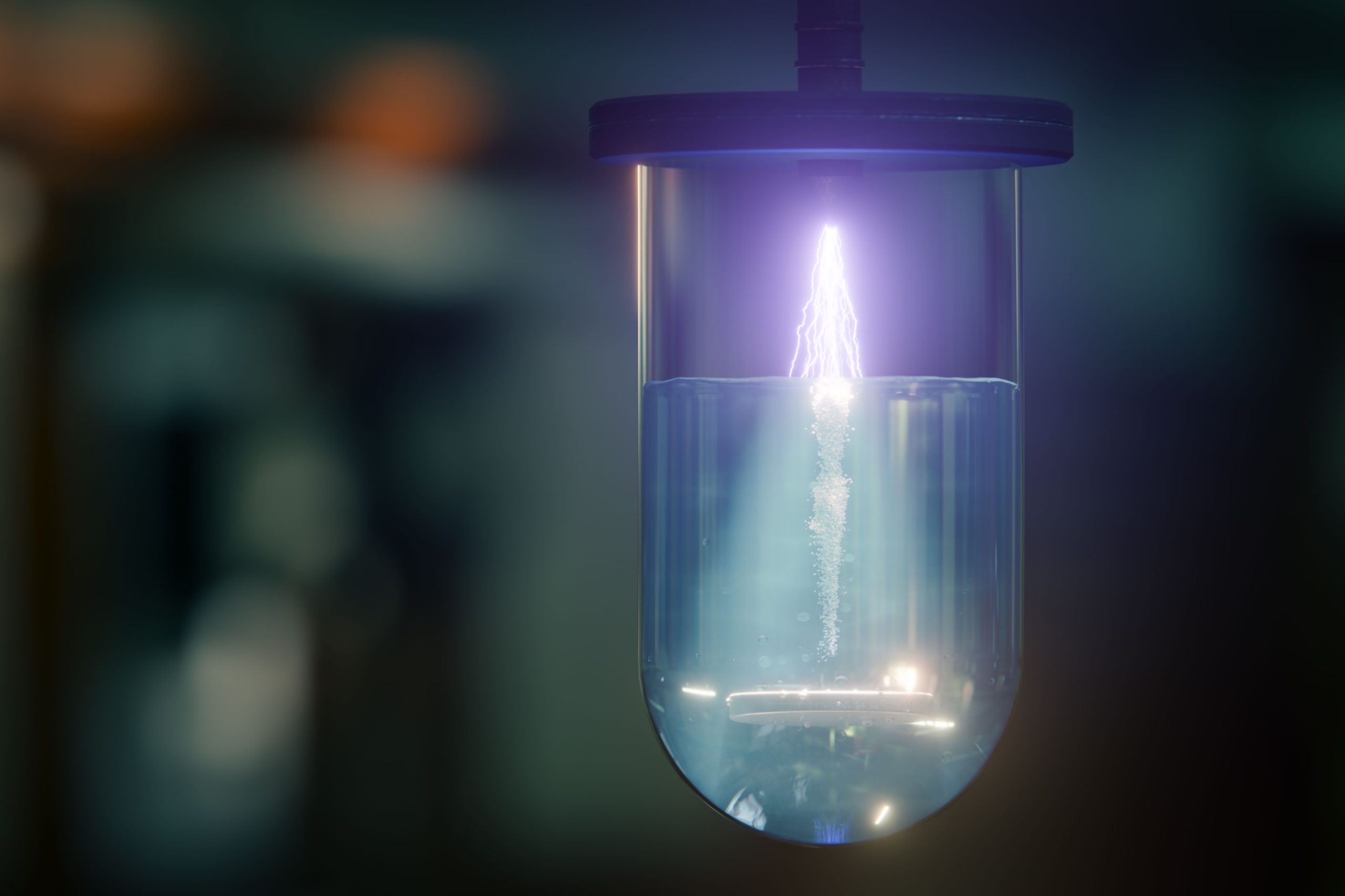
An HZDR research team has developed methods for breaking down “forever chemicals.”
The carbon-fluorine bonds inside PFAS are among the strongest in chemistry, allowing these industrial pollutants to persist in water for years. Researchers at the Helmholtz-Zentrum Dresden-Rossendorf (HZDR) are testing two ways to break those bonds: hydrodynamic cavitation and cold atmospheric plasma combined with gas dispersion.
Analyses by experts at the Helmholtz Centre for Environmental Research (UFZ) confirmed that both processes degraded per- and polyfluoroalkyl substances (PFAS) and released fluoride. If developed into practical industrial systems, the methods could help limit the amount of these highly persistent chemicals entering rivers, lakes and oceans.
The PFAS family contains more than 10,000 short- and long-chain industrial compounds. Some are suspected of damaging genetic material and increasing cancer risk, while the biological effects of many others remain poorly understood. Their resistance to chemical breakdown comes from exceptionally stable carbon-fluorine bonds.
PFAS commonly reach rivers and oceans through wastewater and have spread around the world. Researchers have recently detected high concentrations in the Elbe River, raising potential concerns for plants, wildlife and human health.
Cavitation begins breaking stubborn PFAS bonds
As part of work connected to Germany’s “National Water Strategy,” which aims to protect water resources and secure drinking water supplies, HZDR researchers are exploring how to systematically destroy these “forever chemicals” before they reach the environment.
In a preliminary study that began in 2022, a group led by postdoctoral researcher Dr. Ysabel Huaccallo-Aguilar tested hydrodynamic cavitation as a way to degrade PFAS.
“In hydrodynamic cavitation, we pass PFAS-enriched water through a constriction, generating small vapor bubbles,” explains Dr. Sebastian Reinecke, head of the Department of Water and Environmental Technologies at HZDR.
Long-chain PFAS are surface active, so they gather on the bubbles. As the water moves beyond the narrow passage and pressure rises, those bubbles collapse.
“When the bubbles burst under the rising ambient pressure in the water downstream of the constriction, the PFAS that are attached to the bubbles are exposed to local temperature spikes of several thousand degrees Celsius,” Reinecke explains.
Cavitation also creates highly reactive hydroxyl radicals, which can react with nearby substances rather than targeting only one specific compound. “Our hypothesis is that they attack the intermediate products, significantly boosting PFAS degradation.”
Huaccallo-Aguilar and her colleagues showed that the process degraded PFAS in tap water and converted some organically bound fluorine into fluoride. Fluoride concentrations continued to increase as treatment time grew, providing evidence that the chemicals were being broken apart.
The experiments focused on perfluorooctane sulfonate (PFOS), one of the most persistent and extensively studied PFAS compounds. By the end of the tests, hydrodynamic cavitation had degraded approximately 37 percent of the dissolved PFOS at a stable rate.
“We are now conducting follow-up experiments to increase the degradation rate,” Reinecke explains. “Our goal is to improve the process to a degradation rate of more than 80 percent of the PFAS in the solution and mineralizing more than 50 percent of the fluorine that is bound in the chemicals – that means, breaking down the carbon-fluorine bonds that are typical of PFAS.”
Plasma removes more PFAS at a cost
A separate set of experiments led by environmental engineer Dr. Amit Kumar used cold atmospheric plasma together with gas dispersion. The method operates under ordinary environmental conditions and does not require catalysts or added chemicals.
During his doctoral research, Kumar studied how reactive chemical species created in plasma could destroy micropollutants. He applied that knowledge to PFAS-contaminated water.
“We generated plasma at the water surface while simultaneously introducing gas into the PFAS-contaminated water,” says Sebastian Reinecke, explaining the experimental setup. “The PFAS attach to the surface of the gas bubbles. As they rise, the water is constantly circulated. This brings the PFAS to the surface, where they are broken down in the plasma.”
The plasma treatment almost completely degraded both short- and long-chain PFAS. It also released about 35 percent of the fluorine atoms bound within the compounds as fluoride salts.
The stronger performance came with important tradeoffs. “While this method has significantly faster reaction kinetics than cavitation, it also consumes far more energy per volume unit,” Reinecke notes. “In addition, the process generates numerous transformation products that we have not yet been able to investigate in detail – for instance, gaseous compounds that form during the reaction.”
Further experiments are examining whether any of those transformation products could threaten human health and, if so, how their formation might be prevented.
Combining both methods could improve removal
The researchers are now adapting the plasma process to treat larger quantities of contaminated water. By adding multiple electrodes and a technical gas injector, they are increasing the reaction volume from approximately 50 milliliters to five liters.
Their longer-term plan is to combine plasma treatment with hydrodynamic cavitation, potentially bringing together the strongest features of each method.
“I believe we’ll achieve high degradation rates by combining the highly reactive species from the plasma with the effects of cavitation,” says Reinecke.
If the combined system delivers high degradation while controlling energy use and unwanted byproducts, it could provide a new method for removing PFAS from contaminated water.
References:
“Degradation and defluorination of perfluorooctane sulfonate (PFOS) forever chemical in water using hydrodynamic cavitation treatment” by Amit Kumar, Anett Georgi, Ysabel Huaccallo-Aguilar, Markus Meier, Holger Kryk, Sebastian Felix Reinecke and Uwe Hampel, 16 January 2026, Chemical Engineering Journal Advances.
DOI: 10.1016/j.ceja.2026.101046
“Enhanced degradation and defluorination of perfluorooctane sulfonate (PFOS) in tap water using gas-dispersed cold atmospheric plasma” by Amit Kumar, Ysabel Huaccallo-Aguilar, Holger Kryk, Uwe Hampel and Sebastian Felix Reinecke, 13 June 2026, Scientific Reports.
DOI: 10.1038/s41598-026-57490-6
This research was funded by the Helmholtz Association’s Impulse and Networking Fund via the Clean Water Technology Lab (CLEWATEC), a Helmholtz Innovation Lab, under reference number HIL-A02. The projects “HyKaPro SAB-EFRE” and “Plasma4PFAS SAB-EFRE” are co-financed by the European Union and tax revenue as approved by the Saxon Parliament in its state budget.
Never miss a breakthrough: Join the SciTechDaily newsletter.
Follow us on Google and Google News.
1 Comment
Is there a way to eliminate forever chemicals inside of our bodies? I’ve had ruptured silicone implants for 30 yrs. There are 37 toxic forever chemicals mixed with the silicone gel. Each one destroy internal systems. Blood platelets,dissolve spinal bones, and other connective bones and joints. Erupt all of my teeth. Etc. I’ve lost 6 1/2 inches of height. I’m probably the only woman still alive with this disaster dissolving all internal structure. And eating my blood. I’ve had to have blood transfusions 2 times in 2 years. 2 bags and 3 bags of blood. Doctors don’t know where my blood is going. No internal bleeding at all. But I know I need another transfusion because I am exhausted and am out of breath . Please respond. I can’t get any help from unknowedgable doctors. I have excellent insurance. But I’m not getting any help to continue my life back. Thank you. [email protected]