
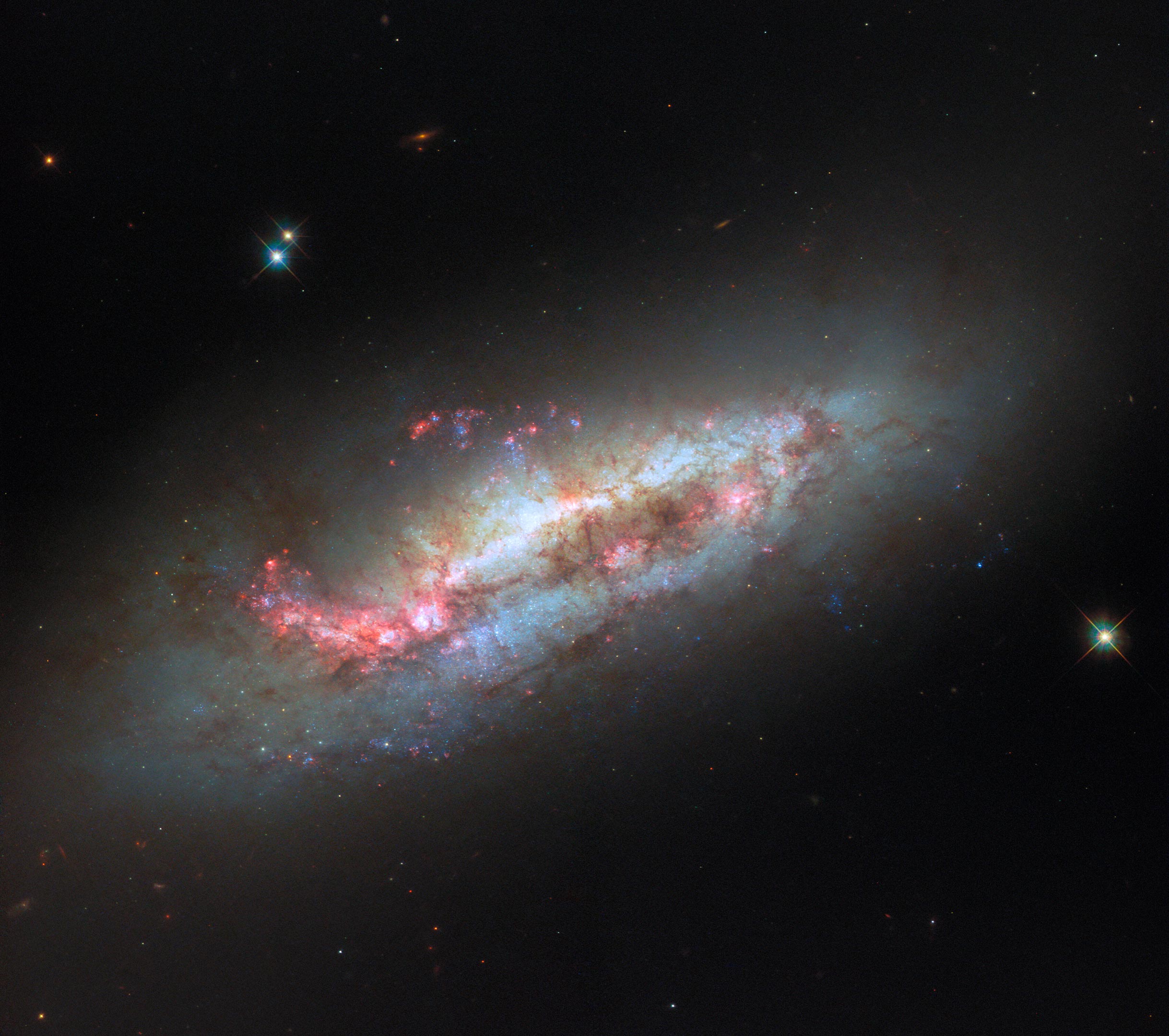
NGC 1511’s chaotic history with nearby galaxies has left it connected by gas streams and littered with warped structures.
Its energetic star-forming regions offer astronomers a chance to study how gas cycles between clouds and stars.
A Peculiar Spiral in Hydrus
Although NGC 1511 is striking in appearance, it is not the kind of galaxy most would hope to live beside. Featured in this Hubble Picture of the Week, NGC 1511 is an unusual spiral galaxy located about 50 million light-years from Earth in the constellation Hydrus.
Companion Galaxies and Past Encounters
NGC 1511 moves through space with two smaller neighbors known as NGC 1511A and NGC 1511B, which lie beyond the borders of this particular Hubble view. NGC 1511B is the closest of the pair, and studies suggest that it and NGC 1511 collided long ago; a thin filament of hydrogen gas still links the two, and NGC 1511B shows clear signs of being stretched and distorted by the event.
Researchers have also uncovered evidence that NGC 1511 once interacted with another small companion galaxy, which now appears to have been completely torn apart.
Star Formation Fueled by Turbulence
These encounters have shaped NGC 1511 as well. The galaxy is currently undergoing a burst of star formation, and its disk contains unusual arcs, loops, and plumes that may be remnants of earlier interactions. Astronomers will use Hubble’s detailed imagery to investigate the star clusters nestled within the galaxy’s dusty regions, hoping to trace how gas moves from interstellar clouds into new stars and later returns to the galactic environment.
Never miss a breakthrough: Join the SciTechDaily newsletter.
Follow us on Google and Google News.