
Close Menu
    Facebook X (Twitter) Instagram
    SciTechDaily
    • Biology
    • Chemistry
    • Earth
    • Health
    • Physics
    • Science
    • Space
    • Technology
    Facebook X (Twitter) Pinterest YouTube RSS
    SciTechDaily
    Home»Space»Astronomy & Astrophysics 101: Open Cluster
    Space

    Astronomy & Astrophysics 101: Open Cluster

    By ESA/HubbleApril 22, 2024No Comments3 Mins Read
    Facebook Twitter Pinterest Telegram LinkedIn WhatsApp Email Reddit
    Share
    Facebook Twitter LinkedIn Pinterest Telegram Email Reddit
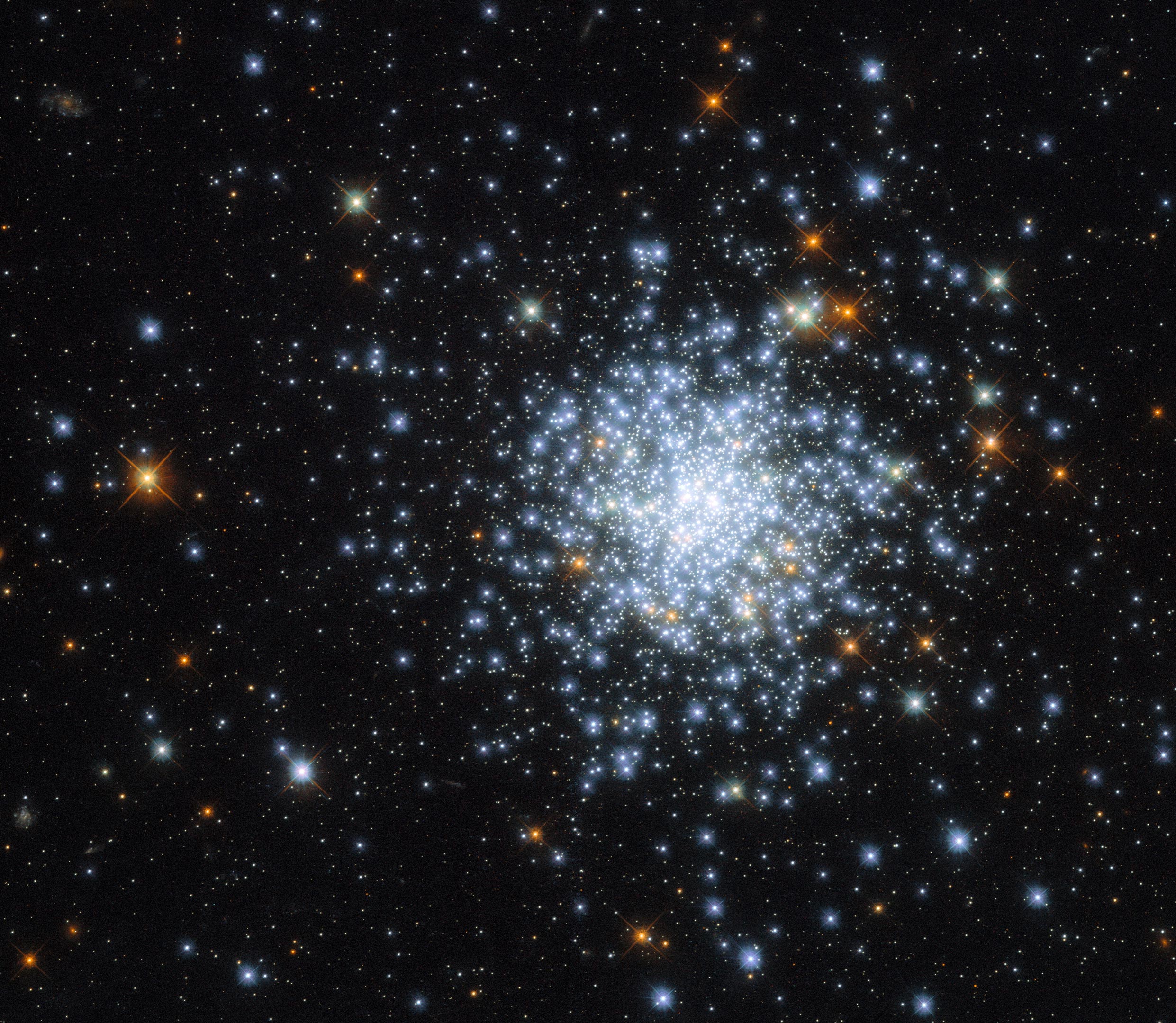
    Open Cluster NGC 2164
    This Hubble Space Telescope image shows an open cluster known as NGC 2164, which was first discovered in 1826 by a Scottish astronomer named James Dunlop. NGC 2164 is located within one of the Milky Way galaxy’s closest neighbors — the satellite galaxy known as the Large Magellanic Cloud. The Large Magellanic Cloud is a relatively small galaxy that lies about 160,000 light-years from Earth. It is considered a satellite galaxy because it is gravitationally bound to the Milky Way. Credit: ESA/Hubble & NASA, J. Kalirai, A. Milone

    What Is an Open Cluster?

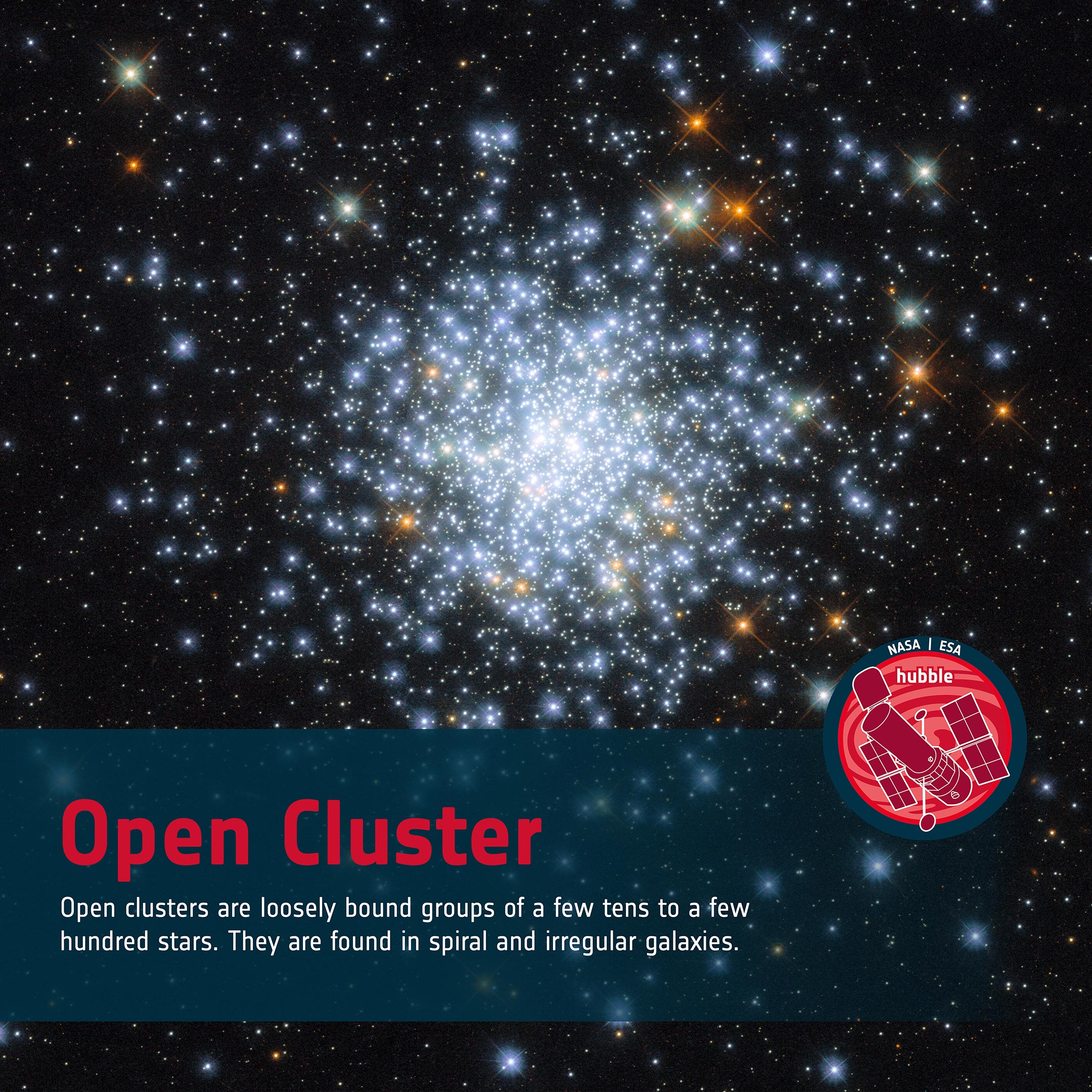
    Open clusters are loosely bound groups of a few tens to a few hundred stars. They are found in spiral and irregular galaxies.

    Open clusters are significantly smaller and less densely populated than globular clusters. Open clusters may contain anything from a few dozen stars up to a few hundred stars. Open clusters have been observed with a range of ages — they may be made up of young stars or older stars.

    Owing to their open and diffuse structure, they are not particularly stable, and their constituent stars might disperse after a few million years. For this reason, open clusters are found in spiral and irregular galaxies, where new stars are being formed, but not in elliptical galaxies, which are not forming stars and in which any open clusters would have long since broken up.

    Within the Milky Way, open clusters are found in and between the spiral arms. All star clusters are of great interest to astronomers, because the stars in them all formed at approximately the same time and location. Open clusters are typically easier to observe than globular clusters, because the individual stars can be studied. The study of star clusters offers unique insights into how stars form and evolve.


    Open clusters are loosely bound groups of a few tens to a few hundred stars. They are found in spiral and irregular galaxies. Credit: NASA & ESA

    Discoveries and Characteristics

    Around 1100 open clusters have so far been discovered within the Milky Way, although many more are thought to exist. Trumpler 14 is one of these, located some 8000 light-years away towards the center of the well-known Carina Nebula, which has been beautifully captured by Hubble. This region of space houses one of the highest concentrations of massive, luminous stars in the entire Milky Way.

    Unique Clusters and Observations by Hubble

    NGC 1872 in our small neighboring galaxy the Large Magellanic Cloud. This cluster has characteristics of both cluster types — it is as rich as a typical globular but is much younger, and, like many open clusters, has bluer stars. Such intermediate clusters are common in the Large Magellanic Cloud.
    Word Bank Open Cluster
    Credit: NASA & ESA

    Hubble has also targeted a spectacular section of the well-known Eagle Nebula known as NGC 6611, an open star cluster that formed about 5.5 million years ago and is found approximately 6500 light-years from Earth. It is a very young cluster, containing many hot, blue stars, whose fierce ultraviolet glow makes the surrounding Eagle Nebula glow brightly.

    Never miss a breakthrough: Join the SciTechDaily newsletter.
    Follow us on Google and Google News.

    Astronomy Astrophysics Hubble Space Telescope
    Share. Facebook Twitter Pinterest LinkedIn Email Reddit

    Related Articles

    Hubble Solves Mystery of Monster Star’s Dimming – Red Hypergiant Is As Bright as 300,000 Suns

    Astronomers Make a Weird Discovery: A Concentration of Smaller Black Holes Lurking Where They Expected a Single Massive Black Hole

    Tantrums of a Baby Star: Herbig-Haro Objects

    Unexpected Discovery: Hubble Space Telescope Uncovers Concentration of Small Black Holes

    Dissecting the Anatomy of Planetary Nebulae Using the Hubble Space Telescope

    HAWC+ Reveals Magnetic Chaos Hidden Within the Whirlpool Galaxy

    Supermassive Black Hole’s Dust Ring May Be Casting Shadows From Heart of a Galaxy

    Quasars Rip Across Galaxies Like Tsunamis – The Most Energetic Outflows Ever Witnessed in the Universe

    “Unprecedented” – Unusual Planetary Nebula Fades Mere Decades After It Arrived

    Leave A Reply Cancel Reply

    • Facebook
    • Twitter
    • Pinterest
    • YouTube

    Don't Miss a Discovery

    Subscribe for the Latest in Science & Tech!

    Trending News

    Scientists Uncover Potential Brain Risks of Popular Fish Oil Supplements

    Scientists Discover a Surprising Way To Make Bread Healthier and More Nutritious

    After 60 Years, Scientists Uncover Unexpected Brain Effects of Popular Diabetes Drug Metformin

    New Research Uncovers Hidden Side Effects of Popular Weight-Loss Drugs

    Scientists Rethink Extreme Warming After Surprising Ocean Discovery

    Landmark Study Links Never Marrying to Significantly Higher Cancer Risk

    Researchers Discover Unknown Beetle Species Just Steps From Their Lab

    Largest-Ever Study Finds Medicinal Cannabis Ineffective for Anxiety, Depression, PTSD

    Follow SciTechDaily
    • Facebook
    • Twitter
    • YouTube
    • Pinterest
    • Newsletter
    • RSS
    SciTech News
    • Biology News
    • Chemistry News
    • Earth News
    • Health News
    • Physics News
    • Science News
    • Space News
    • Technology News
    Recent Posts
    • Students Build Dark Matter Detector and Set New Experimental Limits
    • Scientists Discover Caffeine Can Repair Key Memory Circuits After Sleep Loss
    • Strange 65-Foot Dinosaur Discovered in Argentina
    • Researchers Uncover Source of Strange Deformation in Earth’s Largest Continental Rift
    • Scientists Solve Mystery of Where the Colorado River Vanished Millions of Years Ago
    Copyright © 1998 - 2026 SciTechDaily. All Rights Reserved.
    • Science News
    • About
    • Contact
    • Editorial Board
    • Privacy Policy
    • Terms of Use

    Type above and press Enter to search. Press Esc to cancel.