
Close Menu
    Facebook X (Twitter) Instagram
    SciTechDaily
    • Biology
    • Chemistry
    • Earth
    • Health
    • Physics
    • Science
    • Space
    • Technology
    Facebook X (Twitter) Pinterest YouTube RSS
    SciTechDaily
    Home»Space»Star Cluster Trumpler 14 Displays Some of the Most Luminous Stars in Our Galaxy
    Space

    Star Cluster Trumpler 14 Displays Some of the Most Luminous Stars in Our Galaxy

    By Hubble Space TelescopeJanuary 25, 20161 Comment4 Mins Read
    Facebook Twitter Pinterest Telegram LinkedIn WhatsApp Email Reddit
    Share
    Facebook Twitter LinkedIn Pinterest Telegram Email Reddit
    Hubble Views Star Cluster Trumpler 14
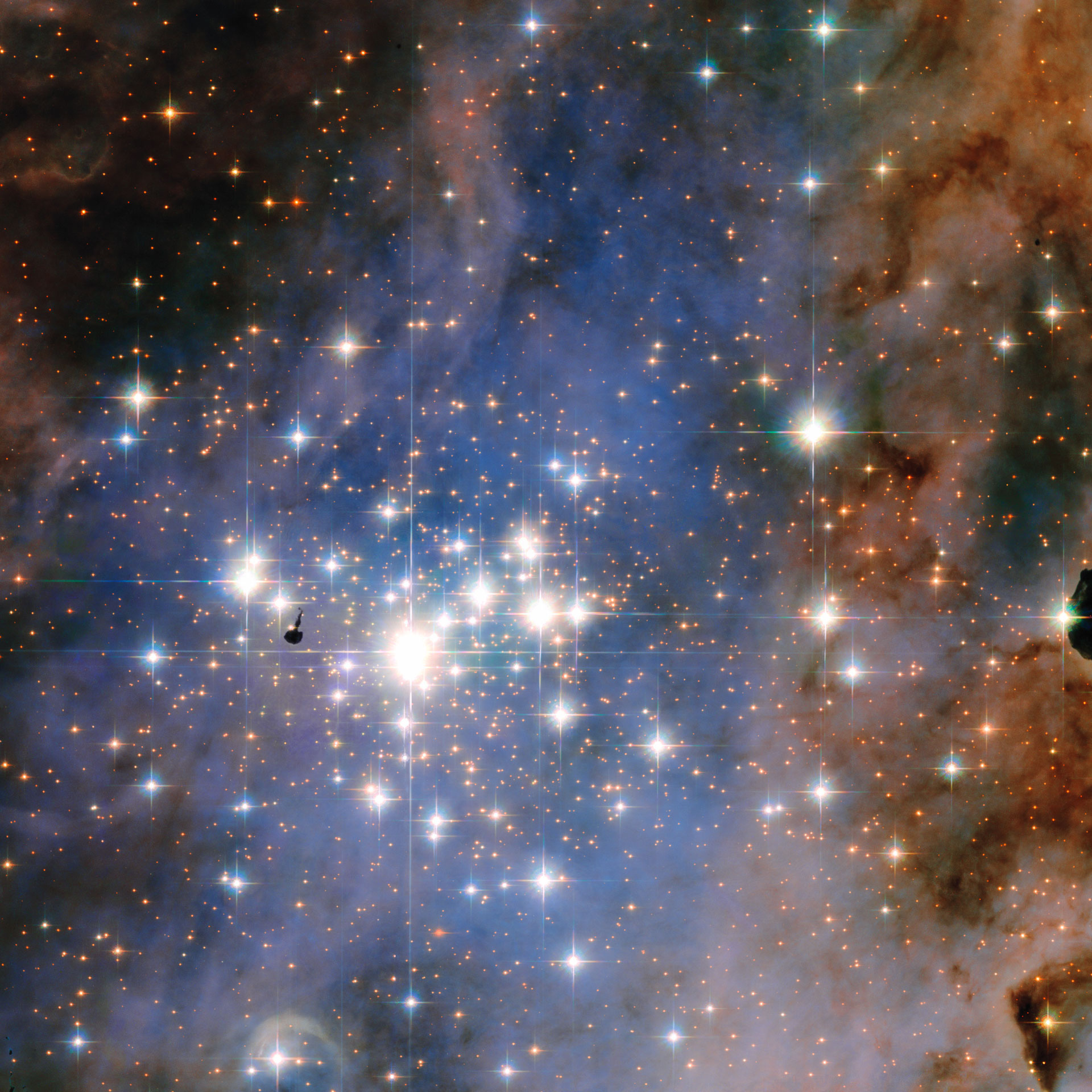
    This NASA/ESA Hubble Space Telescope image features the star cluster Trumpler 14. One of the largest gatherings of hot, massive and bright stars in the Milky Way, this cluster houses some of the most luminous stars in our entire galaxy. Credit: NASA & ESA, Jesús Maíz Apellániz (Centro de Astrobiología, CSIC-INTA, Spain)

    This Hubble image features star cluster Trumpler 14 – one of the largest gatherings of hot, massive and bright stars in the Milky Way.

    Single stars are often overlooked in favor of their larger cosmic cousins — but when they join forces, they create truly breathtaking scenes to rival even the most glowing of nebulae or swirling of galaxies.

    Around 1100 open clusters have so far been discovered within the Milky Way, although many more are thought to exist. Trumpler 14 is one of these, located some 8000 light-years away towards the center of the well-known Carina Nebula.

    At a mere 500,000 years old — a small fraction of the Pleiades open cluster’s age of 115 million years — Trumpler 14 is not only one of the most populous clusters within the Carina Nebula, but also the youngest. However, it is fast making up for lost time, forming stars at an incredible rate, and putting on a stunning visual display.

    Trumpler 14 Embedded in the Carina Nebula
    This color-composite image of the Carina Nebula, made by the MPG/ESO 2.2-meter telescope at La Silla, Chile, reveals exquisite details in the stars and dust of the region. The open star cluster Trumpler 14, a collection of very bright, young stars within the Carina Nebula, is marked with a red circle. Several more well-known astronomical objects can be seen in this wide field image: to the bottom left of the image is one of the most impressive binary stars in the Universe, Eta Carinae, with the famous Keyhole Nebula just adjacent to the star. A second open star cluster, Collinder 228 is also seen in the image, just below Eta Carinae. Credit: ESO

    This region of space houses one of the highest concentrations of massive, luminous stars in the entire Milky Way — a spectacular family of young, bright, white-blue stars. These stars are rapidly working their way through their vast supplies of hydrogen, and have only a few million years of life left before they meet a dramatic demise and explode as supernovae. In the meantime, despite their youth, these stars are making a huge impact on their environment. They are literally making waves!

    As the stars fling out high-speed particles from their surfaces, strong winds surge out into space. These winds collide with the surrounding material, causing shock waves that heat the gas to millions of degrees and trigger intense bursts of X-rays. These strong stellar winds also carve out cavities in nearby clouds of gas and dust, and kickstart the formation of new stars.

    The peculiar arc-shaped cloud visible at the very bottom of this image is suspected to be the result of such wind. This feature is thought to be a bow shock created by the wind flowing from the nearby star Trumpler 14 MJ 218. Astronomers have observed this star to be moving through space at some 350,000 kilometers (220,000 miles) per hour, sculpting the surrounding clumps of gas and dust as it does so.

    Astronomers estimate that around 2000 stars reside within Trumpler 14, ranging in size from less than one-tenth to up to several tens of times the mass of the Sun. The most prominent star in Trumpler 14, and the brightest star in this image, is the supergiant HD 93129Aa. It is one of the most brilliant and hottest stars in our entire galaxy.


    This short sequence zooms in on the open young cluster of stars, Trumpler 14. One of the largest gatherings of hot, massive and bright stars in the Milky Way, this cluster houses some of the most luminous stars in our entire galaxy.

    Never miss a breakthrough: Join the SciTechDaily newsletter.
    Follow us on Google and Google News.

    Astronomy Hubble Space Telescope NASA Popular
    Share. Facebook Twitter Pinterest LinkedIn Email Reddit

    Related Articles

    The Great Escape: NASA’s Hubble and MAVEN Help Solve Mystery of Mars’ Vanishing Water

    Webb and Hubble Unite: A Breathtaking 3D Journey Through the Pillars of Creation

    Stellar Sleuths: Citizen Scientists and AI Uncover Hidden Asteroids With Hubble

    Stellar Fireworks: Hubble Revisits a Strange Star’s 40-Year Nova Mystery

    Cosmic Geode: Hubble Captures the Birth of a Sun-like Star

    Hubble Celebrates 34th Anniversary With a Spectacular View of the Little Dumbbell Nebula

    Jupiter Unveiled: Hubble Captures the Giant’s Roaring Storms and Volcanic Moon Io

    Galaxies Collide, Stars Awaken: Hubble’s Stunning Revelation

    Hubble Spots Water Vapor in Small Exoplanet’s Atmosphere

    1 Comment

    1. Janani prem on February 4, 2016 3:58 am

      Thanks for your details and explanations..I want more information from your side..I Am working in Aquafina Mineral Water In Chennai.

      Reply
    Leave A Reply Cancel Reply

    • Facebook
    • Twitter
    • Pinterest
    • YouTube

    Don't Miss a Discovery

    Subscribe for the Latest in Science & Tech!

    Trending News

    Scientists Discover Cheap, Natural Remedy for High Blood Pressure

    Earth’s Upper Atmosphere Is Cooling Fast and Scientists Finally Know Why

    32,000 Olympic Pools of Magma Nearly Erupted Beneath Atlantic Island

    Exercise Changes the Heart in a Way Researchers Never Expected

    Too Much Sleep May Age Your Body Faster, New Study Warns

    Scientists Uncover Promising New Strategy To Stop Parkinson’s in Its Tracks

    Experts Reveal the Surprising Cancer Link Behind a Common Vitamin

    This Strange “Golden Orb” Found 2 Miles Deep Stumped Scientists for Years

    Follow SciTechDaily
    • Facebook
    • Twitter
    • YouTube
    • Pinterest
    • Newsletter
    • RSS
    SciTech News
    • Biology News
    • Chemistry News
    • Earth News
    • Health News
    • Physics News
    • Science News
    • Space News
    • Technology News
    Recent Posts
    • The Type of Alcohol You Drink Could Affect How Long You Live
    • 19-Year Study Reveals the Surprising Truth About Sitting and Dementia
    • This Common Vitamin May Help Stop Prediabetes From Turning Into Diabetes
    • Canada’s Billion-Year-Old Rocks Could Hold the Future of Clean Energy
    • Climate Change Is Quietly Choking Rivers Across the Planet
    Copyright © 1998 - 2026 SciTechDaily. All Rights Reserved.
    • Science News
    • About
    • Contact
    • Editorial Board
    • Privacy Policy
    • Terms of Use

    Type above and press Enter to search. Press Esc to cancel.