
Close Menu
    Facebook X (Twitter) Instagram
    SciTechDaily
    • Biology
    • Chemistry
    • Earth
    • Health
    • Physics
    • Science
    • Space
    • Technology
    Facebook X (Twitter) Pinterest YouTube RSS
    SciTechDaily
    Home»Space»Galaxies Collide, Stars Awaken: Hubble’s Stunning Revelation
    Space

    Galaxies Collide, Stars Awaken: Hubble’s Stunning Revelation

    By Space Telescope Science InstituteFebruary 8, 20241 Comment5 Mins Read
    Facebook Twitter Pinterest Telegram LinkedIn WhatsApp Email Reddit
    Share
    Facebook Twitter LinkedIn Pinterest Telegram Email Reddit
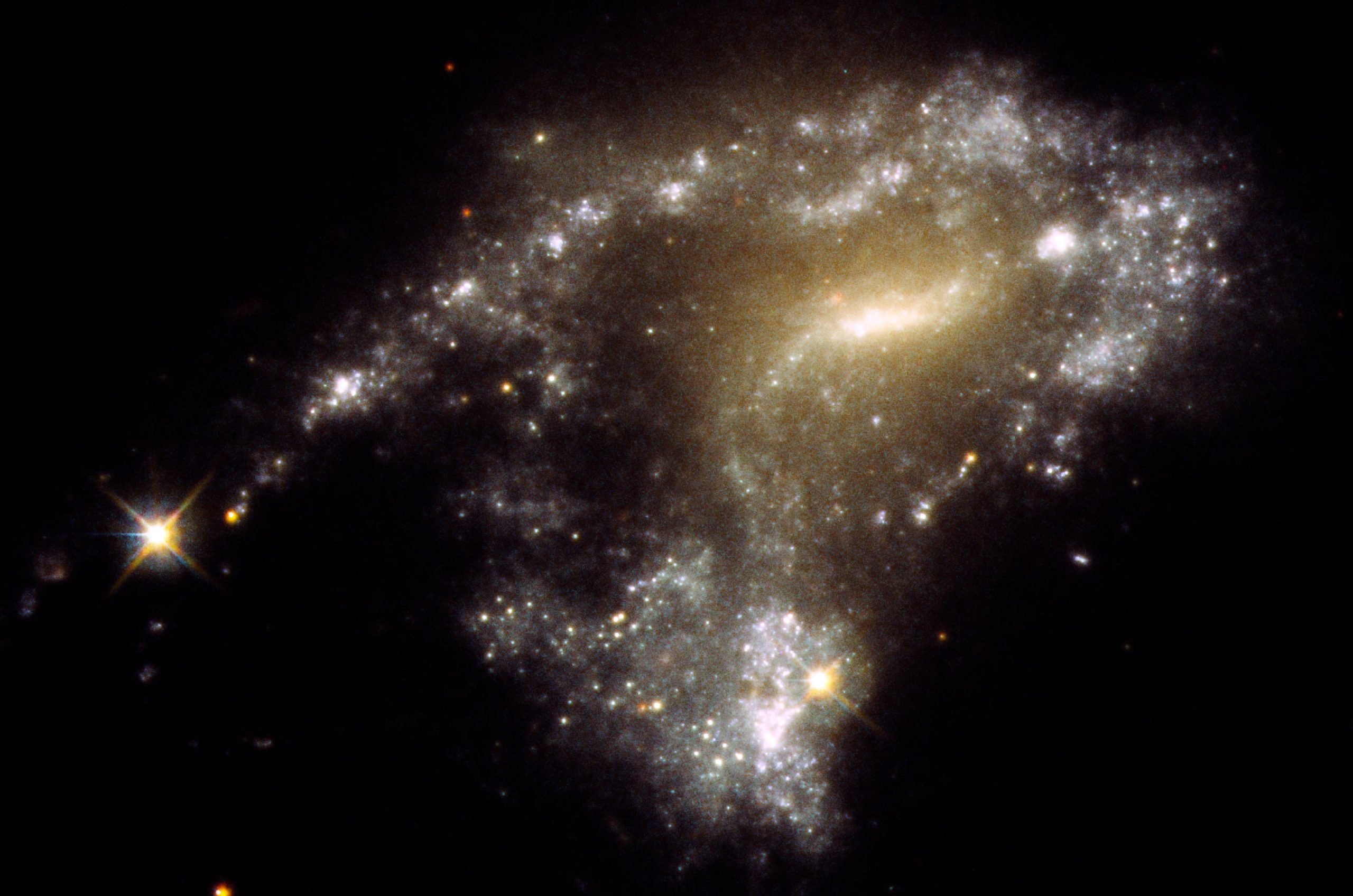
    Galaxy AM 1054-325
    NASA’s Hubble Space Telescope has observed 12 interacting galaxies, revealing long tidal tails rich in gas, dust, and stars, along which 425 clusters of newborn stars have been identified. These clusters, containing up to 1 million blue, newborn stars each, are a result of galaxy collisions that trigger star formation rather than destruction. Credit: NASA, ESA, STScI, Jayanne English (University of Manitoba)

    Long Trail of Clumpy Stars Follows Galaxy Interactions

    When galaxies go bump in the night, they cook up new generations of stars that might otherwise have never been born. These close encounters between galaxies cause a gravitational tug-of-war, and gas and dust are drawn out into large streamers. The Hubble Space Telescope’s vision is so sharp that it can see clusters of newborn stars strung along these tidal tails. They form when knots of gas gravitationally collapse to create about 1 million newborn stars per cluster. These “string of pearls” features are probably more common in the early universe when galaxies collided more frequently.
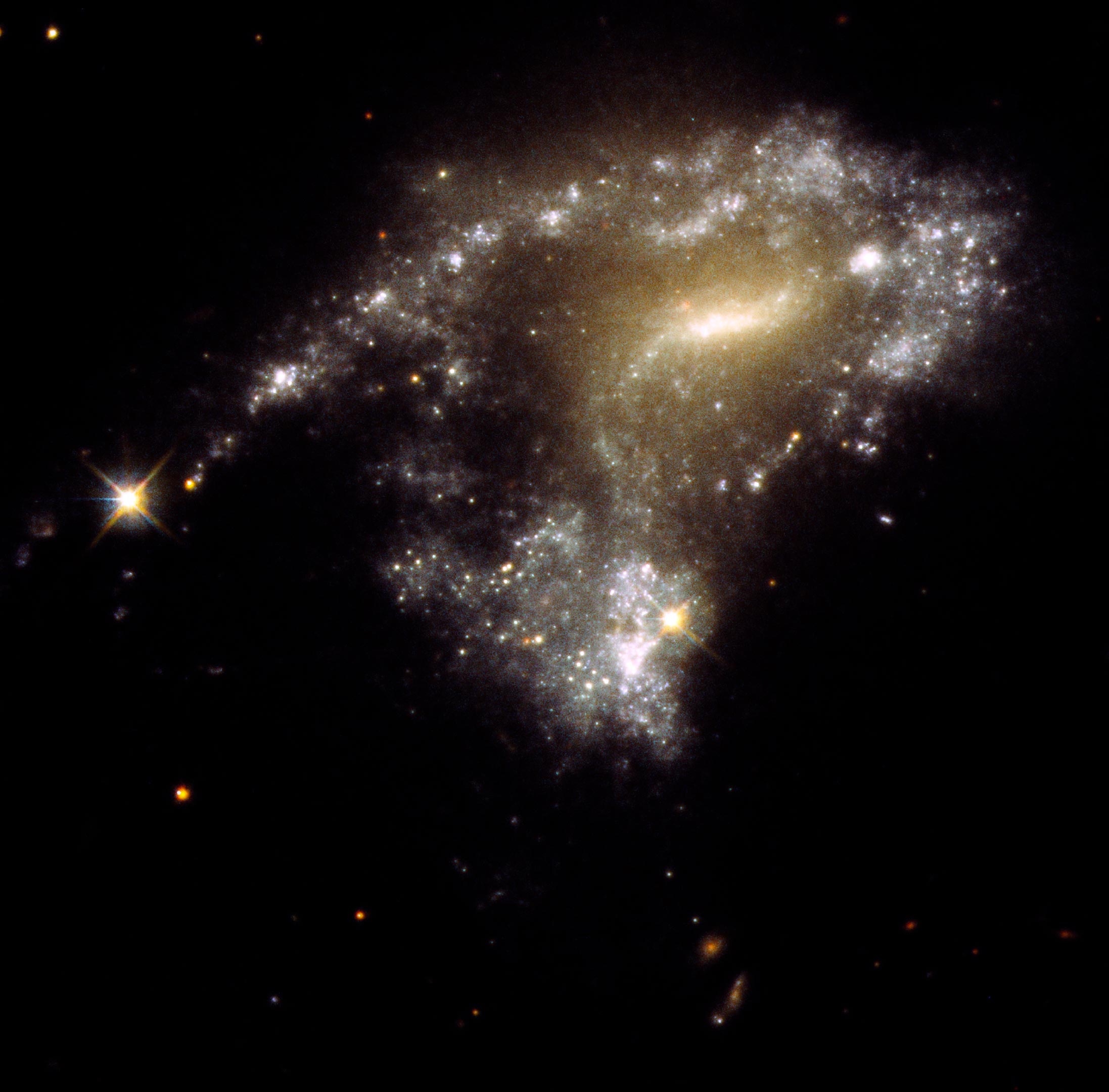
    Galaxy AM 1054-325
    Galaxy AM 1054-325 has been distorted into an S-shape from a normal pancake-like spiral shape by the gravitational pull of a neighboring galaxy, seen in this Hubble Space Telescope image. A consequence of this is that newborn clusters of stars form along a stretched-out tidal tail for thousands of light-years, resembling a string of pearls. They form when knots of gas gravitationally collapse to create about 1 million newborn stars per cluster. Credit: NASA, ESA, STScI, Jayanne English (University of Manitoba)

    Hubble Space Telescope Traces ‘String of Pearls’ Star Clusters in Galaxy Collisions

    Contrary to what you might think, galaxy collisions do not destroy stars. In fact, the rough-and-tumble dynamics trigger new generations of stars, and presumably accompanying planets.

    Now NASA’s Hubble Space Telescope has homed in on 12 interacting galaxies that have long, tadpole-like tidal tails of gas, dust, and a plethora of stars. Hubble’s exquisite sharpness and sensitivity to ultraviolet light have uncovered 425 clusters of newborn stars along these tails, looking like strings of holiday lights. Each cluster contains as many as 1 million blue, newborn stars.

    Unveiling New Star Clusters

    Clusters in tidal tails have been known about for decades. When galaxies interact, gravitational tidal forces pull out long streamers of gas and dust. Two popular examples are the Antennae and Mice galaxies with their long, narrow, finger-like projections.

    A team of astronomers used a combination of new observations and archival data to get ages and masses of tidal tail star clusters. They found that these clusters are very young — only 10 million years old. And they seem to be forming at the same rate along tails stretching for thousands of light-years.

    The Future of Tidal Tail Star Clusters

    “It’s a surprise to see lots of the young objects in the tails. It tells us a lot about cluster formation efficiency,” said lead author Michael Rodruck of Randolph-Macon College in Ashland, Virginia. “With tidal tails, you will build up new generations of stars that otherwise might not have existed.”

    The tails look like they are taking a galaxy’s spiral arm and stretching it out into space. The exterior part of the arm gets pulled like taffy from the gravitational tug-of-war between a pair of interacting galaxies.

    Before the mergers, the galaxies were rich in dusty clouds of molecular hydrogen that simply may have remained inert. But the clouds got jostled and bumped into each other during the encounters. This compressed the hydrogen to the point where it precipitated a firestorm of star birth.

    The fate of these strung-out star clusters is uncertain. They may stay gravitationally intact and evolve into globular star clusters — like those that orbit outside the plane of our Milky Way galaxy. Or they may disperse to form a halo of stars around their host galaxy, or get cast off to become wandering intergalactic stars.

    This string-of-pearls star formation may have been more common in the early universe when galaxies collided with each other more frequently. These nearby galaxies observed by Hubble are a proxy for what happened long ago, and therefore are laboratories for looking into the distant past.

    Reference: “Star clusters in tidal debris” by Michael Rodruck, Jane Charlton, Sanchayeeta Borthakur, Aparna Chitre, Patrick R Durrell, Debra Elmegreen, Jayanne English, Sarah C Gallagher, Caryl Gronwall, Karen Knierman, Iraklis Konstantopoulos, Yuexing Li, Moupiya Maji, Brendan Mullan, Gelys Trancho and William Vacca, 29 September 2023, Monthly Notices of the Royal Astronomical Society.
    DOI: 10.1093/mnras/stad2886

    The Hubble Space Telescope is a project of international cooperation between NASA and ESA. NASA’s Goddard Space Flight Center in Greenbelt, Maryland, manages the telescope. The Space Telescope Science Institute (STScI) in Baltimore, Maryland, conducts Hubble and Webb science operations. STScI is operated for NASA by the Association of Universities for Research in Astronomy, in Washington, D.C.

    Never miss a breakthrough: Join the SciTechDaily newsletter.
    Follow us on Google and Google News.

    Astronomy Astrophysics Hubble Space Telescope NASA Popular Space Telescope Science Institute
    Share. Facebook Twitter Pinterest LinkedIn Email Reddit

    Related Articles

    Runaway Star Might Explain Fast Radio Bursts

    3.7 Billion Miles Away: Hubble Uncovers a Hidden Trio That Could Rewrite Kuiper Belt History

    Hubble Captures a Cosmic Bullseye, Revealing a Stunning Nine-Ring Galaxy

    A Star’s Unexpected Heatwave: FU Orionis Challenges Astrophysics Models

    Legendary Star’s Smooth Disk Mystifies Astronomers, Challenges Planet Formation Theories

    Astronomers Baffled by Black Hole Jets Igniting Star Explosions

    The Big Bang’s Dark Legacy Revealed by Hubble: Unexpected Black Holes

    Historic Discovery: Twin Titans Clash As NASA Unveils Closest Supermassive Black Hole Duo

    Cyclones in Space? See How Hubble Uncovered Extreme Weather on a Distant Planet

    1 Comment

    1. rob on February 12, 2024 9:53 pm

      If the universe is expanding and distance is increasing between galaxies how do galaxies manage to collide?

      Reply
    Leave A Reply Cancel Reply

    • Facebook
    • Twitter
    • Pinterest
    • YouTube

    Don't Miss a Discovery

    Subscribe for the Latest in Science & Tech!

    Trending News

    Millions of People Have Osteopenia Without Realizing It – Here’s What You Need To Know

    Researchers Discover Boosting a Single Protein Helps the Brain Fight Alzheimer’s

    World-First Study Reveals Human Hearts Can Regenerate After a Heart Attack

    Why Your Dreams Feel So Real Sometimes and So Strange Other Times

    This Simple Home Device May Boost Brain Power in Adults Over 40

    Enormous Prehistoric Insects Puzzle Scientists

    Scientists Develop Bioengineered Chewing Gum That Could Help Fight Oral Cancer

    After 37 Years, the World’s Longest-Running Soil Warming Experiment Uncovers a Startling Climate Secret

    Follow SciTechDaily
    • Facebook
    • Twitter
    • YouTube
    • Pinterest
    • Newsletter
    • RSS
    SciTech News
    • Biology News
    • Chemistry News
    • Earth News
    • Health News
    • Physics News
    • Science News
    • Space News
    • Technology News
    Recent Posts
    • Researchers Identify the Most Common Recessive Neurodevelopmental Disorder Ever Discovered
    • This Is What Makes You Irresistible to Mosquitoes
    • Shockingly Powerful Giant Octopuses Ruled the Seas 100 Million Years Ago
    • After 100 Years, Scientists Uncover Hidden Rule Governing Cosmic Rays
    • The Milky Way Has a Hidden Edge and Scientists Finally Mapped It
    Copyright © 1998 - 2026 SciTechDaily. All Rights Reserved.
    • Science News
    • About
    • Contact
    • Editorial Board
    • Privacy Policy
    • Terms of Use

    Type above and press Enter to search. Press Esc to cancel.